The primary purpose of this report is to describe the procedures used
to develop various Medical Expenditure Panel Survey (MEPS) analytic
weights. A working knowledge of these procedures is important for
researchers who wish to produce accurate and valid national estimates
from the MEPS data. Following an introductory section that provides a
brief overview of the survey design as well as the types of MEPS
analytic files and weight variables, the report provides detailed
descriptions of the procedures used to develop the various MEPS analytic
weights (Full Year, Survey Supplements, and Longitudinal weights). The
final section provides an overview of the procedures used to estimate
variances of MEPS estimates, which are necessary for the proper analysis
of MEPS data. Although MEPS weighting procedures do not vary
substantially from year to year, the details presented in this report
apply specifically to the 2023 data year.
1. Introduction
The Medical Expenditure Panel Survey Household Component (MEPS-HC) is
a nationally representative sample of the U.S. civilian
noninstitutionalized population. Sponsored by the Agency for Healthcare
Research and Quality of the U.S. Department of Health and Human
Services, MEPS has been conducted continuously since 1996. MEPS provides
comprehensive data on healthcare use, expenditures, sources of payment,
and health insurance coverage as well as information on survey
respondents’ health status, demographic/socioeconomic characteristics,
employment status, access to healthcare, and satisfaction with
healthcare. Estimates can be produced for persons and families in the
United States as well as subgroups of the population.
Because MEPS is a complex probability sample design, analytic
approaches that assume a simple random sample design are generally not
appropriate. Ignoring the complex survey design can lead to biased
estimates and inaccurate significance levels. To obtain valid estimates
and standard errors, analyses must incorporate the MEPS sample weights
as well as the design’s stratification and clustering features.
The primary purposes of this report are to describe the procedures
used to develop the various MEPS analytic weights and provide an
overview of appropriate variance estimation procedures. A working
knowledge of this information is important for researchers who wish to
produce accurate, valid national estimates from the MEPS data. In this
introduction, we provide a brief overview of the survey design as well
as the types of MEPS analytic files and weighting variables. Sections
2–5 provide detailed descriptions of the procedures used to develop the
various MEPS analytic weights, and Section 6 provides an overview of the
main variance estimation procedures used to analyze MEPS data. MEPS
weighting procedures do not generally change substantially over time but
there can be minor differences in implementation from year to year. The
details presented in this report apply specifically to the 2023 data
year. A glossary of various terms used in this report that have a
technical definition for MEPS can be found in Appendix C.
1.1 Summary of MEPS Sample Design
The MEPS-HC is a complex national probability sample survey of the
U.S. civilian noninstitutionalized population. Each year, a new sample
of households is selected from among those households that participated
in the previous year’s National Health Interview Survey (NHIS), another
large ongoing federal health survey conducted by the National Center for
Health Statistics of the Centers for Disease Control and Prevention
(CDC). The NHIS is based on a probability sample of the U.S. civilian
noninstitutionalized population selected through a complex multistage
area sample design. The details of the NHIS sample design can be found
in Moriarity et al. (2022). The MEPS sample of households is a subsample
of NHIS-responding households and reflects many of the features of the
NHIS design. Chowdhury et al. (2019) provide a detailed overview of the
MEPS sample design, and specifics for 2023 are available in the
documentation for MEPS HC-247: 2023 Full Year Population Characteristics
File.
Each new MEPS sample is referred to as a panel, and data for each
panel are collected through a series of five rounds of computer-assisted
personal interviews or computer-assisted video interviews that yield
annual data for each of two consecutive calendar years. The first two
interviews (Rounds 1–2) cover most of the first year, the last two
interviews (Rounds 4–5) cover most of the second year, and the middle
interview (Round 3) covers the end of the first year and the beginning
of the second year.
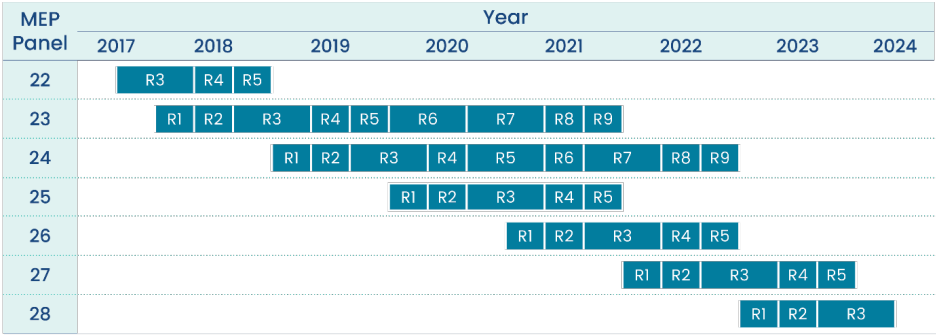
Since 1996, MEPS has selected and fielded a new panel of households
each year. Figure 1.1 shows the panel design from 2018 through 2023,
excluding COVID-19–related adjustments in 2020–2022 that extended Panels
23 and 24 beyond their original timelines. As illustrated, MEPS
typically combines data from two distinct, nationally representative
panels to improve the precision of annual estimates.1
Specifically, estimates are based on data from two consecutive
panels—one in its first year of data collection and the other in its
second year. For example, 2023 estimates use data from the second year
of Panel 27 and the first year of Panel 28.
In addition to annual estimates, the MEPS design structure permits
longitudinal estimates over 2 consecutive calendar years, thus allowing
examination of person-level changes in selected variables over a 2-year
period for a single panel. For example, research analysts can assess the
persistence of high healthcare expenditures by examining whether
individuals with high expenditures in one year also have high
expenditures in the subsequent year or shift to a lower expenditure
level. Figure 1.2 provides an illustration of MEPS from a longitudinal
perspective for Panel 27. Data for this panel can be used to analyze
person-level changes in round-specific variables or changes in
annual-level variables (e.g., total healthcare expenditures) between
2022 and 2023.
Figure 1.2. Illustration of MEPS from longitudinal perspective, Panel 27 (2022–2023)
1.2 Terms Related to Sampling/Target Population
The terms “RU,” “in scope,” “Key,” and “eligible” are used in this
report in the context of developing analytic weights for MEPS sample
persons.
An RU (Reporting Unit) consists of all members of a family unit
living together and reporting as a single family for MEPS, or a single
person if living without other family members. The definition of an RU
and a MEPS family (see Section 3.2.2) are identical except for student
RUs. A student RU refers to a young adult family member living away from
home to attend school but is linked back to their family for MEPS
family-level analysis. Student RUs are identified as an operational
device to help obtain accurate data for the student living away from
home, a special component of the general population.
An individual is in scope at a particular point in time if they are a
member of the target population for MEPS - the civilian
noninstitutionalized population of the United States.
“Key” in MEPS indicates a person’s inclusion status in the survey
based on their sampling status in the NHIS. Because the MEPS sample is
drawn as a subsample of NHIS respondents, the probability of selection
for MEPS is directly tied to the probability of selection for the NHIS.
An individual is defined as Key in MEPS if the person was in scope at
the time of the NHIS and was a member of an NHIS responding household
selected for MEPS. Individuals who were not in scope at the time of the
NHIS (e.g., because they were living outside the United States, serving
in the military, residing in a nursing home, or not yet born) are also
defined as Key if they subsequently become in scope and join a household
participating in MEPS. Thus, Keyness relates to an individual’s
probability of being included in MEPS. Hence, a person who was in scope
(i.e., a member of the civilian noninstitutionalized U.S. population) at
the time of the NHIS but was not selected as part of an original NHIS
sampled household is always classified as non-Key, even if that person
subsequently joins a MEPS household.
Finally, a person is eligible for data collection in MEPS if they are
a member of an RU containing at least one person classified as in scope
and Key. In the typically rare cases where a person’s eligibility for
data collection cannot be ascertained, these persons with unknown
eligibility are treated like nonrespondents. A glossary at the end of
this report (Appendix C) contains definitions of these and other
selected terms and acronyms used in this report.
1.3 MEPS Analytic Files
In general, two types of person-level MEPS public-use data files
(PUFs) with appropriate weight and variance estimation variables are
released every year: the Full Year (FY) Population Characteristics PUF
and the FY Consolidated PUF. The Population Characteristics PUF is the
first to provide annual data on healthcare utilization, whereas the
Consolidated PUF includes both utilization and associated expenditure
data. Beginning in 2024, the Population Characteristics PUF will be
discontinued and only the Consolidated PUF will be released.
Because of the MEPS overlapping panel design, data collected for the
same calendar year from two consecutive MEPS sample panels are used to
develop the files.2 For example, the 2023 files consist
of data from Rounds 1, 2, and 3 (2023 portion) for the MEPS Panel 28
sample and from Rounds 3 (2023 portion), 4, and 5 for the Panel 27
sample.
1.4 Full Year (FY) File and Weights
MEPS FY data are released in two phases. First, a preliminary FY
file, the Population Characteristics PUF, is released. This file is then
superseded a few months later by the final FY file, the Consolidated
PUF. The preliminary file contains all annual survey data except medical
expenditure and income/tax-related variables, which require a longer
time to process and thus are included in the final Consolidated PUF.
Moreover, the weights are not identical in the two FY files because
income data that are not available at the initial release are used to
refine the weight variables for the final release. More specifically, an
adjustment using poverty status is incorporated into the final
Consolidated PUF weight. The FY files allow analysts to produce
person-level estimates for the U.S. civilian noninstitutionalized
population (i.e., the in-scope or target population) at any time during
the year and slightly more restricted cross-sectional estimates for the
U.S. civilian noninstitutionalized population on December 31. In
addition, weights are included in the FY Consolidated PUF that can be
used to produce family-level estimates based on two slightly different
definitions of family units (Current Population Survey [CPS] versus
MEPS).
FY weights are the result of a composite of the following
factors:
Adjustments for person-level nonresponse (survey
attrition)
Raking/poststratification adjustments.
Weights are constructed separately for the two overlapping individual
panels/rounds and then combined into a final weight for the FY PUF. The
steps used to develop the FY person- and family-level weights are
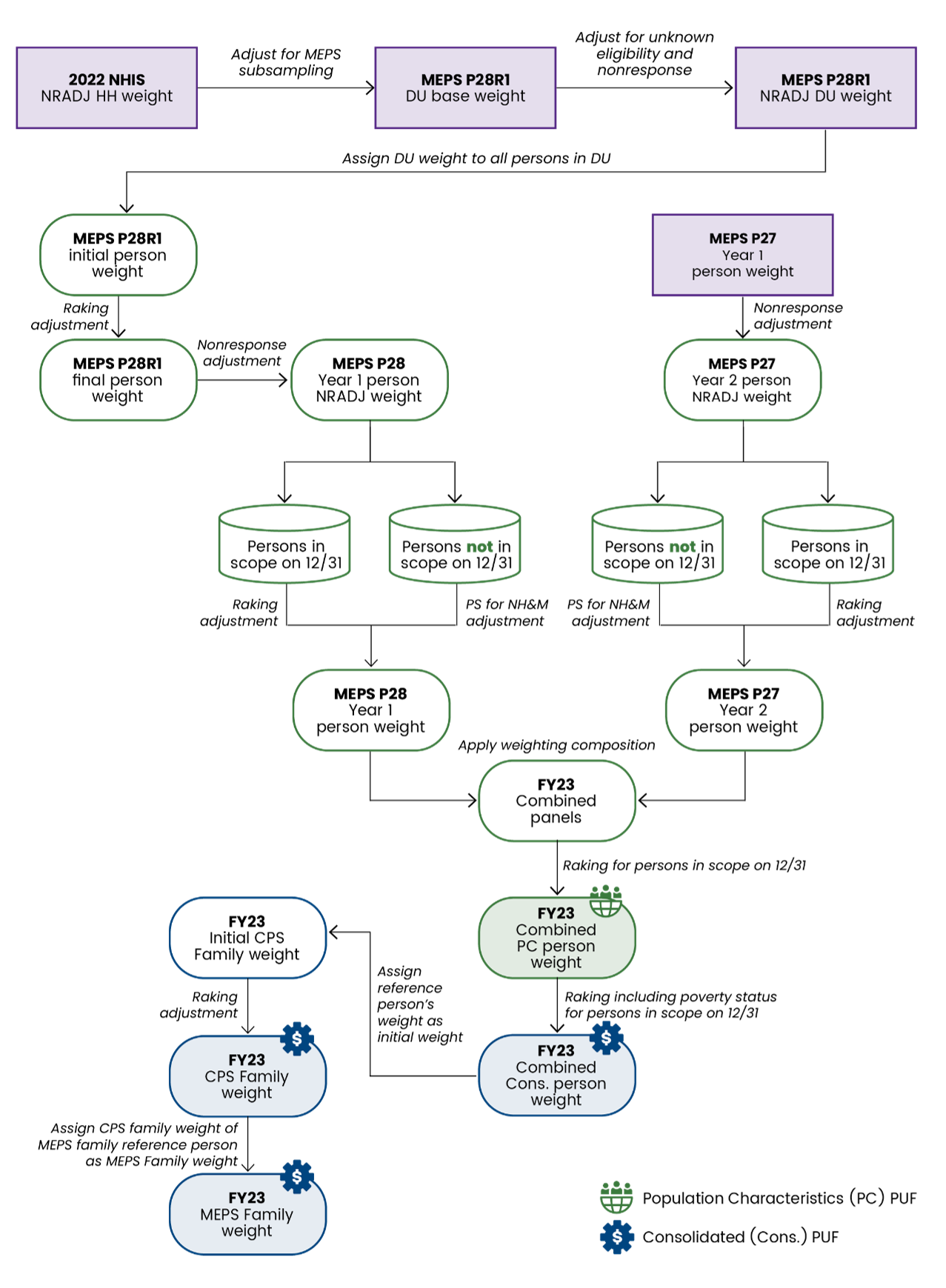
illustrated in Figure 1.3 and described in detail in the following
sections.
1.5 Overview of Development of MEPS Weights
For most MEPS PUFs, data are pooled from two MEPS panels fielded
during the same year. The weight construction process follows these
general steps:
Establish a “base” or initial weight for each panel separately,
using the probability of selection.
Adjust for nonresponse within each panel to account for potential
differences between respondents and nonrespondents.
Calibrate each panel separately to independent population control
figures such as the CPS (usually by raking, with consideration of
trimming and re-raking) to account for undercoverage and differences
between the sample and the population.
Composite the individual panel weights to produce a single weight
for the pooled data from the two panels (achieved by multiplying the
individual panel weights by factors representing the relative effective
sample sizes of the two panels).
Recalibrate the composited weight to the same population control
totals. Monitor presence of outliers and trim and recalibrate if
necessary.
Figure 1.3 presents a flowchart of the weight development process
described in Section 2 (Panel-Specific Weights) and Section 3 (Full Year
Weights). The Round 1 weight is developed first and serves as the
initial weight for deriving the FY weight for a MEPS Panel in its first
year. Panel-specific weights for concurrent panels are combined to
produce final FY weights.
The Population Characteristics PUF includes person weights
(panel-specific and combined) and Self-Administered Questionnaire (SAQ)
weights (combined), and the Consolidated PUF includes person weights
(combined), SAQ weights (panel-specific and combined), the
poverty-adjusted family weights (MEPS families and CPS-like families),
and the food security weight. Table 1.1 lists the final weight variables
provided on the MEPS PUFs that are described in Sections 2–5 of this
report. Appendix A provides summary distributions for 2023 of selected
interim and PUF weights mentioned in this report.
Table 1.1. Type of public-use file (PUF) and variable name in PUF
Type of PUF
Variable name in PUF*
Person level
Family level
FY Population Characteristics
PPANWTyy, PERWTyyP
—
SAQ
SAQWTyyP
—
FY Consolidated
PERWTyyF
FAMWTyyF, FAMWTyyC
SAQ
PSAQWyyF, SAQWTyyF
—
Longitudinal
LONGWT
—
* “yy” in variable names indicates 2-digit year.
Figure 1.3. Weight development process
Additional Notes: CPS = Current Population Survey; DU = dwelling unit; FY = full year; HH = household; P27 = Panel 27; P28 = Panel 28; P28R1 = Panel 28 Round 1; NHIS = National Health Interview Survey; NH&M = nursing home and mortality; NRADJ = nonresponse adjusted; PS = Poststratification
The starting point for development of the MEPS FY weights is the
Round 1 weight. As shown in Figure 1.3, the Round 1 weight is the result
of a composite of the following factors:
A base weight (based on an interim NHIS weight)
Probability of selection for MEPS from NHIS
Adjustments for nonresponse and poststratification using external
control totals
Constructing the Dwelling Unit (DU) base weight.
The MEPS DU (e.g., household) base weight is calculated as the
nonresponse adjusted NHIS household weight multiplied by the reciprocal
of the MEPS subsampling rate used to select the DU. (Note that this rate
varies by MEPS sample domain.3)
The construction of the DU base weight can be expressed as:
where, for DU i,
WTDU0i
is the MEPS DU base weight,
WTDUNi
is the NHIS household weight, and
fi
is the MEPS subsampling rate.
Adjustment for DU-level unknown eligibility and
nonresponse in Round 1. The DU-level base weight calculated
previously is adjusted to compensate for unknown eligibility and
nonresponding DUs to the Round 1 interview. First, an adjustment factor
for unknown eligibility is calculated as the ratio of the weighted total
of all cases to the weighted total of respondents, ineligibles, and
nonrespondents with known eligibility. This adjustment factor is
computed in a simplistic fashion because the percentage of DUs with
unknown eligibility is generally very low. The unknown eligibility
adjustment is applied as follows:
WTDU1i = WTDU0i × A1, with
where
WTDU0i
is the DU base weight in Step a ,
A1
is the overall unknown eligibility adjustment factor,
unk
represents unknown eligibility, and thus
i ∉ unk
indicates DUs with known eligibility (i.e., respondents, ineligibles,
and nonrespondents with known eligibility).
Next, a nonresponse adjustment factor is computed as the ratio of the
weighted total of respondents and nonrespondents with known eligibility
to the weighted total of respondents within each nonresponse adjustment
class. Using a broad range of 26 demographic, geographic, socioeconomic,
and health covariates from the NHIS (see Appendix B, Section B1), a
Chi-squared Automatic Interaction Detector (CHAID) analysis4 (Kass, 1980) is carried out to form MEPS nonresponse adjustment classes to adjust for the MEPS DU-level nonresponse. The
nonresponse adjustment is applied by inflating the weights of the
responding DUs in each adjustment cell as follows:
WTDU2i = WTDU1i × A2c,
if i is a responding DU
with
where
WTDU2i
is the nonresponse adjusted weight,
WTDU1i
is the unknown eligibility adjusted weight calculated previously,
A2c
is the nonresponse adjustment factor for cell
c,
r
represents the set of responding DUs, and
nr
represents the set of nonresponding DUs; therefore,
i ∈ c∩r
represents the set of responding DUs in cell
c,
and
i ∈ c∩r&nr
represents the set of responding and nonresponding DUs in cell
c.
Person-level raking adjustment to form final Round 1
person-level weight. A person-level file is created and the
DU-level nonresponse adjusted weight is assigned as the initial Round 1
person weight for the MEPS respondents. The initial person weight is
raked to the March CPS control totals to yield the final Round 1 person
weight. The variables used in the raking are region, metropolitan
statistical area (MSA) status, race/ethnicity, sex, and age category
(see Appendix B, Section B2). The final Round 1 person weight can be
expressed as follows:
where
WTPR1k
is the final Round 1 weight for MEPS respondent
k,
WTDU2i
is the DU nonresponse adjusted weight in Step b and assigned as the
initial person weight for MEPS respondent
k,
and
A3
is the raking adjustment factor. The distribution of the adjusted weight
is checked for extremely large weights and the raking procedure is
repeated if any weight trimming is required.
2.2 Rounds 1–3 of New Panel in Year 1
Initial weight. The final Round 1 person-level
weight is assigned as the initial weight for the FY person weight.
Therefore, the initial FY weight for person k is
WTPR1k,
where
WTPR1k
is the final Round 1 weight for person k.
Adjustment for person-level nonresponse. The
initial weight is adjusted to compensate for person-level nonresponse
over Rounds 2 and 3 (referred to as Year 1 nonresponse). Only those
individuals who are Key and were ever in scope during the year are
included in developing the adjustment factor. The respondents are those
individuals who responded for their entire period of eligibility over
Round 2 and the Year 1 portion of Round 3, and the nonrespondents are
those who did not respond for some part of their eligibility over Round
2 and the Year 1 portion of Round 3. To form nonresponse adjustment
cells, a CHAID analysis is carried out using a set of potential
predictor variables. The set of 16 predictor variables used as input to
the CHAID analysis to adjust for this Year 1 attrition is detailed in
Appendix B, Section B4.
The nonresponse adjustment is applied to the weights of the
responding persons in each adjustment cell c as follows:
WTPR2k = WTPR1k
× P2c if person k is a
respondent in Rounds 2/3
with
where
WTPR2k
is the nonresponse adjusted weight for person k who belongs to
nonresponse adjustment cell c,
P2c
is the nonresponse adjustment factor for cell c, r
represents the set of responding persons, and thus
c∩r
represents the set of responding persons in cell c. The
adjustment factor is the ratio of the sum of weights of all persons over
the sum of the weights of the responding persons in cell c.
Person-level raking/poststratification adjustments.
This step depends on the in-scope status of a person on December 31 as
follows:
Raking adjustment for persons in scope on December
31. The nonresponse adjusted weights of all Key in-scope
responding persons on December 31 (about 99 percent of cases) are raked
to December 31 control totals estimated based on the subsequent March
CPS estimates of the U.S. civilian noninstitutionalized population and
the U.S. Census Bureau’s population estimates for January 1. The raking
dimensions used in the adjustment are based on various combinations of
the following variables: race/ethnicity, sex, census region, MSA status,
age category, and education categories (see Appendix B, Section B3).
Poststratification adjustments for persons not in scope on
December 31.5 The small proportion of cases that
are not in scope at the end of the year (total of only about 1 percent)
are adjusted as follows:
Decedents. A special poststratification is applied
to the weights of respondents who died during the target year using
control totals derived from vital statistics data that have been
adjusted to eliminate estimated deaths among nursing home residents.6 Separate decedent control totals are
used for persons under age 65 and persons age 65 and over.
Nursing home entrants. A second special
poststratification adjustment is applied to the weights of those who
entered a nursing home prior to December 31 and who were not members of
the U.S. civilian noninstitutionalized population on December 31 using
an estimated control total of 500,000.7
Other not in-scope persons on December 31. For
persons who are out of scope on December 31 and do not belong to the two
special out-of-scope groups defined previously (decedents and nursing
home entrants), the FY weight is set equal to their nonresponse adjusted
weight without any further adjustment.
The FY weight for person k in Year 1 in the recent panel can
be expressed as:
where:
PFY1k
= raking adjustment factor8 for person k who was in scope on December 31
= poststratification adjustment factors for the two special out-of-scope groups (i.e., decedents and nursing home entrants)
= 1 for other out-of-scope persons on December 31
The distribution of the raked/poststratified weights is examined to
identify and trim extremely large values, and the
raking/poststratification process is repeated if any trimming is
done.
2.3 Rounds 3–5 of Preceding Panel in Year 2
Initial weight. The Year 1 FY person weight
derived for this panel in the previous year after Rounds 1–3 is assigned
as the initial weight for the second year for the panel. (See Section
2.2 for the derivation of Year 1 FY weight for the recent panel.)
Therefore, the initial weight for person k at this step can be
denoted by
,
using an asterisk to indicate the same weight for the preceding
panel.
Adjustment for person-level nonresponse. The
initial weight is adjusted to compensate for Year 2 nonresponse over
Rounds 4 and 5. A CHAID analysis is again used to form nonresponse
adjustment cells using a set of potential predictor variables (see
Appendix B, Section B5 for list of variables). Because the nonresponse
adjustment procedure is the same as described previously for the other
panel, there is therefore no need to repeat the detailed steps here;
thus, the nonresponse adjusted weight for person k in this
panel will be denoted as
.
Person-level raking/poststratification
adjustments. As for the other panel, this step depends on the
in-scope status of a person on December 31 as follows:
Raking adjustment for persons in scope on December
31. The nonresponse adjusted weights of all Key in-scope
responding persons on December 31 (about 99 percent of cases) are raked
to December 31 control totals estimated based on the subsequent March
CPS estimates of the U.S. civilian noninstitutionalized population and
the U.S. Census Bureau’s population estimates for January 1. The raking
dimensions used in the adjustment are based on various combinations of
the following variables: race/ethnicity, sex, census region, MSA status,
age category, and education categories (see Appendix B, Section B3).9
Poststratification adjustments for persons not in scope on
December 31.10 As for the other panel, special
poststratification adjustments are applied to the weights of decedents
and nursing home entrants and no adjustment is applied to the weights of
the remaining persons who were not in scope on December 31 (see Section
2.2.c.ii).
Therefore, the FY weight for person k in Year 2 of the
preceding panel can be expressed as:
where:
= raking adjustment factor for person k who was in scope on December 31
= poststratification adjustment factors for the two special out-of-scope groups (i.e., decedents and nursing home entrants)
= 1 for other out-of-scope persons on December 31
As for the most recent panel, the distribution of the
raked/poststratified weights is examined to identify and trim extremely
large values, and the raking/poststratification process is repeated if
any trimming is done.
3.1 Development of Combined-Panel Person Weights11 for FY Population Characteristics File
Assigning compositing factors to panel-specific weights
in the combined panel. The panel-specific FY files are put
together to create a combined person-level FY file, and a compositing
factor is applied to the panel-specific FY weight of each individual
panel to derive the FY weight for the combined panel (or the Population
Characteristics file weight). The compositing factor is calculated so
that it reflects the effective sample size for each individual panel
relative to the total effective sample size in both panels combined. The
FY composite weight for person k in the combined panel can be
expressed as:
PERWT1k = WTPRFY1k × θ,
if
k ∈
recent panel
,
if
k ∈
preceding panel
where
WTPRFY1k
is the FY weight for Year 1 for the recent panel;
is the FY weight for Year 2 for the preceding panel; and θ is the compositing factor, which is the proportion of
effective sample size in the combined panels who came from the most
recent panel (i.e.,
,
where
DEFF
is the design effect of the single-panel weights after adjusting for
nonresponse). In recent years, the values of θ generally ranged
from around 0.4 to 0.6.
Raking adjustment of the FY composite weight.
The resulting composite person weights (excluding decedents and nursing
home entrants) are raked to the same December CPS based control totals
used for the individual panel FY weights. The raking dimensions used in
this adjustment are based on various combinations of the following
variables: race/ethnicity, sex, census region, MSA status, age category,
and education category (see Appendix B, Section B3).12
The decedents and nursing home entrants are separately poststratified as
described in Section 2.2.c. These adjustments produce the PUF variable
PERWTyyP (i.e., preliminary FY weight).
Because this step is the same as the one described in detail in
Section 2.2.c, there is therefore no need to repeat the detailed steps
here; thus, the preliminary FY weight for person k in the
combined panel can be expressed as:
PERWTPFYk = PERWT1k × PPFYk
where
PPFYk
is the raking/poststratification adjustment factor. The distribution of
the adjusted weight is checked for outlier weights, and the raking
procedure is repeated if any weight trimming is required. This weight is
called preliminary FY (PFY) weight because the poverty status is not
included in the raking adjustment yet.
Note that no family weight is produced for the FY Population
Characteristics File.
3.2 Development of Final FY Weights for Consolidated File
3.2.1 Person Level
To produce the final person-level FY Consolidated File weight, the
person-level weights produced for the Population Characteristics File
are re-raked using poverty status13 in addition to the
same set of variables used before (see previous section and Appendix B,
Section B3) that correspond to the estimated control totals for December
31. Persons who are out-of-scope on December 31 are excluded from this
raking so preliminary FY weights for these persons are carried forward
from the previous step without any further adjustment. This produces the
PUF variable PERWTyyF. Therefore, the final FY weight for
person k can be expressed as:
PFYk
represents the complete iterative raking adjustment factor for person
k. The distribution of the final weight is checked, and outlier
weights, if any, are trimmed, followed by reapplication of the raking
procedure.
3.2.2 Family Level
Two final family-level weights are derived for the FY Consolidated
File: one based on the CPS definition of a family (PUF variable
FAMWTyyC) and the other based on the MEPS definition of a
family (PUF variable FAMWTyyF). In addition to the difference
in family definitions, there is also a difference in temporal scopes of
these two weights. The CPS family weight is derived to produce estimates
only for those families in scope on December 31 of the year, whereas the
MEPS family weight is derived to produce estimates for all in-scope MEPS
families that existed any time during the year. In other words, the MEPS
family weight applies to families in scope on December 31 plus families
whose members became out of scope prior to the end of the year.14
Although the CPS and MEPS definitions of family units are identical
in most instances, unmarried partners who identify themselves as a
single-family unit are considered to be a single family in MEPS but
represent two separate families in the CPS. The control totals for a
family-level raking adjustment are obtained from the CPS and represent
families in existence on December 31 of a given year. CPS-like families
are formed from the MEPS families in existence on December 31. For those
MEPS families that are split to form multiple CPS-like families, each
CPS-like family is assigned a reference person. The initial CPS family
weight assigned is the final person-level and poverty-adjusted weight of
the reference person of the CPS-like family. Raking adjustments are then
applied to this initial family weight to obtain the final CPS family
weight. For those MEPS families in scope on December 31, the raked CPS
family weight of the MEPS reference person is assigned as the final MEPS
family weight. For persons in the small number of MEPS families that are
out of scope at the end of the year, the final person-level weight of
their reference persons serves as their final MEPS family weight.
Only families that meet the following conditions are assigned an
initial weight and included in raking adjustment to produce final FY
family weights: (1) at least one Key in-scope person in the family
during the year; (2) the reference person in the family is Key; and (3)
all Key in-scope family members have a positive person weight.
The following steps are used to derive the CPS and MEPS family
weights:
Initial CPS family weight. After forming the CPS
families, a family-level initial weight is assigned to all responding
CPS families using the person-level weight of the reference person of
the CPS family. Therefore, the initial family-level weight for the CPS
family js can be defined as:
where
PERWTFYk
is the weight of person k who is the reference person of CPS
family
js.15
Raking adjustment to produce CPS family weight.
A family-level raking adjustment, using various combinations of family
type, race/ethnicity of the reference person, household poverty status,
region, MSA status, family size, and age category of the reference
person as raking dimensions (see Appendix B, Section B6), is then
applied to the initial CPS family weight. The raking adjustment is
applied only to the eligible CPS families (i.e., those with a Key
reference person) that are in scope on December 31 of the year. The
control totals at the family level for December 31 are derived by
calibrating the estimates obtained from the March CPS of the following
year to December 31 using an estimated monthly average growth rate for
the total population of families.
The raked family-level FY weight for the CPS family
js can be expressed as:
where
FFYjs
is the raking adjustment factor for CPS family js.
The raking procedure is repeated if any trimming of large weights is
necessary.
This family-level FY weight is assigned to all persons within a CPS
family who are eligible to receive a family weight.16
All persons in families not in scope on December 31 or persons in
families with a non-Key reference person are assigned a zero CPS family
weight.17 This produces the PUF variable
FAMWTyyC.
Producing MEPS family weight. Finally, the MEPS
family weight at the person level is assigned based on the MEPS
definition of families. This is done by assigning the CPS family weight
of the reference person of the MEPS family (as derived previously) to
all members of the MEPS family, which becomes FAMWTyyF. If the
MEPS family is not in scope on December 31, then the final person-level
weight (as derived in Section 3.2.1) of the reference person of the MEPS
family is assigned to all members of the MEPS family.
3.3 General Issues Related to Developing FY Weights
Cell collapsing. The initial nonresponse or
poststratification/raking cells created in different steps are collapsed
in some instances to avoid very small cell sizes or large adjustment
factors. Generally, a cell size of at least 20 in the MEPS file and a
cell size of at least 100 in the control total file (i.e.., CPS) are
considered acceptable for nonresponse or poststratification/raking
adjustments. In addition, cells with adjustment factors greater than two
are usually either truncated or collapsed with a neighboring
cell.
Weight trimming. The distribution of weights is
examined after each round of poststratification/raking adjustments to
determine whether there are any inordinately large values. Then weights
with inordinately large values are trimmed in a manner designed to
reduce overall Mean Square Error (MSE; i.e., slight increases in bias
more than offset by reductions in variance). If any trimming is done,
then the poststratification/raking procedure is repeated.
Zero-weighted cases. Most persons in MEPS PUFs
have positive values for both the person-level and family-level weight.
However, a small proportion of cases are assigned a value of zero for
either the person or family weight. The conditions when sample persons
are assigned a zero value for the person- or family-level weight are
described as follows:
Person weight. A person is assigned a person weight
of zero (but a positive family weight) if the following two conditions
are met: (1) the person is either non-Key or in the military for the
entire period but living at home; and (2) the person is a member of a
family that has been assigned a positive family-level weight.
Family weight. A person is assigned a family weight
of 0 (but a positive person weight) when either: (1) the person is a
member of a family in which at least one Key in-scope member does not
have a positive person weight (because of nonresponse); or (2) the
reference person of the family is non-Key.18
Appendix A provides summary distributions for 2023 of selected
interim and PUF weights discussed in this report.
In addition to the person- and family-level weight variables included
on FY files, an additional person-level weight variable is included for
appropriate estimation using data collected in the MEPS SAQ. This
supplement is a self-administered paper-and-pencil questionnaire that is
fielded in selected rounds of the survey to all adults. In general, the
weight variable for this supplement is used in lieu of the FY
person-level weight when the analysis involves data from the supplement.
As for the general survey FY weights described in Section 3, the
preliminary weight for the supplement is provided on the preliminary FY
file and the final weight for the supplement is provided on the final FY
file. The following is the overview of procedures for developing the
special supplement weight variable.
4.1 Self-Administered Questionnaire
A SAQ is requested to be completed by each adult (i.e., aged 18 and
older) family member in Round 2 (Panel X) and Round 4 (Panel X-1) to
obtain additional information for measures of adult health status and
healthcare quality.19 Thus, the target population for the
SAQ is the adult civilian noninstitutionalized population at the time
data were collected for Rounds 2/4. The following is a summary of the
procedure for developing weights to be used when producing estimates of
data collected in the SAQ:
The SAQ weight is developed starting with the nonresponse
adjusted weight used for developing the panel-specific FY weight for
each panel (see Sections 2.2.b and 2.3.b). This weight is then adjusted
to compensate for those persons who were FY respondents, eligible for
SAQ, and in scope at the end of Rounds 2/4 but did not respond to the
SAQ. The variables used in the nonresponse adjustment process are
region, MSA status, family size, marital status, level of education,
health status, health insurance status, age category, sex,
race/ethnicity, NHIS quarter, and NHIS panel. For the second-year panel,
poverty status collected in the previous year is also used (see Appendix
B, Section B7).
The nonresponse adjusted SAQ weight in Step a is raked to the CPS
estimates corresponding to December of the analytic year (the same
source of control figures used for the FY person weights) to produce the
preliminary SAQ weight (SAQWTyyP) for the FY Population
Characteristics File. The variables used in the raking adjustment of
preliminary SAQ weights are the same as those used for the preliminary
FY person weights: region, MSA status, age category, sex,
race/ethnicity, and education category. The main difference is that age
categories here are developed after excluding ages under 18, because
only adults were eligible for the SAQ (see Appendix B, Section
B8).
The panel-specific files are put together to create a combined
person-level file, and a compositing factor (with the same rationale as
Section 3.1.a) is applied to the panel-specific nonresponse adjusted SAQ
weight of each individual panel in Step b to derive the SAQ weight for
the combined panel.
The SAQ weight for the combined panel in Step c is raked again to
CPS estimates based on the first five variables mentioned in Step b as
well as poverty status to produce the final SAQ weight
(SAQWTyyF) for the final FY consolidated data file.
As usual, for both preliminary and final SAQ weighting: After raking,
the distribution of the weights is checked for outliers, and the raking
procedure is repeated if any weight trimming is implemented.
In contrast to FY files that include persons from two consecutive
overlapping panels, the persons included in a longitudinal data file are
from one specific sample panel and represent those who were in the MEPS
population (U.S. civilian noninstitutionalized) for all or part of a
given two-year period (e.g., Panel 27: 2022–2023). Although data are
available for all five rounds for more than 90 percent of the cases in
most longitudinal files, persons who were born, died, were in the
military or an institution, or left the country during the 2-year period
do not have data for one or more rounds. In contrast, persons in the
panel who participated in the survey only for part of the period they
were in scope are treated as nonrespondents and not included in this
file. The longitudinal weight variable (described in the following)
reflects adjustments for this attrition (nonresponse).
To derive the longitudinal person-level weight, a panel is divided
into four non-overlapping groups as follows:
All persons in their Year 2 FY file who are in scope on December
31 of Year 2
All persons in their Year 2 FY file who are out of scope on
December 31 of Year 2 because of death or entering a nursing
home
All persons in their Year 2 FY file who are out of scope on
December 31 of Year 2 for reasons other than death or entering a nursing
home
All persons in their Year 1 FY file from the panel who are out of
scope on December 31 of Year 1 and not part of the Year 2 FY
file
The longitudinal weight for person k is then assigned as
follows:
where a, b, c & d are four
groups as defined previously,
PERWTFY2k
is the panel-specific final poverty-adjusted Year 2 annual weight for
person k, and
PERWTFY1k
is the panel-specific final poverty-adjusted Year 1 annual weight for
person k. Both these weights20
have been adjusted to compensate for survey attrition during the year.
Lbk
and
Lck
are adjustment factors designed to make the sum of the longitudinal
weights of the persons in group b or c equal to the
sum of the combined panel FY person weights of similar out-of-scope
persons from both panels in the Year 2 FY file.21
The adjustment factor
Lbk
for person k can be expressed as:
where
is the sum of combined panel FY weights of persons in both panels who
are out of scope on December 31 because of death or entering a nursing
home and
is the sum of panel-specific Year 2 FY weights of persons in group b of
the longitudinal panel only.
The adjustment factor
Lck
for person k can be expressed as:
where
is the sum of combined panel FY weights of persons in both panels who
are out of scope on December 31 for reasons other than death or entering
a nursing home and
is the sum of panel-specific Year 2 FY weights of persons in group c of
the longitudinal panel only.
In other words, for
Lbk
and
Lck,
the numerator includes all out-of-scope persons as specified previously
from both panels in the FY file and the denominator includes the same
out-of-scope persons from the longitudinal panel only.
5.1 SAQ Longitudinal Weights
To derive the SAQ longitudinal person-level weight, a panel is
divided into two non-overlapping groups as follows:
All SAQ eligible persons in their Year 2 FY file who are in scope
or out of scope for any reason (death or entering a nursing home or any
other reason) on December 31 of Year 2.
All SAQ eligible persons in their Year 1 FY file from the panel
who are out of scope on December 31 of Year 1 and not part of the Year 2
FY file.
The SAQ longitudinal weight for person k is then assigned as
follows:
The MEPS-HC data is collected using a complex multistage sample
design that involves stratification, clustering, and unequal selection
probabilities. Unlike the data obtained through a simple random sample
design where all observations are independent with equal sampling
weights, the MEPS data are correlated because of clustering and have
unequal weights. Moreover, the MEPS weighting procedures employ
differential adjustments for nonresponse, coverage, and
poststratification/raking. These sample design and estimation
complexities require special consideration in computing variances or
standard errors of MEPS estimates. Therefore, a variance estimation
method under the assumption of a simple random sample, as employed by
the most commonly used statistical packages, is not appropriate for
MEPS. These software packages will usually underestimate the variance of
MEPS estimates. To obtain accurate estimates of the variances of MEPS
person- or family-level estimates for either descriptive statistics or
more sophisticated analyses based on multivariate models, the MEPS
sample design complexities must be taken into account using special
analysis approaches developed for complex surveys. A review of commonly
used approaches to design-based estimation of the variances of estimates
from complex survey data can be found in Wolter (2007) and Shao (1996).
The two most commonly used variance estimation methods for complex
survey data are the Taylor series linearization method and Balanced
Repeated Replication (BRR) method.
Various software packages that use these approaches to analyze data
from complex surveys are SUDAAN, Stata, R, and SAS survey
procedures.
The Taylor series method is often used when analyzing MEPS data. MEPS
annual PUFs include the two sample design variables necessary for
implementing this method: the variance estimation strata (VARSTR) and
the variance estimation clusters (VARPSU). Specifying these variables in
conjunction with a ‘with replacement’ design in software packages that
employ the Taylor series approach will produce variances that reflect
the complexities of the MEPS design.
Because the Taylor series method can be difficult to use for
calculating the variances of complex estimators that are not readily
available in complex survey software packages (e.g., two-part model of
health expenditures, ratios of two medians), a linkage file containing a
BRR replication structure in the form of a set of half-sample indicators
is also available for variance estimation. The file is called Replicate
File for BRR Variance Estimation (AHRQ, 2025b) and includes all cases
from 1996 to the current year. The half sample indicators in this file
(+1 and -1) can be used to form BRR replicate weights to compute
variances of MEPS estimates using either BRR or Fay’s BRR (Fay, 1989)
methods.
To facilitate analysis of subpopulations or low prevalence events, it
may be desirable to pool together more than one year of MEPS-HC data to
yield sample sizes large enough to generate reliable estimates. MEPS-HC
samples from year to year are not completely independent because
households are drawn from the same sample geographic areas and many
persons are sample respondents for 2 consecutive years.22
Despite this lack of independence, it is valid to pool multiple years of
MEPS-HC data and keep all observations in the analysis because each year
of MEPS-HC is designed to be nationally representative. However, to
obtain appropriate standard errors when pooling years of MEPS-HC data,
it is necessary to ensure a variance structure that consistently
specifies MEPS geographic sampling units across years.
Before 2002, each annual MEPS PUF was released with a variance
structure unique to the particular MEPS sample in that year. Between
2002 and 2018, the annual MEPS PUFs were released with a common variance
structure that allows users to seamlessly pool annual files from 2002 to
2018. For 2019 and later years, the MEPS public use files were released
with a different common variance structure that allows users to pool
data from 2019 and later years. The common variance structure for 2002
to 2018 and the common variance structure for 2019 and later years are
not compatible with each other nor the structure on the annual PUFs
released prior to 2002. Therefore, when pooling (a) any year from 1996
to 2001 with any year from 2002 or later, or (b) any year from 2019 or
later with any earlier year, it is necessary to obtain a common variance
structure from the Pooled Linkage File for Common Variance Structure
(AHRQ, 2025a) when producing pooled estimates using the Taylor series
method. This file provides a common variance structure (i.e., consistent
specification of MEPS geographic sampling units) across all years since
the inception of MEPS in 1996. In addition, the Replicate File for BRR
Variance Estimation provides standardized replicates across all panels
to facilitate appropriate BRR variance estimation from pooled data.
However, pooling 1999 or 2000 with other years using the BRR file is
inadvisable because of inconsistencies resulting from some primary
sampling units (PSUs) that were dropped in those years.
Chowdhury SR, Machlin SR, Gwet KL. Sample Designs of the Medical
Expenditure Panel Survey Household Component, 1996–2006 and 2007–2016.
Methodology Report #33. Agency for Healthcare Research and
Quality; 2019. https://meps.ahrq.gov/data_files/publications/mr33/mr33.pdf
Fay RE. Theory and application of replicate weighting for variance
calculations. In: Proceedings of the Survey Research Methods
Section. American Statistical Association; 1989:212–217.
Kass GV. An exploratory technique for investigating large quantities
of categorical data. Journal of Applied Statistics.
1980;29(2):119–127.
Moriarity C, Parsons VL, Jonas K, Schar BG, Bose J, Bramlett MD.
Sample design and estimation structures for the National Health
Interview Survey, 2016–2025. National Center for Health
Statistics; Vital Health Stat. 2022;2(191). https://dx.doi.org/10.15620/cdc:115394
Shao J. Resampling methods in sample surveys (with discussion).
Statistics. 1996;27:203–254.
Wolter KM. Introduction to Variance Estimation. 2nd Edition.
Springer-Verlag; 2007.
Chowdhury S, Lin TH, Clark J, Huang P, Eisenhauer E. Estimation
Procedures for the 2023 Medical Expenditure Panel Survey Household
Component. Methodology Report #38. AHRQ Publication No. 26-0018. August 2026.
Agency for Healthcare Research and Quality, Rockville, MD.
https://meps.ahrq.gov/mepsweb/data_files/publications/mr38/mr38.pdf
Appendix A. Distribution of Weights at Different Stages of Weighting for 2023 MEPS
Panel/year
Weight
PUF
variable
Number of records
Sum of weights
Minimum weight
Median weight
Average weight
Maximum weight
CV weights (%)
Panel 28, 2023
DU Final Weight
-
6,543
128,148,914
1,898
18,216
19,586
102,236
44.5
Round 1 Person Weight
-
14,373
327,339,467
2,335
20,584
22,775
113,379
50.2
Panel 28, 2023
FY Person Weight*
-
10,288
333,748,948
2,555
27,887
32,441
218,738
61.2
Panel 27, 2023
FY Person Weight*
-
8,175
333,805,592
1,991
32,777
40,832
300,572
75.0
Panels 27 & 28
Combined, 2023
FY Person Weight (Preliminary)
PERWT23P
18,463
334,530,273
797
15,136
18,119
131,243
67.2
FY Person Weight (Final)
PERWT23F
18,463
334,530,273
502
15,100
18,119
131,657
69.1
FY Family Weight (CPS)
FAMWT23C
8,438
149,273,967
639
14,423
17,691
134,738
72.3
FY Family Weight (MEPS)
FAMWT23F
8,133
142,088,938
639
14,283
17,471
134,738
72.1
Panel 27, 2022–23
Longitudinal Weight
LONGWT
8,292
338,597,320
1,163
32,795
40,834
307,845
75.9
*The weight distributions for these weights do not reflect the
special weight adjustments applied to persons not in scope on December
31 (i.e., for decedents and nursing home entrants).
Chi-Squared Automatic Interaction Detection (CHAID).
CHAID is a software program with a stepwise statistical procedure that
is commonly used to identify subgroups that differ substantially in
their propensity to respond to a survey.
Dwelling Unit (DU). A DU is a house, an apartment, a
group of rooms, or a single room occupied as separate U.S. civilian
noninstitutionalized living quarters or vacant but intended for
occupancy as separate living quarters. An occupied DU corresponds to a
household using the terminology of the National Health Interview Survey
(NHIS) or the Current Population Survey (CPS). A sample of
NHIS-responding households serves as the MEPS sample of DUs
(technically, occupied DUs). A household (DU) can contain one or more
families and/or unrelated individuals.
Eligible. The eligibility of a person for MEPS
pertains to whether data were to be collected for that person. All Key
in-scope persons of a sampled RU are eligible for data collection. The
only non-Key persons eligible for data collection are those who live in
an RU with at least one Key in-scope person. The eligibility of a
non-Key person continues only for the time that they live with such a
person. The only out-of-scope persons eligible for data collection are
those who live with a Key in-scope person, and, again, only for the time
that they live with such a person. Only military persons can meet this
description (for example, a person on full-time active duty military may
live with a spouse who is Key and in scope).
Family:
CPS. A CPS family consists of two or more
persons who are living together in the same household and are related by
blood, marriage, or adoption. Foster children are not considered a
family member in the CPS.
MEPS. The definition of a MEPS family is a bit
more expansive than that of the CPS. A MEPS family consists of two or
more persons who are living together in the same household and are
related by blood, marriage, or adoption, and partners (plus persons
related to partners). Partners are unmarried persons living together who
regard themselves as a family unit; these are not families under the CPS
definition. Generally, MEPS RUs with two or more members are MEPS
families. Student RUs are considered a member of the family of their
parents’ RU and thus assigned the same MEPS family ID as their parents.
This is consistent with how the CPS handles students living away from
home.
Full Year (FY). MEPS FY data are released in two
phases: A preliminary FY Population Characteristics File is released
first, which is superseded a few months later by a final FY Consolidated
File. The first file release contains all annual survey data except
medical expenditure and income/tax-related variables, which require a
longer time to process and thus are included in the final Consolidated
File. Moreover, the analytic weights are not identical in the two
separate FY files because income data that are not available at the
initial release are used to refine the weight variables for the final
release. The FY files allow analysts to produce estimates for the U.S.
civilian noninstitutionalized population (i.e., the MEPS target
population) at the person and/or family levels.
In scope. A member of the civilian
noninstitutionalized population of the U.S. (MEPS target population) is
considered to be in scope for the survey. This status can vary within a
round because a person may, for example, enter or return from the
military or enter or return from a nursing home during the reference
period of a survey round.
Key. This relates to an individual’s chance of being
included in MEPS. A person is Key if they are linked for sampling
purposes to an NHIS-responding household subsampled for inclusion in
MEPS. More specifically, a person is Key if they were a member of an
NHIS household at the time of the NHIS interview or became in scope on
joining an RU with at least one Key member. Examples of the latter
situation include newborns and persons returning from military service,
an institution, or living outside the United States. A person who was in
scope (i.e., a member of the civilian noninstitutionalized U.S.
population) at the time of the NHIS but was not a member of a responding
NHIS household sampled for MEPS is considered non-Key.
Mean Square Error (MSE). The MSE of an estimatorθ* with respect to the estimated parameter
θ is defined as
MSE = E[(θ* − θ)2].
The MSE is equal to the sum of the variance and the
squared bias of the
estimator:
MSE = Var(θ*) + Bias(θ*).
Poststratification. Poststratification is a
procedure used to adjust the sample weights of responding units so that
the totals over various demographic categories match population totals
from another data source.
Raking. Raking procedures involve adjusting the
sample weights iteratively so that the sums over specified margins of
the full cross-classification of characteristics match population sizes
from another data source. In contrast to poststratification, the sum of
the sample weights within each cross-classification cell may not equal
the corresponding control totals from the other data source.
Reference Person:
MEPS. A reference person is defined for each
MEPS family within a DU. This reference person is usually an RU member
16 years of age or older who either owns or rents the home. If more than
one person meets this description, the RU respondent identifies one from
among them. This is consistent with the approach used for the CPS. If
the respondent is unable to identify a person fitting this definition,
the questionnaire asks for the head of the family, who is then
considered the reference person for that RU.
NHIS. The NHIS reference person is defined as
the household member 18 years of age or older who owns or rents the
home. If more than one household member owns or rents the sample unit,
or if none of the household members own or rent the sample unit, the
oldest household member is designated as the reference person.
Reporting Unit (RU). A MEPS RU is an individual
person or a group of persons in a sampled DU who are related by blood,
marriage, adoption, or other familial association. Regardless of the
legal status of their relationship, two persons living together are
treated in MEPS as a single RU if they choose to be identified as a
family unit. Most households contain a single family or a single
individual, although this is not always the case. Examples of households
that may be of the more unusual variety include the following:
A married daughter and her husband living in the same house (DU)
with her parents comprise a single RU.
Two unrelated persons living in the same apartment (DU) who
consider themselves to be two independent entities represent two
distinct RUs.
44.5
A pair of unmarried people living in a condominium (DU) who
characterize themselves as a single family are treated as a single
RU.
In 1996, the first year of MEPS, only one panel (Panel
1) was fielded, thus the annual data for 1996 were based on this single
panel of data. Because of the COVID-19 pandemic, 2020 estimates combined
Panel 23, 24, and 25 samples; 2021 estimates combined Panel 23, 24, 25,
and 26 samples; and 2022 estimates combined Panel 24, 26, and 27
estimates. See documentation for MEPS HC-243: 2022 Full Year
Consolidated Data File for details.↩
Due to the COVID-19 pandemic, 2020 and 2022 estimates
combined data from three panels, and 2021 estimates combined data from
four panels. However, this report focuses on 2023, where two panels are
combined.↩
For more information regarding the MEPS sample design,
see Chowdhury et al., 2019.↩
The purpose of this poststratification is to compensate
for potential underrepresentation of high medical expenditure groups.↩
Adjustment based on Underlying Cause of Death,
1999–2020, data from the CDC’s Wide-ranging ONline Data for
Epidemiologic Research (WONDER) database.↩
This control total is based on data from the Minimum
Data Set (MDS) of the Centers for Medicare & Medicaid Services in
2018.↩
Factors are derived using an iterative raking
algorithm.↩
Note that poverty status is not included here but is
included in raking for the final FY Consolidated File.↩
The purpose of this poststratification is to compensate
for potential underrepresentation of these high medical expenditure
groups.↩
A family-level weight is not constructed for the FY
Population Characteristics File.↩
Poverty status is not available at the time of
development of the Population Characteristics File but is incorporated
in raking for the final weight in the subsequent FY Consolidated File.↩
The poverty status categories are shown in Appendix B,
Section B3.↩
Estimates can be restricted to MEPS families in scope
on December 31 if appropriate for analytic purposes.↩
For a small number of cases, when the weight of the
reference person is not positive, the weight of the spouse of the
reference person or the weight of the oldest member in the family is
used.↩
Family weights are assigned to all members of
responding families whose reference person is Key, regardless of whether
the individual member is Key/in scope or not (e.g., a person in the
military living with a Key and in-scope family member is assigned a
family weight).↩
Sometimes, partitioning of a MEPS family results in a
CPS family where the reference person is non-Key.↩
This removes the issue of multiple chances of selection
being associated with a family.↩
The SAQ includes questions from the Consumer Assessment
of Health Plans (CAHPS®), the SF-12, the EuroQol 5D, and attitude
items.↩
Panel-specific annual weights are not included on
PUFs.↩
This adjustment was approximately 11 percent for Panel
11.↩
Although these variables and categories are fairly
stable across years, there are some instances in certain years where the
variables or categories used differ slightly.↩









 Back
Back
 Email Updates