STATISTICAL BRIEF #11: The Health Insurance Status of U.S. Workers, 2001: Estimates for U.S. Civilian Noninstitutionalized Workers Ages 16-64
2003
By William Carroll, B.A.
Briefly Stated:
Workers with the following job characteristics were most likely to be uninsured: the self-employed, those working in small businesses, those earning low wages, and part-time workers.
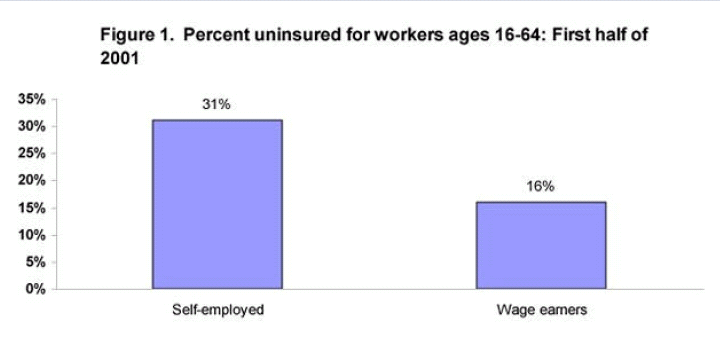
Workers who were self-employed were almost twice as likely as wage earners to be uninsured.
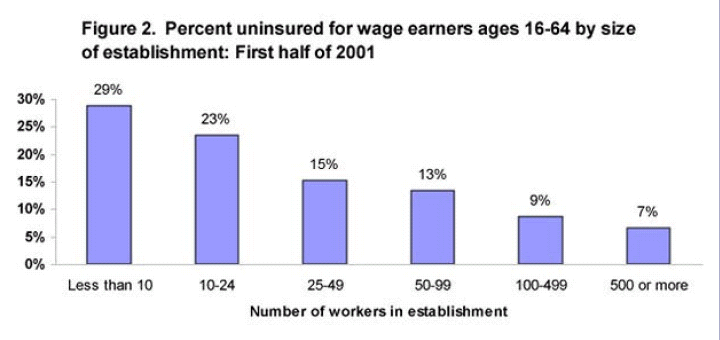
The risk of being uninsured was related to size of business. Wage earners were more likely to be uninsured if they worked for establishments with less than 25 employees.
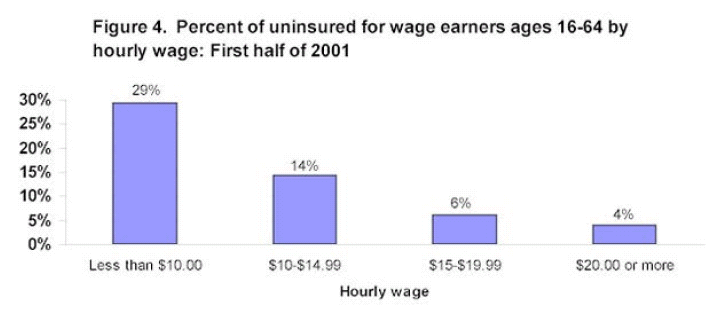
Workers earning less than $10.00 per hour were at substantially greater risk of lacking health insurance than those earning $10.00 or more per hour.
Over three-fourths of full-time workers had job-related insurance.
Introduction
For most Americans, health insurance obtained through the workplace is the primary source of private coverage, whether as a policyholder or as a dependent on a family member's plan. Other sources of health insurance not included in this report are public insurance, such as Medicaid, and private insurance purchased individually. Data from the 2001 Medical Expenditure Panel Survey (MEPS), conducted by the Agency for Healthcare Research and Quality, indicate that nearly two-thirds (65.2 percent) of Americans under 65 years of age had job-related health insurance during the first half of 2001. However, employment does not necessarily lead to health insurance coverage for many working Americans. Slightly more than a sixth (17.7 percent) of working Americans ages 16-64 were uninsured during the first half of 2001 (approximately 23 million people). These workers represented half (51 percent) of the total uninsured population. MEPS data also indicate that certain job characteristics such as self-employment, size of business, hourly wages, and weekly hours of work are strongly associated with workers' health insurance status. The relationship between job characteristics and the health insurance status of workers is not significantly different than in 1996, when the MEPS data was first used to examine this topic.
Findings
Self-employed people were nearly twice as likely as wage earners to be uninsured during the first half of 2001. Roughly 31 percent lacked any type of health insurance, compared to 16 percent of wage earners (Figure 1).
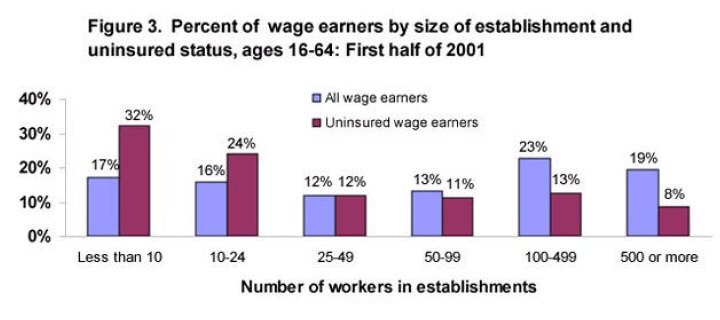
MEPS data also indicate that size of business is a factor that distinguishes whether or not a worker has health insurance, regardless of whether the worker is self-employed or a wage earner. The self-employed with small businesses of fewer than 10 workers were more than two and a half times as likely to be uninsured as those with businesses of 10 or more workers (32 percent and 12 percent, respectively; data not shown). For wage earners the situation is similar. Twenty-nine percent of wage earners in establishments with fewer than 10 workers were uninsured, but only 7 percent of those in large establishments (more than 500 workers) were uninsured (Figure 2). Wage earners in establishments with fewer than 10 employees represented 17 percent of all such workers but accounted for 32 percent of uninsured wage earners (Figure 3).
Wage earners who earned low hourly wages also were at greater risk of being uninsured. Only 59 percent of workers earning less than $10.00 per hour obtained job-related coverage, in contrast to 94 percent of workers earning $15.00 or more per hour (data not shown). About 29 percent of workers earning less than $10.00 and 14 percent of workers earning $10.00-$14.99 were uninsured, compared to only 4 percent of workers earning $20.00 or more per hour (Figure 4).
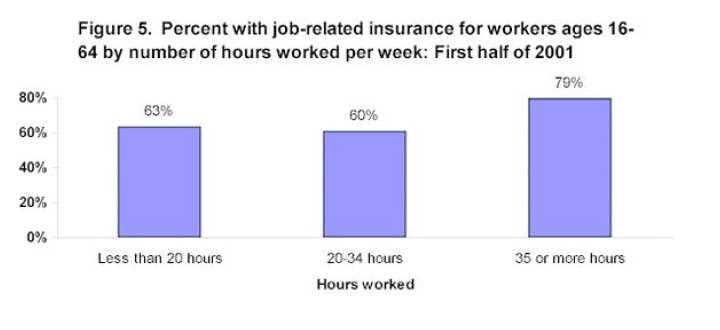
Part-time workers (those working less than 35 hours per week) were more likely than full-time workers to be uninsured (Figure 5). Approximately 61 percent of part-time workers had job-related insurance, compared to 79 percent of full-time workers.
About MEPS
The Medical Expenditure Panel Survey (MEPS) collects nationally representative data on health care use, expenditures, sources of payment, and insurance coverage for the U.S. civilian noninstitutionalized population. MEPS is cosponsored by the Agency for Healthcare Research and Quality (AHRQ) and the National Center for Health Statistics (NCHS). This Statistical Brief summarizes data concerning the health insurance status of workers in the United States during the first half of 2001, as derived from the MEPS Household Component, Point-in-Time File HC-034. For a detailed description of the MEPS survey design see J. Cohen (1997) and S. Cohen (1997).
Figure 1. Percent uninsured for workers ages 16-64: First half of 2001
Self-employed
Wage earners
Percent
31
16
Note: Self-employed workers are nearly twice as likely as wage earners to be uninsured.
Source: Center for Cost and Financing Studies, AHRQ, Medical Expenditure Panel Survey, 2001
Figure 2. Percent uninsured for wage earners ages 16-64 by size of establishment: First half of 2001
Less than 10 workers
10-24 workers
25-49 workers
50-99 workers
100-499 workers
500 or more workers
Percent
29
23
15
13
9
7
Note: As the establishment size increased, the percentage of uninsured workers declined.
Source: Center for Cost and Financing Studies, AHRQ, Medical Expenditure Panel Survey, 2001
Figure 3. Percent of wage earners by size of establishment and uninsured status, ages 16-64: First half of 2001
Less than 10 workers
10-24 workers
25-49 workers
50-99 workers
100-499 workers
500 or more workers
All wage earners
17%
16%
12%
13%
23%
19%
Uninsured wage earners
32%
24%
12%
11%
13%
8%
Note: Wage earners in establishments with less than 10 employees represented 17 percent of all such workers but 32 percent of uninsured wage earners.
Source: Center for Cost and Financing Studies, AHRQ, Medical Expenditure Panel Survey, 2001
Figure 4. Percent of uninsured for wage earners ages 16-64 by hourly wage: First half of 2001
Less than $10.00
$10-$14.99
$15-$19.99
$20.00 or more
Percent
29
14
6
4
Note: The likelihood that a worker was uninsured during the first half of 2001 was directly related to the level of earnings.
Source: Center for Cost and Financing Studies, AHRQ, Medical Expenditure Panel Survey, 2001
Figure 5. Percent with job-related insurance for workers ages 16-64 by number of hours worked per week: First half of 2001
Less than 20 hours
20-34 hours
35 or more hours
Percent
63
60
79
Note: Part-time workers were less likely to have job-related insurance than full-time workers.
Source: Center for Cost and Financing Studies, AHRQ, Medical Expenditure Panel Survey, 2001


 Back
Back
 Email Updates