|

|

|
Font Size:
|
||||

|

|

|
||||
|
MEPS HC 253: 2024 Jobs FileMay 2026 Agency for Healthcare Research and Quality
A. Data Use Agreement Appendices
1 Variable-Source Crosswalk A. Data Use AgreementIndividual identifiers have been removed from the microdata contained in these files. Nevertheless, under Sections 308(d) and 903(c) of the Public Health Service Act (42 U.S.C. 242m and 42 U.S.C. 299a-1), data collected by the Agency for Healthcare Research and Quality (AHRQ) and/or the National Center for Health Statistics (NCHS) may not be used for any purpose other than the purpose for which they were supplied; any effort to determine the identity of any reported cases is prohibited by law. Therefore, in accordance with the previously referenced federal statute, it is understood that
By using these data, you signify your agreement to comply with the previously stated statutorily based requirements with the knowledge that deliberately making a false statement in any matter within the jurisdiction of any department or agency of the federal government violates Title 18, part 1, Chapter 47, Section 1001, and is punishable by a fine of up to $10,000 or up to 5 years in prison. AHRQ requests that users cite AHRQ and the Medical Expenditure Panel Survey as the data source in any publications or research based on these data. B. Background1.0 Household ComponentThe Medical Expenditure Panel Survey (MEPS) provides nationally representative estimates of healthcare use, expenditures, payment sources, and health insurance coverage for the U.S. civilian noninstitutionalized population. The MEPS Household Component (HC) also provides estimates of respondents’ health status, demographic and socio-economic characteristics, employment, access to care, and satisfaction with care. Estimates can be produced for individuals, families, and selected population subgroups. The survey’s panel design includes five rounds of interviews spanning 2 full calendar years. The interviews use computer-assisted personal interviewing (CAPI) technology or computer-assisted video interviewing (CAVI) technology to collect information about each household member, which the survey builds on from interview to interview. A single household respondent reports all data for a sampled household. The MEPS HC was initiated in 1996. Each year, a new panel of sampled households is selected. Because the data collected are comparable to those from earlier medical expenditure surveys conducted in 1977 and 1987, it is possible to analyze long-term trends. Historically, each annual MEPS HC sample consists of up to 15,000 households. Data can be analyzed at the person, family, or event level. Data must be weighted to produce national estimates. The set of households selected for each MEPS HC panel is a subsample of households participating in the previous year’s National Health Interview Survey (NHIS) conducted by NCHS. The NHIS sampling frame provides a nationally representative sample of the U.S. civilian noninstitutionalized population. In 2006, NCHS implemented a new NHIS sample design that included households with Asian persons in addition to households with Black and Hispanic persons in minority group oversampling. In 2016, NCHS introduced another sample design that discontinued the oversampling of these minority groups. 2.0 Medical Provider ComponentWhen the household CAPI instrument is completed and permission is obtained from the sampled members to contact their medical provider(s), a sample of these providers is contacted by telephone to obtain information that household respondents cannot accurately provide. This part of MEPS is called the Medical Provider Component (MPC), and it collects information on dates of visits, diagnosis and procedure codes, and charges and payments. The Pharmacy Component (PC), a subcomponent of the MPC, does not collect data on charges or on diagnosis and procedure codes, but it does collect detailed information on drugs, including the National Drug Code (NDC) and medicine name, as well as payment amounts. The MPC is not designed to yield national estimates; it is primarily used as an imputation source to supplement or replace household-reported expenditure information. 3.0 Survey Management and Data CollectionMEPS HC and MPC data are collected under the authority of the Public Health Service Act. The MEPS HC data are collected under contract with Westat, and the MEPS MPC data are collected under contract with RTI International. Datasets and summary statistics are edited and published in accordance with the confidentiality provisions of the Public Health Service Act and the Privacy Act. NCHS provides consultation and technical assistance. As soon as the MEPS data are collected and edited, they are released to the public in stages of microdata files, and tables via the MEPS website and AHRQ Data Tools site. Additional information on MEPS is available from the MEPS project manager or the MEPS public use data manager at the Center for Financing, Access and Cost Trends, AHRQ, 5600 Fishers Lane Rockville, MD 20857. C. Technical and Programming Information1.0 General InformationThis documentation describes the MEPS Jobs Public Use File HC 253 (hereafter referred to as the Jobs PUF), which is one in a series of public use data files to be released from the 2024 MEPS HC. This documentation offers a brief overview of the types and levels of data provided and a detailed description of the content and structure of the files. It is organized into the following sections:
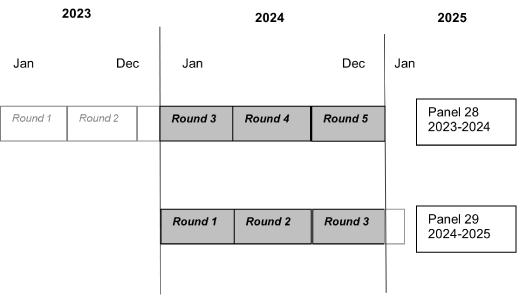
A copy of the survey instrument used to collect the information on this file is available on the MEPS website. This PUF is being released as a research file and has undergone the standard quality control procedures applied to MEPS data files. The file includes 34,297 records, with each record representing a unique job for a person by round. This file presents information about jobs starting on or before December 31, 2024, only. This Jobs PUF contains job records from two MEPS panels and includes information collected in Rounds 3 - 5 for Panel 28 (second-year panel) and Rounds 1 - 3 for Panel 29 (first-year panel), as illustrated in the following figure. The 2025 Jobs PUF will provide data for Panel 29 jobs that start in 2025. Figure 1 Portions of MEPS Panel 28 and Panel 29 Survey Data Included on the 2024 Jobs PUF
For the first-year panel, jobs from Panel 29 Rounds 1-3 are included on the 2024 Jobs PUF. Complete information for any Panel 29 job is available for jobs that started before January 1, 2025, whether that job was first reported in Round 1, 2, or 3. This is the case for any first-year panel (the panel that began its first year of interviewing in the given year) in a Jobs PUF. Round 3 was collected as a cross-year round between 2024 and 2025, covering the entire period between the current and the prior interview dates (regardless of calendar year). Round 3 is not truncated. For the second-year panel (the panel that continued with its second year of interviewing in the given year), jobs from Panel 28 Rounds 3-5 are included on the 2024 Jobs PUF. If the Round 3, 4, or 5 job continued from Round 1 or 2, analysts must reference the Jobs PUF from the previous year (2023) to obtain complete information for the job. Round 3 was collected as a cross-year round between 2023 and 2024, covering the entire period between the current and the prior interview dates (regardless of calendar year). It is not truncated. Round 5 is a terminal round, referring to the period between the Round 4 interview date and December 31, 2024. The round is truncated at December 31, 2024, even if the job continued beyond that date. In the Employment (EM) section of CAPI, MEPS collects job-related information in the round in which a job is first reported. For most jobs, job characteristics are captured only in the first reported round and are not updated in later rounds if the job continues. Although the details collected vary by job type (see Section C.2.0), the data reported for a job in its first survey round may include earnings by type (e.g., gross salary, tips), start and stop dates, hours and weeks worked, establishment size, industry and occupation codes, presence of retirement and other benefits, self-employment versus wage-earner status, temporary or seasonal situations, and health insurance availability. Data updates are collected for only a small subset of job characteristics in later rounds in which the job continues. To obtain complete MEPS information collected for a job, analysts must note the round in which the job is first reported. This is because MEPS collects most job characteristics in that round only, as noted previously. Appendix 4 provides a summary table of variables available on the first report of a job, which are collected in the first round only. Appendix 2 includes sample SAS code and Appendix 3 contains sample Stata code, so analysts can obtain information from previous Jobs PUFs. As mentioned, the Appendix 4 table includes a complete list of variables available on the first report of a job only. Analysts should note that there occasionally may not be a corresponding job in the previous year file, either because of differences in sample composition between the current year and the previous year files (i.e., a person being included in the previous year’s delivery but not the current year, or vice versa) or because subsequent round comments provided updated information after the delivery of the Jobs PUF the previous year. 2.0 Data File Information2.1 Codebook StructureFor each variable on the 2024 Jobs PUF, an unweighted frequency is provided in the accompanying codebook file. 2.2 Reserved CodesThis Jobs PUF includes several reserved code values (Table 1).
The value Cannot be Computed (-15) was assigned to the MEPS constructed variables when there was not enough information from the instrument to calculate the constructed variables. “Not having enough information” is often the result of skip patterns in the data or missing information stemming from the responses Refused (-7) or Don’t Know (-8). Note that, in addition to Don’t Know, reserved code -8 also includes cases for which the information from the question was not ascertained. 2.3 Codebook FormatThis codebook describes an ASCII dataset (with related SAS, SPSS, R, and Stata programming statements and data user information), although the data are also provided in a SAS dataset, SAS transport file, Stata data set, and Excel file. The file contains 87 variables and has a logical record length of 296 with an additional 2-byte carriage return/line feed at the end of each record.
2.4 Variable Source and Naming ConventionsAs the collection, universe, or categories of variables were altered, the variable names have been appended with “_Myy” to indicate the collection year (“yy”) in which the alterations took place. These alterations are described in detail throughout this document. In general, the variable names reflect the variable’s content. Variables contained on this file were either copied or derived from the CAPI questionnaire itself. The source of each variable is identified in Appendix 1. Sources for each variable are indicated in one of two ways:
2.5 File ContentsEach record on the 2024 Jobs PUF represents one job reported by a person in a round. In MEPS, all persons whose reported age is 16 years or older are asked to report on jobs held. Depending on an individual’s job history, these reported jobs may be held
Only those persons reporting a job in a round who have either a positive person-level or family-level study weight will have a record on the 2024 Jobs PUF. Job records may appear on the 2024 Jobs PUF when the person’s edited age contained in the Full Year Consolidated PUF (hereafter referred to as the Consolidated PUF) is younger than 16. In these cases, the full-year person-level variables on the Consolidated PUF will indicate no employment, even though the Jobs PUF records for these individuals will continue to contain valid employment information. Although this typically occurs in the second panel of a full-year delivery, it may, in rare instances, occur in the first panel as well. 2.5.1 Record IdentifiersThe unique record identifier is the variable JOBSIDX, which is composed of a person identifier (DUID plus PID), a round identifier (RN), and a job number (JOBNUM). The similarly named variable JOBIDX (without “S”) has the same structure as JOBSIDX but without the round identifier (RN). JOBIDX allows analysts to easily select all rounds for the same job for the same person. The DUID identifier in this data release is composed of a two-digit code to identify the panel and a five-digit dwelling unit identifier. A panel indicator (PANEL) is included on the file to distinguish Round 3 jobs held by Panel 29 persons from Round 3 jobs held by Panel 28 persons. The variable ORIGRND indicates the round in which a job was first created. As such, ORIGRND may or may not contain the same value as RN. After the round in which the job was first reported, ORIGRND is copied forward to job records in subsequent rounds. ESTBIDX, an establishment identifier composed of DUID plus “an establishment number,” can help analysts to (1) determine potential duplication of job records (i.e., a person reports multiple jobs to the same establishment in the same round with many or all the same characteristics), and (2) better understand job changes because job holders may leave an establishment and return to the same establishment in any round. Each job record contains the following identifier variables: JOBSIDX, JOBIDX, ESTBIDX, DUID, and DUPERSID. Each of these identifier variables begins with the two-digit panel number, which allows analysts to easily identify records delivered in a previous year Jobs PUF (when PANEL is used in conjunction with other variables, such as RN and ORIGRND). In addition, CAPI assigns a unique job number that may not be used in subsequent rounds on different jobs. This 3-byte number, JOBNUM, is unique to the reporting unit (RU) and is set to a value that corresponds with the RU in which a person’s job was first reported (e.g., A RU is “1”, B RU is “2” C RU is “3”). The unique job number and establishment number within the RU did not exist in all prior years of MEPS Jobs files. Analysts using multiple years of Jobs files must carefully read the documentation to identify important differences in variables across data years. Analysts pooling current data with data prior to 2018 (the year identifier structures were modified) are encouraged to refer to prior years’ documentation files to ensure correct and consistent treatment of data over time. 2.5.2 Initial Reporting RoundMost persons held only one job at the first interview date - their current main job. For persons who held multiple current jobs at the round’s interview date, respondents were asked to identify one main job. This job was classified as the current main job; any other simultaneously held jobs were classified as a current miscellaneous job. MEPS also obtained some information on any former jobs (former main job or former miscellaneous job) held in the reference period but not at the interview date. For those persons working neither at the interview date nor earlier during the reference period, limited information on the last job the person held outside of the reference period was collected. Additionally, for those persons aged 55 or older who retired from a job during the reference period, MEPS obtained some job-level information about the retirement job (retirement job). The variable SUBTYPE indicates the type of job record - Current Main (1), Current Miscellaneous (2), Former Main (3), Former Miscellaneous (4), Last Job Outside Reference Period (5), or Retirement Job (6). When a job was initially reported, MEPS asked for detailed information about any current main job and basic information about other job types. Refer to Table 3 and to the EM section of the questionnaire for information requested for each job type. Table 3 identifies which variables were collected for each job SUBTYPE (e.g., Current Main Job, Current Miscellaneous Job). Whether a variable was collected also depended on whether the person was self-employed or a wage-earner (paid to work for an employer); these distinctions are shown in the first two columns of the table. (Note: Wage-earner is used to describe workers who are not self-employed.) The last column indicates whether the variable was collected only in the round in which the job was first reported (collection only), only when the job was reviewed (review only), or both (collection and review). Appendix 4 is an additional resource that lists variables collected only in the round in which the job was first reported. Table 3 varies over time to reflect changes in MEPS, so analysts should refer to the documentation for each separate MEPS year included in their analyses. As changes are made, details concerning new and removed variables are addressed in Jobs documentation sections that describe the variable type.
For last jobs outside of the reference period and retirement jobs that ended more than 2 years before the beginning of the reference period, questions that populate HHMEMBER_M18 (indicating whether any other household members work at the business) and TOTLEMP_M18 (number of employees as of this round at the self-employed job) were not asked. The precise calculation of the 2-year cut-off date was not possible for some persons because of allowed negative values on stop year, stop month, and reference period start month. Therefore, in some circumstances, HHMEMBER_M18 and TOTLEMP_M18 may still be collected for some retirement jobs and for some jobs outside of the reference period, even though they ended more than 2 years before the reference period. Additional factors that determine whether an employment question was asked or whether a job characteristic is available on this file are described throughout this document. 2.5.3 Skip PatternsDue to the complexity of many skip patterns, it is recommended that analysts of the 2024 Jobs PUF become familiar with the EM section in the MEPS questionnaire. To aid analysts, Appendix 1 provides a crosswalk between variables and MEPS questionnaire numbers in this release. The following examples of variables involved in skip patterns are illustrative and do not represent the full range of variables affected by questionnaire skip patterns. In one example of a skip pattern, because MEPS does not obtain information on job-related benefits for the self-employed, such as vacation, sick leave, and pension, these benefits variables were coded as Inapplicable (-1) for self-employed jobs. MEPS also does not collect information on wages or salary for the self-employed, nor information on whether the self-employed jobs were in the private sector or in federal or local government (TYPEEMPL). Thus, due to the skip pattern, TYPEEMPL, HRLYWAGE, and all other wage and salary variables were coded as Inapplicable (-1) for self-employed jobs. Conversely, questions relating to business organization type (BUSINC, PROPRIET) are asked only of the self-employed, so those variables were coded as Inapplicable (-1) for jobs performed by wage-earners. 2.5.4 Job Updates and Inapplicable (-1) ValuesMEPS used dependent interviewing in Rounds 3- 5 for Panel 28 and in Rounds 2 and 3 for Panel 29 (see Review of Employment Information [RJ] section in the questionnaire). In these rounds, MEPS asked about current main and current miscellaneous jobs held at the previous round interview date to determine whether the job holder continued to work at these jobs. For other job types (former, last, or retirement) reported in the previous round, MEPS did not ask any follow-up questions. By definition, these jobs, are no longer held by the person and therefore are not included on the file except in the round they were first reported, the rounds in which the job continued, and the round in which it ended. (Note: A former job in the prior round may have been a current job in an earlier round.) In accordance with dependent interviewing, if a person still held a current main job from the previous round, MEPS asked whether it was still their main job. For most job holders, it was reported that they still worked at the same job and that it remained their main job. For some job holders, the job is reported to have ended, or to have continued but is no longer the main job. If a job was no longer held in a subsequent interview, it was designated as a former job for that follow-up round. It is also possible, although unusual, for a job to change from main to miscellaneous (or vice versa) in a round after the initial report. If job status remained the same for a continuing job (either current main or current miscellaneous), MEPS asked a subset of the employment questions as a review. Because MEPS asked only this subset of questions when job status remained the same in later rounds, many job-level variables on the subsequent rounds’ job records were coded as Inapplicable (-1); the information for these variables for a continued job are located on the record for the job in the first round in which it was reported. Thus, when working with job records, it is important to (1) determine whether a job continues from the previous round, and (2) identify the round in which the continuing job was first reported (ORIGRND). In rounds for a continuing job, the variables STILLAT (for jobs that were current main in the previous round) and STILLWRK (for jobs that were current miscellaneous in the previous round) indicate whether a person still holds the job at the subsequent round interview date. The variable SUBTYPE on the subsequent round record indicates whether the job is main or miscellaneous in that subsequent round. Note that if a Panel 28 job included in this 2024 Jobs PUF continued from a job first reported in Round 1 or 2, much of the information will be contained in the 2023 Jobs PUF (HC 246). Analysts should access the prior year file to obtain the desired job characteristics. Appendix 2 and Appendix 3 provide sample SAS and Stata programs, respectively, that demonstrate this process. Appendix 4 lists the variables available only on the first report of a job. Any newly reported job in Rounds 2-5 is collected the same way as a newly reported job in Round 1. Variables that relate only to the review of a job that was first reported in a previous round (DIFFWAGE, ESTBTHRU_M24, INSESTB_M24, MAIN_JOB, NOWTAKEI_M22, OFFTAKEI, STILLAT, STILLWORKFTPT, STILLWRK, RVWTOTNUMEMP, WHY_LEFT_M18, WHYCHNGPTTOFT, WHYCHNGFTTOPT) were not asked in Round 1 and are not asked in any round in which a job is newly reported. These variables were coded as Inapplicable (-1) on a Jobs record for the round in which the job was initially reported. Another type of job update pertains to situations where a reviewed current miscellaneous job becomes the current main job in the round. The flag variable TYPECHGD indicates whether a job changed from a current miscellaneous job to a current main job. For these types of jobs, the questions asked when the job was first reported as a current miscellaneous job were not re-asked, with three exceptions:
2.5.5 Exceptions to the Inapplicable (-1) RuleUnlike the situation explained in the previous section (applicable for most variables on the file), for certain variables a value other than Inapplicable (-1) does not necessarily mean that a job is newly reported. For a small subset of variables, values from the previous round were carried forward to the next round, even if they had not been updated since originally reported. This special processing was used in two distinct situations as a result of internal processing needs. The first exception occurred when interview questions relating to the affected variables were skipped as Inapplicable (-1) in the rounds following the job’s initial report, and the originally reported responses were carried forward from round to round. This group includes the following 14 variables: EMPLINS HRSPRWK HRS35WK JOBTYPE JSTRTY JSTRTM MORELOC NUMEMPS OFFRDINS_M24 EMPLUNIONPROV TYPEEMPL JOBHASHI HRSALBAS RETIRJOB Note that HRSALBAS and RETIRJOB may also be updated in subsequent rounds. The second exception occurred for certain questions asked during the review of a job in the rounds following its initial report. If there was no change based on the review, the value for the affected variable was carried forward from the previous round. If there was a change, the variable was updated to reflect the new information. These five variables are: JSTOPY, NOWTAKEI_M22, OFFTAKEI, SUBTYPE, and TOTLEMP_M18. Variables related to earnings (e.g., HRLYWAGE, GROSSPAY, SALARIED) were treated similarly to the five variables just discussed. In the RJ section, MEPS sought to obtain information regarding wage changes for the same job from round to round. If there were no such changes (indicated by the DIFFWAGE variable), then the information from the most recent round was carried forward to the current round. If changes were recorded, then the relevant variables were updated. For every new main job reported for a person, MEPS attempted to obtain current wage information. 2.5.6 Top-Coding, Bottom-Coding, Editing, and ConfidentialityOutlier Wage Editing on Current Main Jobs As of FY 2024, the wage outlier editing process is no longer performed. In prior years (except for 2020), wage information on current main job records was logically edited for consistency using established rules and guidance from AHRQ. The outlier editing process evaluated wages for persons who reported a wage change where the newly reported wage was (1) substantially different from the prior wage (change ≥100%) or (2) no different from the prior wage. Wage amounts at newly reported jobs or updated wages at a continuing job were also checked to determine whether the wage (3) was low in value ($0 < wage < $1) or (4) had a value higher than the prior year’s top-code value. There are numerous reasons for these types of errors, including keystroke or other interviewer error. In a typical year, approximately 100 wages were reviewed per panel, resulting in approximately 50 wage edits (overall). The wage outlier editing process directly impacted the Jobs PUF. Outliers were identified using person-level variables delivered on the Consolidated PUF. Then, if edits were implemented, both the person- and job-level wage variables were updated. Analysts should keep in mind that such edits were not performed in 2024 when using the wage variables on the Jobs file, especially when comparing 2024 with other data years. To help analysts identify persons whose wages would have been reviewed (but not necessarily edited) in this process, the 2024 Consolidated PUF data includes wage outlier flag variables, OUTFLAGrr. These round-specific wage outlier flag variables - OUTFLAG31, OUTFLAG42, and OUTFLAG53 - indicate that a person’s new or newly updated wage at the current main job would have been programmatically selected for review (but not necessarily edited) had the wage outlier editing process been conducted in 2024. If an updated wage is copied forward to the next round, OUTFLAGrr is not selected for comparison in that round. The flag is constructed before wage imputation, consistent with the timing of full-year wage outlier review. A wage is selected for review if one (and only one) of the following is true:
In rare circumstances, a person may have a mix of both an “updated” wage with no difference in calculated wage amount (category 3: No Wage Change) and either a low wage (category 1: Low) or high wage (category 4: High). OUTFLAG is set to either Low Wage Outlier (1) or High Wage Outlier (4) respectively, for these cases. Table 4 shows the values for the OUTFLAG variables.
Analysts should also keep in mind that many of the high wage outlier amounts identified in OUTFLAG have wages that are subsequently top-coded, as described in the following. The wage outlier flag is included on the 2024 Consolidated PUF only and not on the 2024 Jobs file. Analysts using the 2024 Jobs file can link to the 2024 Consolidated PUF through the variable DUPERSID, as described in the Consolidated PUF documentation. Wage Top-Coding Wage information reported during the interview is delivered on the 2024 Jobs PUF. For reasons of confidentiality, earnings amount variables on the 2024 Jobs PUF were top-coded. The wage top-code value in 2024 is $141.35 per hour. A value of Top Coded (-10) on a wage amount variable indicates that the variable had a positive value and that, after extrapolating that wage to an hourly rate, earnings were greater than or equal to $141.35 per hour. This top-code value is calculated using person-level wages reported on the Consolidated PUF. To top-code wage amounts delivered on the Jobs PUF using the hourly wage top-code value identified in Consolidated PUF processing, special processing is required for the Jobs PUF. Converting job-level wage amounts to “hourly” The Employment Wage (EW) section of CAPI is designed to capture how wage-earners are paid. Respondents first indicate whether wages are salaried, hourly, or earned in some other way. CAPI then asks respondents to indicate the wage amount, the unit of pay, and the period of pay. Because of this variation, calculated hourly wage variables were created for internal use in Jobs PUF processing by converting a wage from annual, monthly, biweekly, weekly, or daily to a calculated hourly amount using unit, hour, and week information reported along with the wage amount. Earnings variables that contain wage amounts include HRLYWAGE, BONSAMT, COMMAMT, TIPSAMT, DAYWAGE, WKLYAMT, GROSSPAY, and MAKEAMT. All but WKLYAMT may be reported on a new or reviewed current main job, as well as on a new former job (where SUBTYPE = 3, STILLAT = -1, and STILLWRK = -1). WKLYAMT is reported on new current miscellaneous jobs only. These are the earnings variables that were top-coded on the Jobs PUF. Mathematical calculations for converting wages to hourly amounts rely on the type of wage and the wage amount, unit, hour, and week information reported during the interview. In most cases, calculations are standardized to base the calculated hourly wage on a 2,080-hour work year. For instance, if the wage reported is monthly, the calculation uses 40 hours per week and 4 weeks per month. A weekly wage calculation simply uses 40 hours per week. In three cases, calculations use reported weeks or hours when available. The weekly earnings calculation for a miscellaneous job uses the variable HRSPRWK (number of hours worked per week), substituting 40 hours if missing. The daily earnings calculation for a main job uses the variable HRSPRDY (number of hours worked per day), substituting 8 hours if missing. Finally, when a salaried wage is reported as annual, the calculation uses SALRYWKS (number of weeks per year on which salary is based), substituting 52 weeks if missing. Table 5 summarizes the values used to calculate an hourly wage for a job.
a Substitute value, if required, follows “or.” The calculated hourly variables (including assignment of missing hour and week values) are for internal use and are not delivered on the Jobs PUF. In other cases, such as when earning units were reported as Other (91), Refused (-7), or Don’t Know (-8), no substitution was made and an hourly wage was not calculated for top-coding purposes. In these cases, wage amounts were left as reported. Analysts should keep in mind that wage amounts will be positive in the Jobs PUF on jobs where unit information is missing and, in most cases, an hourly wage can still be calculated in Jobs PUF processing using substitutions. If a current main job has missing unit information, the wage may have been imputed on the Consolidated PUF in which case, wage reports differ across PUFs. Coordinating wage confidentiality across public use files The purpose of coordinated top-coding is to ensure confidentiality for each person across files. This coordination involves using the same top-code top coding persons across files. The hourly amount $141.35 is the top-code value calculated by the wage top-code process in Consolidated PUF wage processing. Any person whose wages were top-coded on the 2024 Consolidated PUF also has all jobs top-coded on the 2024 Jobs PUF in all 2024 rounds. However, only current main jobs are summarized on the 2024 Consolidated PUF. This means that analysts will not find job information for current miscellaneous jobs, former miscellaneous jobs, newly reported former main jobs, retirement jobs, or last jobs held outside of the reference period on the 2024 Consolidated PUF. When reported wages at current miscellaneous jobs and newly reported former main jobs exceeded the current year top-code value on the 2024 Jobs PUF, the wages for that job were top-coded on the 2024 Jobs file, along with all other wages for that job holder on all other jobs on the file. All wages for that job holder were top-coded on the 2024 Consolidated PUF as well. Additional top coding in Jobs PUF only Analysts should note that there are other wages appearing only on the 2024 Jobs PUF that are top coded on the 2024 Jobs PUF but do not prompt top coding of all other wages on the 2024 Consolidated PUF or Jobs PUF. For some jobs, respondents indicated that a supplemental wage, such as a commission, tip, or bonus, is greater than or equal to the wage top-code value, but, the primary wage at this job is not. In these cases, only the tips, commissions, or bonus amounts were top-coded on the job. (Note: These supplemental wages are on the 2024 Jobs PUF but not the 2024 Consolidated PUF). All other wage amounts on all jobs for these persons are left as reported. This applies to wages and jobs on both the 2024 Consolidated PUF and 2024 Jobs PUF. In addition, wages can be top-coded to -10 on the Jobs PUF for three situations that occur less commonly.
Wage Confirmation in CAPI To improve the quality of wage reports, CAPI prompts the respondent to confirm wages reported in the EW section if a wage amount falls outside a specified wage range. Ranges vary depending on the unit of pay (Table 6).
To calculate the hourly rate for earnings types not reported on an hourly basis, the number of hours per week worked and, in some cases, the number of weeks worked were used in conjunction with the various amounts. These hours and weeks are included in the Jobs PUF along with the reported earnings amounts, but the calculated hourly rates are not included for these jobs. (Earnings variables were not reconciled with income data collected elsewhere in MEPS.) Establishment Size Information The establishment size variable for the self-employed is TOTLEMP_M18. In addition, two variables contain the individual responses collected at RJ110 and EM740 (number of employees at a self-employed job): RVWTOTNUMEMP (establishment size at continuing self-employed job) and TOTNUMEMP (establishment size at newly reported self-employed job), respectively. The establishment size for wage-earners can be found in NUMEMPS (establishment size at non-self-employed job); this value is collected at EM430 (number of employees). Respondents who did not know the actual establishment size (NUMEMPS) were asked in question EM440 (ESTMATE1_M19) to choose an approximate establishment size from several size ranges (e.g., 2-9, 10-25). The value Cannot be Computed (-15) is not an allowed value for ESTMATE1_M19. For confidentiality reasons, NUMEMPS, TOTLEMP_M18, RVWTOTNUMEMP, and TOTNUMEMP were top-coded to “-10 TOP CODED” for establishment sizes greater than or equal to 24,000 employees. Job Start and Stop Year In addition to top-coding wages and establishment size, the start year of the job (JSTRTY) and the stop year of the job (JSTOPY) were bottom-coded. This was done because a person’s age may be calculated using the job start or stop year and that age may indicate that the job holder is older than 85 years, which is the age top-code value used across MEPS PUFs. The bottom-code year value was calculated by taking the delivery year in which the job is first reported (e.g., 2024), subtracting the age top-code value (i.e., 85 years of age), and then adding back 15 (i.e., the age of a person in the year before entering the work force as defined in MEPS). For the 2024 Jobs file, the bottom code value for the job start and stop year on jobs first reported in Panel 29 Rounds 1 - 3, or Panel 28 Rounds 3 - 5 is 1954. Jobs that were first reported in Panel 28 Rounds 1 or 2 were delivered in the 2023 Jobs file and have a bottom-code value of 1953. 2.5.7 Temporary and Seasonal JobsTwo variables on this Jobs PUF pertain to the temporary and seasonal nature of a person’s main or miscellaneous job. The variable TEMPJOB indicates whether a main or miscellaneous job is temporary (i.e., is a current main job for a limited time or until the completion of a project). The variable SESNLJOB indicates whether a main or miscellaneous job is available only during certain times of the year or whether the individual works throughout the entire year at that job. Teachers and other school personnel who work only during the school year are considered to work year-round. These questions were asked for newly reported jobs only. These variables were set to Inapplicable (-1) for all subsequent rounds. These questions were not asked for newly reported former miscellaneous jobs, last jobs outside of reference period, and retirement jobs. 2.5.8 Reason No Longer at Place of EmploymentIn cases where a former job is newly reported, questions were asked regarding why the person is no longer at that place of work. For wage-earners, this information is stored in YLEFT_M18. For self-employed persons, this information is stored in YNOBUSN_M18. When a main or miscellaneous job ends in the round, the variable WHY_LEFT_M18 indicates the reason for leaving the place of employment in the round. This variable is also helpful for understanding job changes. It is included on the Consolidated PUF when describing a person’s job change from one current main job to another in the variable YCHGrrrr. To ensure consistent interpretation of selection values for these variables, MEPS provides interviewers with accessible guidance on the analytic construct of each value. Refer to Appendix 5 for further information. 2.5.9 Retirement From a Job or WorkforceMEPS reflects the complex status of “retired” in several ways across the Jobs and Consolidated PUFs. The Jobs PUF reflects retirement status at a job in one of three variables: RETIRJOB, YNOBUSIN_M18, and WHY_LEFT_M18. The variable SUBTYPE can be set to Retirement Job (6). RETIRJOB will always be set to Yes (1) for these jobs. The following sections describe the instrument flows that set Jobs PUF retirement variables and the person-level retirement variables delivered on the Consolidated PUF. CAPI Path 1 For persons aged 55 or older who either worked at some point in the round OR are in their first MEPS interview and did not work in the round but worked before MEPS, the question EM350 probes for instances of retirement in the round. If the respondent reports retirement, they may then select an existing former job at question EM380 or create a new retirement job whose SUBTYPE is set to Retirement Job (6) at question EM390. More than one job may be selected. The Jobs PUF variable RETIRJOB is automatically set to Yes (1) at these questions. CAPI Path 2 In the case of persons who worked in the round (i.e., person has a former main job [SUBTYPE=3] in the round or a former miscellaneous job [SUBTYPE=4] in the round), a setting of Yes (1) on the Jobs PUF variable RETIRJOB indicates the job holder was actively employed at the job in the round but stopped working due to retirement if the job is selected at EM380. This information is represented in the Consolidated PUF variable EVRETIRE if the person is in scope and aged 55 or older in the round. These persons may continue to work in the round and have current job records, that is, jobs with SUBTYPE values of Current Main Job (1) and Current Miscellaneous Job (2). Analysts should note that EVRETIRE is not applicable to persons under age 55 and that no equivalent variable relates to retirement for younger MEPS respondents. CAPI Path 3 Jobs reported by persons in their first interview who worked before MEPS but not in the round, where SUBTYPE is Last Job Outside Reference Period (5), may also be selected at EM380 and RETIRJOB will be set to Yes (1). The designation is automatic when a new retirement job is reported instead of selected at EM390. These persons will have EVRETIRE set to Yes (1) in the Consolidated PUF if the person is in scope with an edited age of 55 years or older in the round. As long as CAPI conditions are met, a person may report any number of retirement jobs in any round. CAPI Path 4 When a person aged 55 or older is not employed in a round (i.e., not actively employed at any point in the round), the retirement question EM350 is skipped. Instead, MEPS collects information on the reason the person is not working in the round at question EM750, where a workforce status of “retired” can be selected. This question is also asked in a person’s first MEPS round when the person was employed before MEPS but not in the current round, or when the person was never employed at all. The response selected at EM750 to indicate why the person is not employed is captured in the Consolidated PUF variable NWK. Persons who previously indicated “retired” at EM750 will skip EM750 in all future rounds. This routing is applicable to Rounds 2 - 5. NWK is specially constructed for persons not working in the reference period and who indicated in any prior interview their reason for not working is “retired.” NWK will be set to Retired (2) when a person is not working in the reference period and previously indicated “retired” at EM750. These persons were not asked EM750 in the current round and will not be asked EM750 in the future. Because some retirees return to the workforce and then stop working again, NWK will be set to “retired” in any subsequent round for which the person is not employed during the reference period. The construction logic of the Consolidated PUF variable EVRETIRE also impacts how “retirement” is reflected. EVRETIRE prioritizes persons indicating “retirement” as the reason for not working in the round at EM750 over whether “retirement” is indicated in the current round at EM350. CAPI Path 5 Of note, the retirement job classification is independent of any retirement response in the following variables:
These variables are set for persons who will not be asked EM750 in the round (NWK) because they were employed at some point in the round and either ended a self-employment job during the round or left a current main job in the round. Responses to these questions and to EM750 (reflected in NWK) are not age dependent. Therefore, analysts may also derive information regarding retirement status for persons of any age including persons aged 54 or younger using YNOBUSN_M18 and WHY_LEFT_M18 from the Jobs PUF and NWKrr from the Consolidated PUF. No variable equivalent to EVRETIRE is asked of persons aged 54 or younger to assess whether a person who is currently working or had a job history when entering MEPS has ever retired. 2.5.10 Health Insurance DataInsurance Reporting on New Jobs Questions about employment-related health insurance are asked both when any type of job is newly reported and when any continuing job is reviewed. For main jobs, either newly reported or changing from miscellaneous, the variable indicating whether insurance is held through that establishment is EMPLINS. For all non-main jobs, including current miscellaneous jobs and all newly reported former jobs, the variable JOBHASHI indicates whether insurance is held through that establishment. MEPS also asks questions about whether insurance is offered to the job holder through the establishment, whether insurance is offered to anyone at the establishment, and whether multiple plans are offered to the job holder. Analysts should note that prior to Panel 28 Round 3 and Panel 29 Round 1 which were collected in 2024, if a respondent indicated Refused (-7) or Don’t Know (-8) at EM660 (EMPLINS/JOBHASHI) or EM670 (OFFRDINS), subsequent insurance questions were skipped. As of Panel 28 Round 3, and Panel 29 Round 1, CAPI was adjusted so that persons who indicate Refused (-7) or Don’t Know (-8) at EM660 or EM670 are asked subsequent insurance questions. Depending on whether employment-related insurance is held, there may be follow-up information gathered for newly reported jobs; this information is contained in the following variables:
Consistent with variable naming protocol across MEPS, variables with significant changes to response values or the population being asked the question were renamed (Table 7).
Additional changes were made to the corresponding review of health insurance variables asked in the RJ section, discussed further in the following sections regarding continuing jobs. Source of Insurance: Employer/Union For a job first reported in the round, if the job holder holds insurance through the employer (Yes [1] at EM660, EMPLINS or JOBHASHI) and also belongs to a union (Yes [1] at EM700, INUNION), respondents were asked to indicate whether the health insurance is from the employer/business or the union at EM710. Either or both establishments may be the source of insurance. Respondents were required to identify the primary source of health insurance - either the employer/business or the union - if the respondent indicated that both provide insurance at EM710 (EMPLUNIONPROV). Employer (1) Union (2) Both Employer and Union (Employer is Primary) (3) Both Employer and Union (Union is Primary) (4) Only the primary source of insurance coverage is created in the Health Insurance (HX) section. The result is that persons who reported insurance via both union and employer sources no longer have the secondary source of insurance coverage recorded in HX. Union status at a job is collected in the round the job was first reported; it is not re-asked in the RJ section. Therefore, no insurance through a union can be reported on a continuing job in the EM section. Coverage can be reported separately from a job in the HX section where private sources of coverage are collected. No link to a job is established. Insurance Reporting on Continuing Jobs For a continuing job, when no health insurance was held through the job in the round in which the job was first reported but health insurance was offered through the job, the question RJ70 OFFTAKEI is asked in later rounds to determine whether the employee now holds the health insurance that is offered through the job. (Note: If health insurance through this job was reported as being held via RJ70 in the prior round, RJ70 was not asked in the current round.) Similarly, the insurance status question RJ80 (responses stored on NOWTAKEI_M22) is asked to determine whether health insurance is now held through the job in the following cases:
RJ80 is asked if the respondent reports new employer-sponsored health insurance in the prior round but that coverage was not active at the interview date, that is, a response of No (2) in the Health Insurance Time Period Covered Detail (HQ) section of MEPS at HQ01 (“Was {PERSON} covered the whole time from {START DATE} until {END DATE}?”) and at HQ02 (“Is {PERSON} covered now?”) MEPS then includes several clarifying questions regarding health insurance availability through an employer. CAPI flow for reviewed jobs with responses of Refused (-7) and Don’t Know (-8) for the following questions is similar to CAPI flow described previously for employment-related health insurance questions asked for new jobs. When the person (1) does not report, does not know, or refuses to indicate the insurance coverage status through the job at RJ70, or (2) reports no insurance coverage through the job at RJ80, or, as of Panel 28 Round 3, does not know or refuses to indicate the insurance coverage status through the job at RJ80, the respondent is asked whether the person was offered insurance through the job at RJ90 (ESTBTHRU_M24). Lastly, when a respondent indicates that the job holder of a reviewed job neither holds insurance through the job nor was offered health insurance at the job, or, as of Panel 28 Round 3, does not know or refuses to indicate whether the job holder of a reviewed job holds or was offered health insurance at the job, the respondent is asked whether any other employees were offered health insurance through the job at RJ100 (INSESTB_M24). Disavowed Insurance In some cases, respondents indicate in the HX section that health insurance reported in the EM section was reported in error. This is referred to as insurance being “disavowed.” If newly reported health insurance through the job is disavowed in the HX section, follow-up questions (HX22, HX23, HX24) regarding whether health insurance is offered at the job, whether more than one plan is available, and whether health insurance is offered to any employees are asked in the HX section. This information was used in an editing process whereby responses in the HX section were transferred into the EM or RJ section. As a result, the disavowal process may result in a change to values originally collected in the EM or RJ section (wherever the health insurance was initially reported). The complete list of variables potentially impacted includes EMPLINS, JOBHASHI, OFFRDINS_M24, DIFFPLNS_M24, ANYINS_M24, and EMPLUNIONPROV (collected in the EM section) and NOWTAKEI_M22, OFFTAKEI, ESTBTHRU_M24, and INSESTB_M24 (collected in the RJ section). In some cases, a disavowal may result only in a change to the value of EMPLUNIONPROV. Health insurance through an employer can be disavowed in MEPS based on a respondent’s answer to one of two questions (HX20 and HP70). The variable HIDISAVW indicates which of the two questions resulted in the disavowal. HIDISAVW is set to the question number of the disavowal as described here.
2.5.11 Industry and Occupation CodingIndustry and occupation codes were assigned by professional coders at the Census Bureau based on verbatim descriptions of job characteristics provided by respondents during the interview. The codes were determined at a detailed four-digit level and then collapsed into broader groups on the file at a two-digit level to ensure record confidentiality. Starting in 2023, industry and occupation code variables are set based on newer Census Bureau coding schemes. The Census Bureau uses 2017 Census industry (based on 2017 North American Industry Classification System [NAICS]) and 2018 Census occupation (based on 2018 Standard Occupational Classification [SOC]) coding schemes developed for the Census Bureau’s Current Population survey (CPS) and American Community Survey (ACS). Earlier versions of Census coding schemes were used in files before FY 2023. For the 2010-2022 files, the Census Bureau used 2007 industry and 2010 occupation codes, which were developed for the Census Bureau’s CPS and ACS. These coding schemes incorporated minor changes from the 2003 industry and occupation codes used for the 2002-2009 files; therefore, INDCODEX and OCCCODEX for the 2010 and later files are comparable to those variables on the 2002-2009 files. (Industry and occupation variables for pre-2002 files are not comparable to those for later files.) Categorical values on condensed industry and occupation variables did not change in 2023. However, because newer coding schemes were used to code variables, the previous variable representing the condensed industry code for a job at the interview date, INDCODEX, was renamed to INDCAT17, representing the condensed industry code for a job at the interview date coded to the 2017 Census coding scheme. Similarly, OCCCODEX was renamed to OCCCAT18, representing the condensed occupation code for a job at the interview date coded to the 2018 Census coding scheme. As newer coding schemes are used in future study years, the last two digits of industry and occupation code variables will be renamed with the year of the newer coding scheme. To assist analysts with the transition between old and new coding schemes used on the 2022 and 2023 Jobs PUF, where a Panel 27 Round 3 job continues from Round 1 or Round 2, special 2023 Jobs PUF processing copied INDCODEX, INDCAT17, OCCCODEX, and OCCCAT18 to the Panel 27 Round 3 record. These variables were set to Inapplicable (-1) for Panel 28 jobs and for Panel 27 Round 4 and Round 5 records. No special processing was required in FY 2024 since jobs were coded using only the newer coding schemes, and INDCODEX and OCCCODEX were dropped. Appendices 5 and 6 contain crosswalks between the detailed and collapsed codes for industry and occupation. Notes to Analysts Using Uncondensed Industry and Occupation Coding in MEPS-HC 2018-2023 Users of the detailed uncondensed four-digit codes from MEPS-HC 2018-2023, available by application in the Data Center, should be aware of two factors impacting industry and occupation codes: Factor 1 - FY 2023 Transition from 2010 to 2017 NAICS Industry Codes, and from 2010 to 2018 Census Occupation Codes As described previously, Panel 27 persons in the FY 2023 Jobs PUF had both versions of industry and occupation codes, allowing AHRQ to compare cases where no change in industry or occupation code would be expected. These are cases where there was no change in reported job characteristics and no changes in the underlying NAICS/Census Occupation codes. Despite the expectation for no change between the old vs new NAICS/Census Occupation codes, the Census results for the new 2017 NAICS industry code were different from the old 2010 NAICS industry code for 900-1000 jobs. In addition (and independent of the NAICS cases), the Census results for the new 2018 Census Occupation code were different from the old 2010 Census Occupation Code for 900-1000 jobs. Census is unable to provide details on why these differences occurred. Factor 2 - Truncation of Job Duties in 2018-2023 For data years 2018-2023, the verbatim text data sent to Census related to “job duties” was mistakenly truncated, resulting in 85%-89% of jobs having incomplete information when Census determined industry and occupation codes. While the MEPS survey collects up to 100 characters at question EM510 (job duties), if fewer than 50 characters were reported, Census received no job duty information. This omission may have impacted the accuracy of both industry and occupation codes in those years. This issue has been corrected for 2024 and future years.
Advice to Analysts For both factors detailed above, the potential impact on the accuracy of industry and occupation codes could not be determined. When considering Factor 1, analysts should note that the detailed 4-digit codes provided by Census for MEPS jobs are available only in the Data Center by special request. The industry and occupation codes provided on the MEPS public use files (Consolidated PUF and Jobs PUF) are categorized into a smaller, condensed set of 2-digit codes. In Factor 1 cases, despite the large number of differences between the new and old versions of the 4-digit industry and occupation codes, AHRQ found very few differences in the 2-digit condensed industry and occupation codes generated under the old and new NAICS/Census Occupation coding schemes. Note: The error in Factor 2 does not lend itself to a similar comparison of the relative impacts of Factor 2 on the 2-digit vs. the 4-digit codes. Analysts using industry and occupation codes from 2018-2023 may wish to either (a) defer solely to the PUF 2-digit condensed industry and occupation codes, or, (b) if using the 4-digit detailed codes available only in the Data Center, perform sensitivity analyses comparing (i) results obtained using the 2-digit industry and occupation codes available on the PUF files against (ii) results obtained using the 4-digit industry and occupation codes available in the data center. In FY 2024, no truncation occurred. Consistent with prior years, approximately 14% of records had fewer than 50 bytes and approximately 86% had 50 bytes or more. Because there was no data loss due to truncation, we expect more reliable values in FY 2024. 2.5.12 Changes in Variable ListVariables were added to or removed from the file because of question changes in the 2024 survey compared to prior years. The MEPS HC questionnaires from these years are available on the MEPS website. The following variables were added to or removed from the 2024 Jobs PUF. Added
Removed
2.6 Person-Level EstimatesThe weight variable PERWT24F included on this Jobs file can be used to make person-level estimates. Note that only those persons who have job records and have either a positive person- or family-level weight in the 2024 Consolidated PUF are included in the 2024 Jobs PUF. To extrapolate data to the U.S. population, include non-job holders by linking to any of the 2024 MEPS PUFs. The link should be made through the variable DUPERSID. 2.7 Longitudinal AnalysisPanel-specific longitudinal files can be downloaded from the data section of the MEPS website. For each panel, the longitudinal file comprises MEPS survey data collected in Rounds 1 - 5 of the panel and can be used to analyze changes over a 2-year period. Variables on the file pertaining to survey administration, demographics, employment, health status, disability days, quality of care, health insurance, and medical care use and expenditures were obtained from the Consolidated PUF from the 2 years covered by that panel. For more details or to download the data files, please see longitudinal data files on the MEPS website. 3.0 Survey Sample Information3.1 Discussion of Pandemic Effects on Quality of MEPS DataLike most surveys, MEPS has been substantially affected by the COVID-19 pandemic. One effect of the pandemic is significantly lower response rates (see Section C.3.2 in the Consolidated PUF), which might differentially exclude households more likely to experience inpatient hospital (IP) stays. The demographic shifts on MEPS between 2019 and 2022 suggest a more educated, higher income, older MEPS sample. (For more details, see Section C.3.1 of the 2020 Consolidated PUF, Section C.3.1 of the 2021 Consolidated PUF, and Section C.3.1.2 of the 2022 Consolidated PUF.) MEPS sample design modifications due to the COVID-19 pandemic reverted in 2022. Thus, concerns about potential bias due to these modifications no longer apply to data collected in this PUF. To examine the quality of the MEPS FY 2024 data, analyses compared healthcare utilization and health insurance coverage for the MEPS target population between the panels fielded. These comparisons were undertaken for the full sample and three age groups: 0-17, 18-64, and 65 or older. Analysts found no abnormal differences between the two panels. Analyses across years also suggest a rebound to pre-pandemic utilization levels for most essential event types. The development of the person-level weights for the MEPS FY 2024 data was designed to limit the potential for response bias. However, analysts of the MEPS FY 2024 data should continue to exercise caution when interpreting estimates and assessing analyses, especially for data collected from 2020 through 2022. This includes comparing estimates with those of other years and conducting corresponding trend analyses. 3.2 Sample Weight (PERWT24F)A single full-year person-level weight (PERWT24F) is assigned to each record for each Key in-scope person who responded to MEPS for the entire duration that they were in scope during 2024. A Key person was either a member of a responding NHIS household at the time of the interview or joined a family associated with such a household after being out of scope at the time of NHIS (the latter circumstance includes newborns and those returning from military service, an institution, or residence in a foreign country). A person is in scope whenever they are a member of the U.S. civilian noninstitutionalized population. 3.3 Details on Person Weight ConstructionThe person-level weight PERWT24F was developed in several stages. First, a person-level weight for Panel 28 was created, including an adjustment for nonresponse over time and raking. Raking involved adjusting to several sets of marginal control totals reflecting Current Population Survey (CPS) population estimates based on six variables. The six variables used to establish the initial person-level control figures include the following:
The person-level weight for Panel 29 was created similarly. A composite weight was formed by multiplying each weight from Panel 28 by the factor 0.44 and each weight from Panel 29 by the factor 0.56. The choice of factors reflects the relative effective sample sizes of the two panels, helping to limit the variance of estimates obtained from pooling both samples. Weights for the 2024 Consolidated PUF were then developed by raking the composite weight to CPS-based control totals, replacing educational attainment with poverty status while retaining the other five raking variables previously indicated. Specifically, control totals based on CPS estimates of poverty status (five categories: below poverty, from 100%-125% of poverty, from 125%-200% of poverty, from 200%-400% of poverty, at least 400% of poverty) in addition to age, race/ethnicity, sex, region, and MSA status are used to calibrate weights. 3.3.1 MEPS Panel 28 Weight Development ProcessThe person-level weight for Panel 28 was developed using the 2023 full-year weight as a “base” weight for survey participants present in 2024. For Key in-scope members who joined a reporting unit (RU) at some time in 2024 after being out of scope in 2023, the initially assigned person-level weight was the corresponding 2023 family weight. The weighting process also included an adjustment for person-level nonresponse over Rounds 4 and 5, as well as raking to the population control figures for December 2024 for Key responding persons in scope on December 31, 2024. These control totals were derived by scaling back the population distribution obtained from the March 2025 CPS to reflect the December 31, 2024, estimated population total (based on census projections for January 1, 2025). The six variables listed in Section C.3.3 were also used for person-level raking: education of the reference person, census region, MSA status, race/ethnicity, sex, and age. The final weight for Key responding persons who were not in scope on December 31, 2024, but were in scope earlier in the year was the nonresponse-adjusted person weight without raking. Note that the 2023 full-year weight that was used as the base weight for Panel 28 was derived using the 2023 MEPS Round 1 weight and reflected adjustment for nonresponse over the remaining data collection rounds in 2023, as well as raking to the December 2023 population control figures. 3.3.2 MEPS Panel 29 Weight Development ProcessThe person-level weight for Panel 29 was developed using the 2024 Round 1 person-level weight as a base weight. The Round 1 weights incorporated the following components: the original household probability of selection for NHIS and for the NHIS subsample reserved for MEPS, an adjustment for NHIS nonresponse, the probability of selection for MEPS from NHIS, an adjustment for nonresponse at the DU level for Round 1, and raking to control figures at the person level from the March CPS of the corresponding year. For Key in-scope members who joined an RU after Round 1, the Round 1 DU weight served as a base weight. The weighting process also included an adjustment for nonresponse over the remaining data collection rounds in 2024, as well as raking to the same population control figures for December 2024 that were used for the Panel 28 weight for Key responding persons in scope on December 31, 2024. The same six variables used for Panel 28 raking (education level of the reference person, census region, MSA status, race/ethnicity, sex, and age) were also used for Panel 29 raking. Similar to Panel 28, the Panel 29 final weight for Key responding persons who were not in scope on December 31, 2024, but were in scope earlier in the year was the nonresponse-adjusted person weight without raking. 3.3.3 The Final Weight for 2024The final raking of those in scope at the end of the year has been described previously. In addition, the composite weights of two groups of persons who were out of scope on December 31, 2024, were adjusted for expected undercoverage. Specifically, the weights of those who were out of scope on December 31, 2024, but in scope at some time during the year and were residing in a nursing home at the end of the year were poststratified to an estimate of the number of persons who were residents of Medicare- and Medicaid-certified nursing homes for part of the year (approximately 3-9 months) during 2014. This estimate was developed from data on the Minimum Data Set (MDS) of the Centers for Medicare & Medicaid Services (CMS). The weights of persons who died while in scope were poststratified to corresponding estimates derived using data from the Centers for Disease Control and Prevention (CDC), NCHS, and About Provisional Mortality Statistics, 2018 through Last Week on the CDC WONDER online database (released in 2025, the latest available data at the time). Separate decedent control totals were developed for the “65 or older” and “under 65” civilian noninstitutionalized populations. Overall, the weighted population estimate for the civilian noninstitutionalized population for December 31, 2024, is 336,022,966 (PERWT24F >0 and INSC1231 = 1). The sum of person-level weights across all persons assigned a positive person-level weight is 339,797,629. 3.4 CoverageThe target population associated with MEPS is the 2024 U.S. civilian noninstitutionalized population. However, the MEPS sampled households are a subsample of the NHIS households interviewed in 2022 (Panel 28) and 2023 (Panel 29). New households created after the NHIS interviews for the respective panels and consisting exclusively of persons who entered the target population after 2022 (Panel 28) or after 2023 (Panel 29) are not covered by the 2024 MEPS. Nor are previously out-of-scope persons who joined an existing household but are not related to the current household residents. Thus, persons not covered by a given MEPS panel include some members of the following groups: newborns, immigrants, persons leaving the military, U.S. citizens returning from residence in another country, and persons leaving institutions. Those not covered represent a small proportion of the MEPS target population. 3.5 Variance Estimation (VARSTR, VARPSU)To obtain estimates of variability in MEPS estimates (e.g., the standard error of sample estimates or corresponding confidence intervals), analysts should consider MEPS’s complex sample design for both person-level and family-level analyses. Several methods have been developed to estimate standard errors for surveys with complex sample designs, including the Taylor series linearization method, balanced repeated replication (BRR), and jackknife replication; various software packages can implement these methods. MEPS analysts most commonly use the Taylor series approach. Although this PUF does not contain replicate weights, analysts can use the BRR method to construct replicate weights to develop variances for more complex estimators (see Section C.3.5.2). VARSTR and VARPSU are included in the 2024 Jobs PUF for this purpose. 3.5.1 Taylor Series Linearization MethodThe variables needed to calculate appropriate standard errors based on the Taylor series linearization method are included on this file, as well as all other MEPS PUFs. Software packages that support the Taylor series linearization method include SUDAAN, R, Stata, SAS (version 8.2 or higher), and SPSS (version 12.0 or higher). For complete information on a package’s capabilities, analysts should refer to the software’s user documentation. With the Taylor series linearization method, variance estimation strata and the variance estimation primary sampling units (PSUs) within these strata must be specified. The variables VARSTR and VARPSU on this Jobs PUF identify the sampling strata and PSUs required by the variance estimation programs. Specifying a “with replacement” design in one of the previously mentioned software packages will provide estimated standard errors appropriate for assessing the variability of MEPS estimates. Note that the number of degrees of freedom associated with estimates of variability indicated by a package may not appropriately reflect the number available. For variables of interest distributed throughout the country (and thus across the MEPS sample PSUs), one can generally expect to see at least 100 degrees of freedom associated with the estimated standard errors for national estimates based on this MEPS database. Before 2002, the MEPS variance strata and PSUs were developed independently from year to year, and the last two characters of the strata and PSU variable names denoted the year. Beginning with the 2002 Point-in-Time PUF, the approach changed with the intention that variance strata and PSUs would be developed to be compatible with all future PUFs until the NHIS design changed. Thus, when pooling data from 2002 through Panel 11 in the 2007 files, analysts can use the variance strata and PSU variables provided without modifying them for variance estimation purposes for estimates covering multiple years of data. There are 203 variance estimation strata; each stratum has either two or three variance estimation PSUs. Beginning with Panel 12 in the 2007 files, a new set of variance strata and PSUs was developed because of the introduction of a new NHIS design. There are 165 variance strata with either two or three variance estimation PSUs per stratum. Therefore, there are a total of 368 (203 + 165) variance strata in the 2007 Consolidated PUF because it consists of two panels selected under two independent NHIS sample designs. Because both MEPS panels in the full-year files from 2008 to 2016 are based on the same NHIS design, there are only 165 variance strata. These strata (VARSTR values) have been numbered from 1001 to 1165 so they can be readily distinguished from those developed under the former NHIS sample design when pooling data across multiple years. The NHIS sample design was changed again in 2016, effectively changing the MEPS design beginning with calendar year 2017. Beginning with Panel 22 in the 2017 files, a new set of variance strata and PSUs was developed. There are 117 variance strata with either two or three variance estimation PSUs per stratum. Therefore, there are a total of 282 (165 + 117) variance strata in the 2017 Consolidated PUF because it consists of two panels selected under two independent NHIS sample designs. To simplify data pooling across multiple years of MEPS, the variance strata numbering system was changed. The strata associated with the new design are numbered from 2001 to 2117. The NHIS sample design was further modified in 2018, so the MEPS variance structure for the 2019 Consolidated PUF was also modified, reducing the number of variance strata to 105. The new variance structure maintained consistency with the prior structure by assigning the 2019 variance strata to values within the same 2001 to 2117 range, although there are now some gaps in the sequence of the assigned values. Because of the modification, each stratum could contain up to five variance estimation PSUs. For Panel 26 in the 2021 and 2022 Consolidated PUFs, an additional NHIS sample was used for MEPS to account for increasing nonresponse during the pandemic (as discussed in Section C.3.1.2). The additional sample was assigned to the existing variance strata, so the 2021 and 2022 Consolidated PUFs continued to have 105 variance strata, numbered from 2001 to 2117, though there are now some gaps in the values in that range. In many cases, the additional sample was assigned to new variance estimation PSUs. Thus, in the 2021 and 2022 Consolidated PUFs, each stratum contained up to eight variance estimation PSUs. Additional NHIS samples were no longer needed beginning in 2023, leading to fewer variance estimation PSUs than in the 2021 and 2022 Consolidated PUFs. The Consolidated PUF continues to have 105 variance strata, numbered from 2001 to 2117, with a few gaps in the values in that range. Each stratum contains up to seven variance estimation PSUs. When pooling data across multiple years of MEPS data, it is necessary to specify a common variance structure to obtain appropriate standard errors. Before 2002, each annual PUF was released with a variance structure unique to the particular MEPS sample in that year. Starting in 2002, the annual PUFs were released with a common variance structure to allow analysts to pool data from 2002 to 2018. However, analysts can no longer do this routinely because the variance structure was modified beginning in 2019. To ensure that variance strata are identified appropriately for variance estimation purposes when pooling MEPS data across several years, analysts should proceed as follows:
3.5.2 Balanced Repeated Replication MethodBRR replicate weights are not provided on this MEPS Jobs PUF for the purposes of variance estimation. However, a file containing a BRR structure is available so that analysts can form replicate weights, if desired, from the final MEPS weight to compute variances of MEPS estimates using either BRR or Fay’s modified BRR (Fay, 1989) methods. The replicate weights are useful for computing variances of complex nonlinear estimators for which a Taylor linear form is neither easy to derive nor available in commonly used software. For instance, it is not possible to calculate the variances of a median or the ratio of two medians by using the Taylor linearization method. For these types of estimators, analysts can calculate a variance using BRR or Fay’s modified BRR methods. However, it should be noted that the replicate weights are derived from the final weight through a shortcut approach. Specifically, the replicate weights are not computed from the base weight, and all adjustments made in different stages of weighting are not applied independently in each replicate. Thus, the variances computed using this one-step BRR do not capture the effects of all weighting adjustments that would be captured in a set of fully developed BRR replicate weights. The Taylor series approach does not fully capture the effects of the different weighting adjustments, either. The dataset HC-036BRR: MEPS 1996-2024 Replicates for Variance Estimation File contains the information necessary to construct the BRR replicates. It includes a set of 128 flags (BRR1-BRR128) in the form of half-sample indicators, each of which is coded 0 or 1 to indicate whether the person should or should not be included in that particular replicate. These flags can be used in conjunction with the full-year weight to construct the BRR replicate weights. For an analysis of MEPS data pooled across years, the BRR replicates can be formed in the same way by using the HC-036: MEPS 1996-2024 Pooled Linkage Variance Estimation File. 4.0 Using MEPS Data for Trend AnalysisFor analysts using the MEPS data for trend analysis, there are uncertainties associated with 2020, 2021, and 2022 data quality, as discussed in Section C.3.0. Evaluations of important MEPS estimates suggest that the estimates are of reasonable quality. Nevertheless, analysts are advised to exercise caution when interpreting these estimates, particularly for trend analyses, because the pandemic substantially affected healthcare access and related factors (e.g., health insurance coverage, employment status). MEPS began in 1996, and the utility of the survey for analyzing healthcare trends expands with each additional year of data; however, when examining trends over time using MEPS, the duration being analyzed should be considered. In particular, large shifts in survey estimates over short periods (e.g., from one year to the next) that are statistically significant should be interpreted with caution, unless they are attributable to known factors such as changes in public policy, economic conditions, or the MEPS methodology. With respect to methodological considerations, changes in data collection methods, such as interviewer training, were introduced in 2013 to obtain more complete information about healthcare utilization from MEPS respondents; the changes were fully implemented in 2014. This effort likely improved data quality and reduced underreporting starting in the second half of 2013 and continuing throughout the 2014 full-year files. The changes have also affected analyses involving utilization trends across years. Changes in the NHIS sample design in 2016 and 2018 could also affect trend analyses. The new NHIS sample design is based on more up-to-date information related to the distribution of housing units across the United States. As a result, it can be expected to better cover the full civilian noninstitutionalized population - the target population for MEPS - and many of its subpopulations. Improved coverage of the target population helps to reduce the potential for bias in both NHIS and MEPS estimates. Another change with the potential to affect trend analyses involves major modifications to the MEPS instrument design and data collection process, particularly in the events sections of the instrument. These were introduced in spring 2018 and thus affected data beginning with Round 1 of Panel 23, Round 3 of Panel 22, and Round 5 of Panel 21. Because the full-year 2017 MEPS files were established from data collected in Rounds 1-3 of Panel 22 and Rounds 3-5 of Panel 21, they reflect two instrument designs. To mitigate the effect of such differences within the same full-year file, the Panel 22, Round 3 data and the Panel 21 Round 5 data were transformed to be as consistent as possible with data collected under the previous design. The changes to the instrument were designed to make data collection more efficient and easier to administer. In addition, data on some items, such as those related to healthcare events, were expected to be more complete with the potential of identifying more events. Increases in service use reported since the implementation of these changes are consistent with these expectations. Note: Analysts should be aware of the possible impacts of these changes on data, especially trend analyses, that include the year 2018 because of the design transition. Process changes, such as data editing and imputation, may also affect trend analyses. For example, analysts should refer to Section C.2.5.11: Utilization, Expenditures, and Sources of Payment Variables in the Consolidated PUF (HC 256). For more details, refer to the documentation for the prescription drug file (HC 254A) when analyzing prescription drug spending over time. As always, before conducting trend analyses, analysts should review relevant documentation sections for descriptions of changes that might affect interpretation over time. To smooth or stabilize trend analyses based on MEPS data, analysts may also wish to consider statistical approaches such as comparing pooled time periods (e.g., 1996-1997 vs. 2011-2012), working with moving averages or using modeling techniques with several consecutive years of data. Finally, statistical significance tests should be conducted to assess the likelihood that observed trends are not attributable to sampling variation. In addition, researchers should be aware of the impact of multiple comparisons on Type I error. Without making appropriate allowance for multiple comparisons, conducting numerous statistical significance tests of trends will increase the likelihood of concluding that a change has occurred when one has not. ReferencesFay, R.E. (1989). Theory and application of replicate weighting for variance calculations. Proceedings of the Survey Research Methods Sections of the American Statistical Association, 212-217. Appendix 1
|
|||||||||||||||||||||||||||||||||||||||||||||||||||||||||||||||||||||||||||||||||||||||||||||||||||||||||||||||||||||||||||||||||||||||||||||||||||||||||||||||||||||||||||||||||||||||||||||||||||||||||||||||||||||||||||||||||||||||||||||||||||||||||||||||||||||||||||||||||||||||||||||||||||||||||||||||||||||||||||||||||||||||||||||||||||||||||||||||||||||||||||||||||||||||||||||||||||||||||||||||||||||||||||||||||||||||||||||||||||||||||||||||||||||||||||||||||||||||||||||||||||||||||||||||||||||||||||||||||||||||||||||||||||||||||||||||||||||||||||||||||||||||||||||||||||||||||||||||||||||||||||||||||||||||||||||||||||||||||||||||||||||||||||||||||||||||||||||||||||||||||||||||||||||||||||||||||||||||||||||||||||||||||||||||||||||||||||||||||||||||||||||||||||||||||||||||||||||||||||||||||||||||||||||||||||||||||||||||||||||||||||||||||||||||||||||||||||||||||||||||||||||||||||||||||||||||||||||||||||||||||||||||||||||||||||||||||||||||||||||||||||||||||||||||||||||||||||||||||||||||
| Variable | Description | Source |
|---|---|---|
| JOBSIDX | Job-round identifier | CAPI Derived/Encrypted |
| JOBIDX | Person’s unique job identifier | CAPI Derived/Encrypted |
| JOBNUM | Unique DU-job identifier | CAPI Derived |
| ESTBIDX | Establishment identifier | CAPI Derived/Encrypted |
| DUPERSID | Person ID (DUID + PID) | Assigned in Sampling |
| DUID | Panel # + encrypted DU identifier | Assigned in Sampling |
| PID | Person number | Assigned in Sampling |
| RN | Round | CAPI Derived |
| ORIGRND | Round job first reported | CAPI Derived |
| PANEL | Panel to which job holder belongs | Assigned in Sampling |
| Variable | Description | Source |
|---|---|---|
| JSTRTM | Job start date - month | EM60_02, EM90_02, EM110_02, EM130_02, EM190_02, EM250_02 |
| JSTRTY | Job start date - year | EM60_01, EM90_01, EM110_01, EM130_01, EM190_01, EM250_01 |
| JSTOPM | Job stop date - month | EM140_02, EM200_02, EM260_02, EM310_02, EM400_02, RJ120_02 |
| JSTOPY | Job stop date - year | EM140_01, EM200_01, EM260_01,EM310_01, EM400_01, RJ120_01 |
| RETIRJOB | Person retired from this job | EM50, EM80, EM100, EM270, EM380 |
| SUBTYPE | Job sub-type | EM50, EM80, EM100, EM120, EM180, EM270, EM340, EM380, EM390, EM410, RJ10/RJ60 |
| STILLAT | Still works at main job establishment | RJ10 |
| TYPECHGD | Job sub-type changed between rounds | Constructed |
| MAIN_JOB | Still main job or business | RJ20 |
| DIFFWAGE | Any change in wage amount | RJ30 |
| STILLWORKFTPT | Still works full or part time | RJ40 |
| WHYCHNGPTTOFT | Why change part to full time | RJ50 |
| WHYCHNGFTTOPT | Why change full to part time | RJ55 |
| STILLWRK | Still works at misc job establishment | RJ60 |
| OFFTAKEI | Offered insurance and now take | RJ70 |
| NOWTAKEI_M22 | Now has health insurance through employer | RJ80 |
| ESTBTHRU_M24 | Offered insurance, did not take (review) Panel 28 Round 3/Panel 29 Round 1 | RJ90 (as of Panel 28 Round 3/Panel 29 Round 1) |
| INSESTB_M24 | Insurance offered to any employees (review) Panel 28 Round 3/Panel 29 Round 1 | RJ100 (as of Panel 28 Round 3/Panel 29 Round 1) |
| HIDISAVW | Capi q where health insur thru emp/union disavowed | Constructed from HX responses |
| RVWTOTNUMEMP | Establishment size at continuing self-employed job | RJ110 |
| WHY_LEFT_M18 | Reason why no longer at job now | RJ130 |
| JOBTYPE | Self-employed or works for someone else | EM420 |
| NUMEMPS | Establishment size at not self-employed job | EM430 |
| ESTMATE1_M19 | Categorical approximate establishment size | EM440 |
| MORELOC | Employer has more than one location | EM450 |
| BUSINC | Business incorporated | EM460 |
| PROPRIET | Proprietorship or partnership | EM470 |
| TYPEEMPL | Employee type | EM480 |
| YLEFT_M18 | Reason why no longer at job | EM520 |
| YNOBUSN_M18 | Reason why no longer has business | EM530 |
| HRSPRWK | Number of hours worked per week | EM540, EM620 |
| HRS35WK | Works at least 35 hours per week | EM550 |
| TEMPJOB | Job at employer is temporary | EM560, EM630 |
| SESNLJOB | Job is available certain time of year | EM570, EM640 |
| SICKPAY | Has paid sick leave thru job | EM580 |
| PAYDRVST | Has paid sick leave for doc visit thru job | EM590 |
| PAYVACTN | Has paid vacation leave thru job | EM600 |
| RETIRPLN | Has pension/retirement plan thru job | EM610 |
| WKLYAMT | Usual weekly gross income at misc job | EM650 |
| EMPLINS | Has health insurance thru current main job | EM660 |
| JOBHASHI | Has health insurance thru job | EM660 |
| OFFRDINS_M24 | Offered insurance but chose not to take Panel 28 Round 3/Panel 29 Round 1 | EM670 (as of Panel 28 Round 3/Panel 29 Round 1) |
| DIFFPLNS_M24 | Choice of different health insurance plans Panel 28 Round 3/Panel 29 Round 1 | EM680 (as of Panel 28 Round 3/Panel 29 Round 1) |
| ANYINS_M24 | Health insurance offered to any employees Panel 28 Round 3/Panel 29 Round 1 | EM690 (as of Panel 28 Round 3/Panel 29 Round 1) |
| INUNION | Belongs to labor union | EM700 |
| EMPLUNIONPROV | Employer or union is primary health insurer | EM710 |
| HHMEMBER_M18 | Any other hh member wrk at this business | EM730 |
| TOTLEMP_M18 | Current establishment size at self-employed job | Constructed from EM740 and RJ110 |
| TOTNUMEMP | Establishment size at new self-employed job | EM740 |
| SALARIED | Person salaried, paid by hour, some other way | EW10 |
| HOWPAID | How is person paid | EW20 |
| DAYWAGE | Person's daily wage rate | EW30 |
| HRSPRDY | Number of hours person worked in one day | EW40 |
| MAKEAMT | How much money does person make | EW50 |
| PERUNIT_M18 | Period for which person is paid | EW60 |
| HRLYWAGE | How much person makes per hour | EW70, EW140, EW190 |
| MORE10 | Person makes more or less than $10/hour | EW80, EW150, EW200 |
| MORE15 | Person makes more or less than $15/hour | EW90, EW160, EW210 |
| MOREMINM | Person makes more or less than min. wage | EW100, EW170, EW220 |
| GROSSPAY | Person’s salary before taxes (gross) | EW110 |
| GROSSPER | Period in which gross salary was earned | EW120 |
| SALRYWKS | Number of weeks per year salary is based | EW130 |
| HRSALBAS | Hours per week salary based on | EW180 |
| EARNTIPS | Person earns tips | EW230A |
| EARNBONS | Person earns bonuses | EW230B |
| EARNCOMM | Person earns commission | EW230C |
| TIPSAMT | How much are person’s tips | EW240 |
| TIPSUNIT_M18 | Period which tip earnings are based on | EW250 |
| BONSAMT | How much are person’s bonuses | EW260 |
| BONSUNIT | Period which bonuses are based on | EW270 |
| COMMAMT | How much are person’s commissions | EW280 |
| COMMUNIT | Period which commissions are based on | EW290 |
| INDCAT17 | Condensed industry code (2017 Census IND) | Constructed from EM490 |
| OCCCAT18 | Condensed occupation code (2018 Census OCC) | Constructed from EM500, EM510 |
| Variable | Description | Source |
|---|---|---|
| PERWT24F | Final person weight, 2024 | Constructed |
| VARSTR | Variance estimation stratum, 2024 | Constructed |
| VARPSU | Variance estimation PSU, 2024 | Constructed |
7 *** APP24.sas ***;
8
9 OPTIONS LS=132 PS=79;
10
11
12 *** Program Name: SAMPLE.SAS ***
13 *** ***
14 *** Description: This job provides an example of how to get job info ***
15 *** from Round 1 or Round 2 in the FY2023 JOBS file when a***
16 *** continuation current main job in the FY2024 JOBS file ***
17 *** is first reported in the FY2023 JOBS File. ***
18 *** ***
19 *** This example creates a dataset of continuation JOBS ***
20 *** records with a SICKPAYX variable copied from the ***
21 *** Round 1 or 2 newly reported job. ***
22 *** ***
23 ;
24
25 libname jobs23 "c:\mydata\jobs23";
26 libname jobs24 "c:\mydata\jobs24";
27 libname out "c:\mydata";
28
29 *** a. ***
30 *** Select continuing Panel 28 Round 3 Current Main
Jobs ***
31 *** (SUBTYPE=1, STILLAT=1) from the FY 2024 JOBS
file and ***
32 *** print selected variables from the first 20
observations ***;
33
34 data j24r3;
35 set jobs24.h253;
36 if panel=28
37 and rn=3
38 and origrnd<3
39 and subtype=1
40 and stillat=1
41 and sickpay=-1
42 ;
43 run;
NOTE: There were 34297 observations read from the data
set JOBS24.H253.
NOTE: The data set WORK.J24R3 has 3506 observations
and 87 variables.
NOTE: Compressing data set WORK.J24R3 decreased size
by 0.00 percent.
Compressed is 20 pages; un-compressed would require 20
pages.
NOTE: DATA statement used (Total process time):
real time 2.18 seconds
cpu time 0.00 seconds
44
45 proc print data=j24r3 (obs=20);
46 title1 'Print Sample of Continuation Current Main
Jobs';
47 title2 'Panel 28 Round 3 Records';
48 var jobidx panel rn origrnd subtype stillat
sickpay;
49 run;
NOTE: There were 20 observations read from the data
set WORK.J24R3.
NOTE: PROCEDURE PRINT used (Total process time):
real time 0.03 seconds
cpu time 0.03 seconds
50
51
52 *** b. ***
53 *** Select newly reported Panel 28 Current Main
Jobs records ***
54 *** from the FY 2023 JOBS file and print selected
variables ***
55 *** from the first 20 observations. ***;
56
57 data j23;
58 set jobs23.h246;
59 if panel=28
60 and rn in (1,2)
61 and subtype=1
62 and stillat=-1
63 ;
64 run;
NOTE: There were 34513 observations read from the data
set JOBS23.H246.
NOTE: The data set WORK.J23 has 5285 observations and
91 variables.
NOTE: Compressing data set WORK.J23 decreased size by
6.45 percent.
Compressed is 29 pages; un-compressed would require 31
pages.
NOTE: DATA statement used (Total process time):
real time 1.86 seconds
cpu time 0.00 seconds
65
66 proc print data= j23 (obs=20);
67 title1 'Print Sample of Newly Reported Current Main
Jobs';
68 title2 'Panel 28 Round 1 or 2 Records';
69 var jobidx panel rn origrnd subtype stillat
sickpay;
70 run;
NOTE: There were 20 observations read from the data
set WORK.J23.
NOTE: PROCEDURE PRINT used (Total process time):
real time 0.01 seconds
cpu time 0.00 seconds
71
72 proc freq data= j23 ;
73 tables sickpay/list missing;
74 title1 'Sickpay Value of FY2023 Newly Reported
Current Main Jobs';
75 title2 'Panel 28 Round 1 or 2 Records';
76 run;
NOTE: There were 5285 observations read from the data
set WORK.J23.
NOTE: PROCEDURE FREQ used (Total process time):
real time 0.03 seconds
cpu time 0.00 seconds
77
78 title2;
79
80
81 *** c. ***
82 *** Sort and merge datasets into j24r3F ***
83 *** Prepare FY2023 and FY2024 data for merge ***;
84
85 proc sort data=j24r3;
86 by jobidx;
87 run;
NOTE: There were 3506 observations read from the data
set WORK.J24R3.
NOTE: SAS sort was used.
NOTE: The data set WORK.J24R3 has 3506 observations
and 87 variables.
NOTE: Compressing data set WORK.J24R3 decreased size
by 0.00 percent.
Compressed is 20 pages; un-compressed would require 20
pages.
NOTE: PROCEDURE SORT used (Total process time):
real time 0.04 seconds
cpu time 0.00 seconds
88
89 proc sort data=j23;
90 by jobidx;
91 run;
NOTE: There were 5285 observations read from the data
set WORK.J23.
NOTE: SAS sort was used.
NOTE: The data set WORK.J23 has 5285 observations and
91 variables.
NOTE: Compressing data set WORK.J23 decreased size by
6.45 percent.
Compressed is 29 pages; un-compressed would require 31
pages.
NOTE: PROCEDURE SORT used (Total process time):
real time 0.00 seconds
cpu time 0.00 seconds
92
93
94 *** d. ***
95 *** Create a dataset (j24r3F) that includes all
variables ***
96 *** for the continuation Panel 28 Round 3 Current
Main Jobs ***
97 *** and create the new variable SICKPAYX by copying
SICKPAY ***
98 *** from the corresponding Round 1 or Round 2 newly
reported ***
99 *** job record. Users may prefer to drop "yy"
variables at ***
100 *** this point ***;
101
102 data out.j24r3f j24r3f;
103 merge j24r3 (in=a)
104 j23 (in=b keep = jobidx sickpay
rename=(sickpay=SICKPAY23));
105 by jobidx;
106
107 if a and b and SICKPAY23 ^= .
108 then SICKPAYX = SICKPAY23;
109
110 if a and b;
111 run;
NOTE: There were 3506 observations read from the data
set WORK.J24R3.
NOTE: There were 5285 observations read from the data
set WORK.J23.
NOTE: The data set OUT.J24R3F has 3506 observations
and 89 variables.
NOTE: Compressing data set OUT.J24R3F decreased size
by 4.76 percent.
Compressed is 20 pages; un-compressed would require 21
pages.
NOTE: The data set WORK.J24R3F has 3506 observations
and 89 variables.
NOTE: Compressing data set WORK.J24R3F decreased size
by 4.76 percent.
Compressed is 20 pages; un-compressed would require 21
pages.
NOTE: DATA statement used (Total process time):
real time 0.67 seconds
cpu time 0.01 seconds
112
113 proc freq data=j24r3f;
114 tables panel*rn*sickpay*sickpayx/list missing;
115 title1 'Diagnostic Post-Merge - Sickpay *
Sickpayx';
116 title2 'Panel 28 Round 3 Continuation Current Main
Jobs ';
117 run;
NOTE: There were 3506 observations read from the data
set WORK.J24R3F.
NOTE: PROCEDURE FREQ used (Total process time):
real time 0.03 seconds
cpu time 0.00 seconds
| Obs | JOBIDX | PANEL | RN | ORIGRND | SUBTYPE | STILLAT | SICKPAY |
|---|---|---|---|---|---|---|---|
| 1 | 2810003101103 | 28 | 3 | 2 | 1 | 1 | -1 |
| 2 | 2810006101101 | 28 | 3 | 1 | 1 | 1 | -1 |
| 3 | 2810006102102 | 28 | 3 | 1 | 1 | 1 | -1 |
| 4 | 2810007102102 | 28 | 3 | 1 | 1 | 1 | -1 |
| 5 | 2810007109103 | 28 | 3 | 1 | 1 | 1 | -1 |
| 6 | 2810013101101 | 28 | 3 | 1 | 1 | 1 | -1 |
| 7 | 2810013102103 | 28 | 3 | 1 | 1 | 1 | -1 |
| 8 | 2810016101101 | 28 | 3 | 1 | 1 | 1 | -1 |
| 9 | 2810021101101 | 28 | 3 | 1 | 1 | 1 | -1 |
| 10 | 2810023101101 | 28 | 3 | 1 | 1 | 1 | -1 |
| 11 | 2810027101101 | 28 | 3 | 1 | 1 | 1 | -1 |
| 12 | 2810029101101 | 28 | 3 | 1 | 1 | 1 | -1 |
| 13 | 2810031101101 | 28 | 3 | 1 | 1 | 1 | -1 |
| 14 | 2810031102102 | 28 | 3 | 1 | 1 | 1 | -1 |
| 15 | 2810032101101 | 28 | 3 | 1 | 1 | 1 | -1 |
| 16 | 2810035101101 | 28 | 3 | 1 | 1 | 1 | -1 |
| 17 | 2810045102102 | 28 | 3 | 1 | 1 | 1 | -1 |
| 18 | 2810048102102 | 28 | 3 | 2 | 1 | 1 | -1 |
| 19 | 2810049101101 | 28 | 3 | 1 | 1 | 1 | -1 |
| 20 | 2810056101101 | 28 | 3 | 2 | 1 | 1 | -1 |
| Obs | JOBIDX | PANEL | RN | ORIGRND | SUBTYPE | STILLAT | SICKPAY |
|---|---|---|---|---|---|---|---|
| 1 | 2810003101101 | 28 | 1 | 1 | 1 | -1 | 2 |
| 2 | 2810003101103 | 28 | 2 | 2 | 1 | -1 | 2 |
| 3 | 2810004101101 | 28 | 1 | 1 | 1 | -1 | 2 |
| 4 | 2810005101101 | 28 | 1 | 1 | 1 | -1 | 1 |
| 5 | 2810006101101 | 28 | 1 | 1 | 1 | -1 | 1 |
| 6 | 2810006102102 | 28 | 1 | 1 | 1 | -1 | 1 |
| 7 | 2810007102102 | 28 | 1 | 1 | 1 | -1 | -1 |
| 8 | 2810007109103 | 28 | 1 | 1 | 1 | -1 | 2 |
| 9 | 2810008101101 | 28 | 1 | 1 | 1 | -1 | 1 |
| 10 | 2810013101101 | 28 | 1 | 1 | 1 | -1 | 2 |
| 11 | 2810013102103 | 28 | 1 | 1 | 1 | -1 | 1 |
| 12 | 2810016101101 | 28 | 1 | 1 | 1 | -1 | 2 |
| 13 | 2810017101101 | 28 | 1 | 1 | 1 | -1 | 2 |
| 14 | 2810021101101 | 28 | 1 | 1 | 1 | -1 | 1 |
| 15 | 2810022101101 | 28 | 1 | 1 | 1 | -1 | 1 |
| 16 | 2810023101101 | 28 | 1 | 1 | 1 | -1 | 1 |
| 17 | 2810027101101 | 28 | 1 | 1 | 1 | -1 | 2 |
| 18 | 2810029101101 | 28 | 1 | 1 | 1 | -1 | 2 |
| 19 | 2810029102102 | 28 | 2 | 2 | 1 | -1 | 2 |
| 20 | 2810031101101 | 28 | 1 | 1 | 1 | -1 | 1 |
| SICKPAY | Frequency | Percent | Cumulative Frequency |
Cumulative Percent |
|---|---|---|---|---|
| -8 | 155 | 2.93 | 155 | 2.93 |
| -7 | 21 | 0.40 | 176 | 3.33 |
| -1 | 626 | 11.84 | 802 | 15.18 |
| 1 | 3139 | 59.39 | 3941 | 74.57 |
| 2 | 1344 | 25.43 | 5285 | 100.00 |
| PANEL | RN | SICKPAY | SICKPAYX | Frequency | Percent | Cumulative Frequency |
Cumulative Percent |
|---|---|---|---|---|---|---|---|
| 28 | 3 | -1 | -8 | 71 | 2.03 | 71 | 2.03 |
| 28 | 3 | -1 | -7 | 14 | 0.40 | 85 | 2.42 |
| 28 | 3 | -1 | -1 | 447 | 12.75 | 532 | 15.17 |
| 28 | 3 | -1 | 1 | 2239 | 63.86 | 2771 | 79.04 |
| 28 | 3 | -1 | 2 | 735 | 20.96 | 3506 | 100.00 |
libname jobs23 "c:\mydata\jobs23";
libname jobs24 "c:\mydata\jobs24";
proc export data=jobs23.H246 outfile= jobs23.dta;
run;
proc export data=jobs24.H253 outfile= jobs24.dta;
run;
The Stata program ASDOC generates a log file and is called in the Stata program provided in the following. Analysts should download the program by entering Stata and keying the following into Stata command line:
ssc install asdoc, replace
*#delimit ;
set linesize 100
log using "c:\mydata\APPdofile.log", replace
* a. Select continuing Panel 28 Round 3 Current Main Jobs (SUBTYPE=1, STILLAT=1)
* from the FY 2024 JOBS file and print selected variables from first 20 obs
use "c:\mydata\jobs24.dta", clear
format PANEL ORIGRND SUBTYPE STILLAT SICKPAY %3.0f
keep if (PANEL==28 & RN==3 & ORIGRND < 3 & SUBTYPE==1 & STILLAT==1 & SICKPAY==-1)
*Print Sample of Continuation P28 R3 Records
asdoc list JOBIDX PANEL RN ORIGRND SUBTYPE STILLAT SICKPAY if _n<=20, font(arial) fs(8) separator(0) noobs, save(stata_output.doc) title(Print Sample of Continuation P28 R3 Records)
sort JOBIDX
save "c:\mydata\j24.dta", replace
* b. Select newly reported Panel 28 Current Main Jobs records from
* the FY 2023 JOBS file and print selected variables from first 20 obs
use "c:\mydata\jobs23.dta", clear
format PANEL ORIGRND SUBTYPE STILLAT SICKPAY %3.0f
keep if (PANEL==28 & (RN==1 | RN==2)) & SUBTYPE==1 & STILLAT==-1
*Print Sample of Newly Reported P28 R1 or R2 Records
asdoc list JOBIDX PANEL RN ORIGRND SUBTYPE STILLAT SICKPAY if _n<=20, font(arial) fs(8) separator(0) noobs, save(stata_output.doc) title(Print Sample of Newly Reported P28 R1 or R2 Records)
sort JOBIDX
rename SICKPAY SICKPAY23
keep JOBIDX SICKPAY23
save "c:\mydata\j23.dta", replace
*Sickpay Value of FY2023 P28 R1 or R2 Newly Reported CMJs
asdoc tabulate SICKPAY23, font(arial) fs(8), save(stata_output.doc) title(Sickpay Value of FY2023 P28 R1 or R2 Newly Reported CMJs)
* c. Create a dataset (J24R3F) that includes all variables
* for the continuation Panel 28 Round 3 Current Main Jobs
* and create the new variable SICKPAYX by copying SICKPAY
* from the corresponding Round 1 or Round 2 newly reported
* job record.
use "c:\mydata\j24.dta", clear
merge 1:m JOBIDX using "c:\mydata\j23.dta", generate(matchvar23)
gen SICKPAYX = .
keep if matchvar23 == 1 | matchvar23 == 3
replace SICKPAYX = SICKPAY23 if SICKPAY23 != .
save "c:\mydata\J24R3f.dta", replace
* Diagnostic Post-Merge - Sickpay * Sickpayx
* Continuation P28 R3 Current Main Jobs Only
asdoc tabulate SICKPAY SICKPAYX, save(stata_output.doc) font(arial) fs(8) title(Diagnostic Post-Merge - Sickpay * Sickpayx)
log close
name: <unnamed>
log: c:\mydata\APPdofile.log
log type: text
. * a. Select continuing Panel 28 Round 3 Current Main Jobs (SUBTYPE=1, STILLAT=1)
. * from the FY 2024 JOBS file and print selected variables from first 20 obs
. use "c:\mydata\jobs24.dta", clear
. format PANEL ORIGRND SUBTYPE STILLAT SICKPAY %3.0f
. keep if (PANEL==28 & RN==3 & ORIGRND < 3 & SUBTYPE==1 & STILLAT==1 & SICKPAY==-1)
(30,791 observations deleted)
. *Print Sample of Continuation P28 R3 Records
. asdoc list JOBIDX PANEL RN ORIGRND SUBTYPE STILLAT SICKPAY if _n<=20, font(arial) fs(8) separator(> 0) noobs, save(stata_output.doc) title(Print Sample of Continuation P28 R3 Records)
. sort JOBIDX
. save "c:\mydata\j24.dta", replace
(file c:\mydata\j24.dta not found)
file c:\mydata\j24.dta saved
* b. Select newly reported Panel 28 Current Main Jobs records from
. * the FY 2023 JOBS file and print selected variables from first 20 obs
. use "c:\mydata\jobs23.dta", clear
. format PANEL ORIGRND SUBTYPE STILLAT SICKPAY %3.0f
. keep if (PANEL==28 & (RN==1 | RN==2)) & SUBTYPE==1 & STILLAT==-1
(29,228 observations deleted)
. *Print Sample of Newly Reported P28 R1 or R2 Records
. asdoc list JOBIDX PANEL RN ORIGRND SUBTYPE STILLAT SICKPAY if _n<=20, font(arial) fs(8) separator(> 0) noobs, save(stata_output.doc) title(Print Sample of Newly Reported P28 R1 or R2 Records)
(File stata_output.doc already exists, option append was assumed)
. sort JOBIDX
. rename SICKPAY SICKPAY23
. keep JOBIDX SICKPAY23
. save "c:\mydata\j23.dta", replace
(file c:\mydata\j23.dta not found)
file c:\mydata\j23.dta saved
. *Sickpay Value of FY2023 P28 R1 or R2 Newly Reported CMJs
. asdoc tabulate SICKPAY23, font(arial) fs(8), save(stata_output.doc) title(Sickpay Value of FY2023 > P28 R1 or R2 Newly Reported CMJs)
(File stata_output.doc already exists, option append was assumed)
. * c. Create a dataset (J24R3F) that includes all variables
. * for the continuation Panel 28 Round 3 Current Main Jobs
. * and create the new variable SICKPAYX by copying SICKPAY
. * from the corresponding Round 1 or Round 2 newly reported
. * job record.
. use "c:\mydata\j24.dta", clear
. merge 1:m JOBIDX using "c:\mydata\j23.dta", generate(matchvar23)
. gen SICKPAYX = .
(5,285 missing values generated)
. keep if matchvar23 == 1 | matchvar23 == 3
(1,779 observations deleted)
. replace SICKPAYX = SICKPAY23 if SICKPAY23 != .
(3,506 real changes made)
. save "c:\mydata\J24R3f.dta", replace
(file c:\mydata\J24R3f.dta not found)
file c:\mydata\J24R3f.dta saved
. * Diagnostic Post-Merge - Sickpay * Sickpayx
. * Continuation P28 R3 Current Main Jobs Only
. asdoc tabulate SICKPAY SICKPAYX,
save(stata_output.doc) font(arial) fs(8) title(Diagnostic Post-Me > rge - Sickpay * Sickpayx)
(File stata_output.doc already exists, option append was assumed)
. log close
name: <unnamed>
log: c:\mydata\APPdofile.log
log type: text
| Variable | Applicable to current main job | Applicable to current miscellaneous job |
|---|---|---|
| ESTMATE1_M19 | x, wage earner | |
| BUSINC | x, self-employed | |
| PROPRIET | x, self-employed | |
| SICKPAY | x, wage earner | |
| PAYDRVST | x, wage earner | |
| PAYVACTN | x, wage earner | |
| RETIRPLN | x, wage earner | |
| SESNLJOB | x | x |
| TEMPJOB | x | x |
| WKLYAMT | x | |
| DIFFPLNS_M24 | x | x |
| ANYINS_M24 | x | x |
| INUNION | x | x |
| HHMEMBER_M18 | x, self-employed | x, self-employed |
| TOTNUMEMP | x, self-employed | x, self-employed |
| INDCAT17 | x | |
| OCCCAT18 | x |
Interviewers use the following information to guide the selection of values regarding reasons for leaving employment. Former jobs selected as retirement jobs at EM380 will not be asked EM520 or EM530. Numeric response values are included parenthetically next to the label. The most current version of this language may be found online in the MEPS Survey Questionnaires section of the MEPS website.
JOB ENDED, TEMPORARY, SEASONAL, CONTRACT, ETC. (1)
Voluntary or involuntary termination of employment based on the completion or cancellation of a predetermined task or work order. For example, construction workers may no longer be employed due to the fact that a specific project has been completed and no subsequent projects have begun.
BUSINESS CLOSED OR SOLD (2)
Voluntary or involuntary cessation of operations by the owners of the business.
ILLNESS, INJURY, HEALTH PROBLEM (3)
Inability to work due to impairments, or physical or mental health conditions. The impairment or condition should be of such severity that it incapacitates the individual and prevents him/her from doing any kind of gainful employment.
TERMINATED, FIRED, DISMISSED (4)
Employer ends job against the will of the employee. This can be due to issues with the employee’s performance but it also may be due to factors outside the employee’s control, such as company restructuring or the elimination of a position.
LAID OFF, LET GO (5)
Persons are on layoff if they are waiting to be recalled to a job from which they were temporarily separated for business-related reasons, such as temporary drops in demand, business downturns, plant remodeling, material shortages, and inventory taking. They must have either been given a date to report back to work or, if not given a date, must expect to be recalled to their job within six months.
QUIT - FAMILY REASON, MATERNITY LEAVE (6)
This answer category includes cases where an RU member ceases employment in order to be in the household to take care of household duties, children, and/or spouse. It also includes cases where an RU member may quit in order to be available to care for another family member who is ill, either in the RU member’s home or elsewhere. Maternity leave allows a pregnant RU member voluntarily terminates employment due to the birth of her child or quits to take care of an adopted child.
QUIT - SCHOOL (7)
RU member is no longer employed in order to attend classes at any kind of public or private school, including trade or vocational schools in which students receive no compensation in money or kind, or only minimal educational stipends (fellowship, scholarship).
QUIT - JOB RELATED REASON (8)
RU member voluntary leaves employer directly due to job related conditions. Examples may include a difficult work environment, inconsistency or dissatisfaction with scheduling or hours, change in position expectations or responsibilities, or relocation. This includes quitting due to taking another job.
QUIT - ANY OTHER REASON (9)
RU member voluntary leaves employer for any other reason. This may include wanting time off from working or time off to pursue other interests such as volunteering or personal hobbies.
BUSINESS CLOSED OR SOLD (1)
Voluntary or involuntary cessation of operations by the owners of the business.
RETIRED (2)
Voluntary termination of employment usually the result of reaching a specified age and tenure. Also include situations in which the person is no longer seeking main employment due to a retirement decision.
ILLNESS OR INJURY (3)
Inability to work due to impairments, or physical or mental health conditions. The impairment or condition should be of such severity that it incapacitates the individual and prevents him/her from doing any kind of gainful employment.
JOB ENDED, TEMPORARY, SEASONAL, CONTRACT, ETC. (1)
Voluntary or involuntary termination of employment based on the completion or cancellation of a predetermined task or work order. For example, construction workers may no longer be employed due to the fact that a specific project has been completed and no subsequent projects have begun.
BUSINESS CLOSED OR SOLD (2)
Voluntary or involuntary cessation of operations by the owners of the business.
RETIRED (3)
Voluntary termination of employment usually the result of reaching a specified age and tenure. Also include situations in which the person is no longer seeking main employment due to a retirement decision.
ILLNESS, INJURY, HEALTH PROBLEM (4)
Inability to work due to impairments, or physical or mental health problems. The impairment or problem should be of such severity that it incapacitates the individual and prevents him/her from doing any kind of gainful employment.
TERMINATED, FIRED, DISMISSED (5)
Employer ends job against the will of the employee. This can be due to issues with the employee’s performance but it also may be due to factors outside the employee’s control, such as company restructuring or the elimination of a position.
LAID OFF, LET GO (6)
Persons are on layoff if they are waiting to be recalled to a job from which they were temporarily separated for business-related reasons, such as temporary drops in demand, business downturns, plant remodeling, material shortages, and inventory taking. They must have either been given a date to report back to work or, if not given a date, must expect to be recalled to their job within six months.
QUIT - FAMILY REASON, MATERNITY LEAVE (7)
This answer category includes cases where an RU member ceases employment in order to be in the household to take care of household duties, children, and/or spouse. It also includes cases where an RU member may quit in order to be available to care for another family member who is ill, either in the RU member’s home or elsewhere. Maternity leave allows a pregnant RU member voluntarily terminates employment due to the birth of her child or quits to take care of an adopted child.
QUIT - SCHOOL (8)
RU member is no longer employed in order to attend classes at any kind of public or private school, including trade or vocational schools in which students receive no compensation in money or kind, or only minimal educational stipends (fellowship, scholarship).
QUIT - JOB RELATED REASON (9)
RU member voluntary leaves employer directly due to job related conditions. Examples may include a difficult work environment, inconsistency or dissatisfaction with scheduling or hours, change in position expectations or responsibilities, or relocation. This includes quitting due to taking another job.
QUIT - ANY OTHER REASON (10)
RU member voluntary leaves employer for any other reason. This may include wanting time off from working or time off to pursue other interests such as volunteering or personal hobbies.
| Condensed industry code | 2007 Census industry code range | 2017 Census industry code range | Description |
|---|---|---|---|
| 1 | 0170 - 0290 | 0170-0290 | Natural Resources |
| 2 | 0370 - 0490 | 0370-0490 | Mining |
| 3 | 0770 | 0770 | Construction |
| 4 | 1070 - 3990 | 1070-3990 | Manufacturing |
| 5 | 4070 - 4590, 4670 - 5790 | 4070-4590, 4670-5790 |
Wholesale and Retail Trade |
| 6 | 0570 - 0690, 6070 - 6390 | 0570-0690, 6070-6390 |
Transportation and Utilities |
| 7 | 6470 - 6780 | 6470-6780 | Information |
| 8 | 6870 - 7190 | 6870-7190 | Financial Activities |
| 9 | 7270 - 7790 | 7270-7790 | Professional and Business Services |
| 10 | 7860 - 8470 | 7860-8470 | Education, Health, and Social Services |
| 11 | 8560 - 8690 | 8561-8690 | Leisure and Hospitality |
| 12 | 8770 - 9290 | 8770-9290 | Other Services |
| 13 | 9370 - 9590 | 9370-9590 | Public Administration |
| 14 | 9890 | 9890 | Military |
| 15 | 9990 | 9990 | Unclassifiable Industry |
MEPS uses the four-digit Census occupation and industry coding systems developed for the Current Population Survey and the American Community Survey.
Through FY 2022, Census used the 2007 four-digit Census industry codes for MEPS. Starting in FY 2023, Census began using 2017 four-digit Census industry codes for MEPS.
Descriptions of the four-digit Census industry codes (all years) and their cross-walk to North American Industry Classification System (NAICS) can be found at the U.S. Census Bureau website.
See Census IO Index for more information on the Census coding systems used by MEPS.
| Condensed occupation code | 2010 Census occupation code range | 2018 Census occupation code range | Description |
|---|---|---|---|
| 1 | 0010 - 0950 | 0010-0960 | Management, Business, and Financial Operations Occupations |
| 2 | 1005 - 3540 | 1005-3550 | Professional and Related Occupations |
| 3 | 3600 - 4650 | 3601-4655 | Service Occupations |
| 4 | 4700 - 4965 | 4700-4965 | Sales and Related Occupations |
| 5 | 5000 - 5940 | 5000-5940 | Office and Administrative Support Occupations |
| 6 | 6005 - 6130 | 6005-6130 | Farming, Fishing, and Forestry Occupations |
| 7 | 6200 - 7630 | 6200-7640 | Construction, Extraction, and Maintenance Occupations |
| 8 | 7700 - 9750 | 7700-9760 | Production, Transportation, and Material Moving Occupations |
| 9 | 9840 | 9840 | Military Specific Occupations |
| 10 | 9920 | 9920 | Not in Labor Force |
| 11 | 9990 | 9990 | Unclassifiable Occupation |
MEPS uses the four-digit Census occupation and industry coding systems developed for the Current Population Survey and the American Community Survey.
Through FY 2022, Census used the 2010 four-digit Census occupation codes for MEPS. Starting in FY 2023, Census began using the 2018 four-digit Census occupation codes for MEPS.
Descriptions of the four-digit Census occupation codes and their cross-walk to Standard Occupational Classification (SOC) system can be found at the U.S. Census Bureau website.
See the Census IO Index for more information on the Census coding systems used by the MEPS.
|
|||||


 Back
Back
 Email Updates