|

|

|
Font Size:
|
||||
|

|

|
||||
|
MEPS HC 256 2024 Full Year Consolidated Data FileAugust 2026 Agency for Healthcare Research and Quality
A. Data Use Agreement A. Data Use AgreementIndividual identifiers have been removed from the micro-data contained in these files. Nevertheless, under Sections 308 (d) and 903 (c) of the Public Health Service Act (42 U.S.C. � 242m and 42 U.S.C. � 299 a-1), data collected by the Agency for Healthcare Research and Quality (AHRQ) and/or the National Center for Health Statistics (NCHS) may not be used for any purpose other than the purpose for which they were supplied; any effort to determine the identity of any reported cases is prohibited by law. Therefore, in accordance with the previously referenced federal statute, it is understood that:
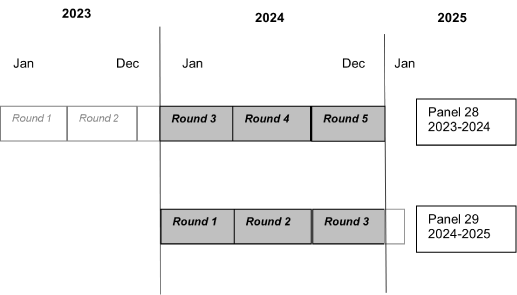
By using these data, you signify your agreement to comply with the previously stated statutorily based requirements with the knowledge that deliberately making a false statement in any matter within the jurisdiction of any department or agency of the federal government violates Title 18, Part 1, Chapter 47, Section 1001 (18 U.S.C. � 1001), and is punishable by a fine of up to $10,000 or up to 5 years in prison. The AHRQ requests that users cite AHRQ and the Medical Expenditure Panel Survey as the data source in any publications or research based on these data. B. Background1.0 Household ComponentThe Medical Expenditure Panel Survey (MEPS) provides nationally representative estimates of health care use, expenditures, payment sources, and health insurance coverage for the U.S. civilian noninstitutionalized population. The MEPS Household Component (HC) also provides estimates of respondents’ health status, demographic and socio-economic characteristics, employment, access to care, and satisfaction with care. Estimates can be produced for individuals, families, and selected population subgroups. The survey’s panel design includes five rounds of interviews spanning 2 full calendar years. The interviews use computer-assisted personal interviewing (CAPI) technology or computer-assisted video interviewing (CAVI) technology to collect information about each household member, which the survey builds on from interview to interview. A single household respondent reports data for a sampled household. The MEPS HC was initiated in 1996. Each year, a new panel of sampled households is selected. Because the data collected are comparable to those from earlier medical expenditure surveys conducted in 1977 and 1987, it is possible to analyze long-term trends. Historically, each annual MEPS HC sample consists of up to 15,000 households. Data can be analyzed at the person, family, or event level. Data must be weighted to produce national estimates. The set of households selected for each MEPS HC panel is a subsample of households participating in the previous year’s National Health Interview Survey (NHIS) conducted by NCHS. The NHIS sampling frame provides a nationally representative sample of the U.S. civilian noninstitutionalized population. In 2006, NCHS implemented a new NHIS sample design that included households with Asian persons in addition to households with Black and Hispanic persons in minority group oversampling. In 2016, NCHS introduced another sample design that discontinued the oversampling of these minority groups. 2.0 Medical Provider ComponentWhen the household instrument is completed, and permission is obtained from the sampled members to contact their medical provider(s), a sample of these providers is contacted by telephone to obtain information that household respondents cannot accurately provide. This part of MEPS is called the Medical Provider Component (MPC), and it collects information on dates of visits, diagnosis and procedure codes, and charges and payments. The Pharmacy Component (PC), a subcomponent of the MPC, does not collect data on charges or on diagnosis and procedure codes, but it does collect detailed information on drugs, including the National Drug Code (NDC) and medicine name, as well as payment amounts. The MPC is not designed to yield national estimates; it is primarily used as an imputation source to supplement or replace household-reported expenditure information. 3.0 Survey Management and Data CollectionMEPS HC and MPC data are collected under the authority of the Public Health Service Act. The MEPS HC data are collected under contract with Westat, and the MEPS MPC data are collected under contract with RTI International. Datasets and summary statistics are edited and published in accordance with the confidentiality provisions of the Public Health Service Act and the Privacy Act. NCHS provides consultation and technical assistance. As soon as the MEPS data are collected and edited, they are released to the public in stages of microdata files and tables via the MEPS website and AHRQ Data Tools site. Additional information on MEPS is available from the MEPS project manager or the MEPS public use data manager at the Center for Financing, Access, and Cost Trends, AHRQ, 5600 Fishers Lane, Rockville, MD 20857. C. Technical and Programming Information1.0 General InformationThis documentation describes the 2024 Full-Year (FY) Consolidated Public Use File (hereafter referred to as the Consolidated PUF) from the MEPS HC. It was released as an ASCII data file (with related SAS, Stata, SPSS, and R programming statements and data user information), SAS dataset, SAS transport dataset, Stata dataset, and Excel file. The Consolidated PUF provides information collected from a nationally representative sample of the U.S. civilian noninstitutionalized population for calendar year 2024. It contains 1,615 variables and has a logical record length of 4,686 with an additional 2-byte carriage return/line feed at the end of each record. The data on this PUF were obtained in (1) the 2024 portion of Round 3 and all of Rounds 4 and 5 of Panel 28, and (2) Rounds 1 and 2 and the 2024 portion of Round 3 of Panel 29 (i.e., the rounds for MEPS panels covering calendar year 2024). The variables on the Consolidated PUF pertain to survey administration, demographics, income, person-level conditions, health status, disability days, quality of care, employment, health insurance, and person-level medical care, use, and expenditures. This documentation offers a brief overview of the types and levels of data provided, as well as a detailed description of the content and structure of the files, and programming information. It is organized into the following sections:
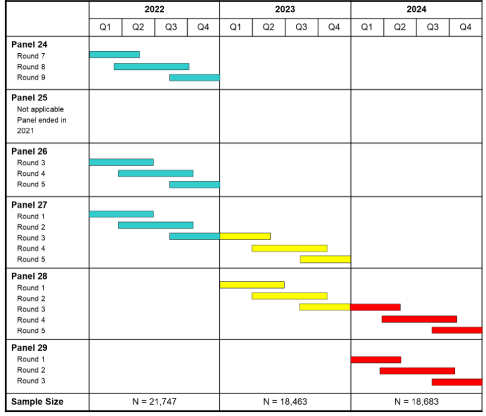
For most variables on this PUF, both weighted and unweighted frequencies are provided in the accompanying codebook file. The exceptions to this are weight variables, variance estimation variables, and variables that have a separate weight. Variables with separate weights are in the Self-Administered Questionnaire (SAQ). Only unweighted frequencies of these variables are included on the codebook file. Appendix 1 lists the weights and variables. A database of all MEPS products released to date can be found on the MEPS website. 2.0 Data File InformationThis PUF contains variables and frequency distributions associated with 19,140 persons who participated in the MEPS HC in 2024. These persons were assigned a positive person-level weight, a positive family-level weight, or both (some participating persons belonged to families characterized as family-level nonrespondents while some members of participating families were not eligible for a person-level weight). These 19,140 persons were part of one of the two MEPS panels for whom data were collected in 2024: Rounds 3, 4, and 5 of Panel 28, or Rounds 1, 2, and 3 of Panel 29. Of these persons, 18,683 were assigned a positive person-level weight. There were 8,405 families receiving a positive family-level weight. The codebook provides both weighted and unweighted frequencies for most variables on the dataset. In conjunction with the person-level weight variable (PERWT24F) provided on this PUF, data for persons with a positive person-level weight can be used to make estimates for the U.S. civilian noninstitutionalized population for 2024. Figure 1 MEPS Panel Design: Data Reference Periods
N is equal to the number of people with a positive person weight on the file. 2.1 Codebook StructureThe codebook and data file list variables in the following order:
2.2 Reserved CodesThis Consolidated PUF includes several reserved code values (Table 1).
The value Cannot be Computed (-15) was assigned to the MEPS constructed variables when there was not enough information from the instrument to calculate the constructed variables. Not enough information is often the result of skip patterns in the data or of missing information stemming from the responses Refused (-7) or Don’t Know (-8). Note that, in addition to Don’t Know, reserved code -8 also includes cases for which the information from the question was not ascertained. 2.3 Codebook FormatThis codebook describes an ASCII dataset (although the data are also being provided in a SAS dataset, SAS transport file, Stata dataset, and Excel file) and provides programming identifiers for each variable (Table 2).
2.4 Variable NamingIn general, variable names reflect the variable’s content. Names of edited variables end in an “X” and are described as such in the variable label. The last two characters in round-specific variables denote the rounds of data collection, Round 3, 4, or 5 of Panel 28, and Round 1, 2, or 3 of Panel 29. Unless otherwise noted, variables that end in “24” represent the status as of December 31, 2024. As the collection, universe, or categories of variables were altered, the variable names have been appended with “_Myy” to indicate the collection year (“yy”) in which the alterations took place. Alterations made in 2024 are described in detail throughout this document; descriptions of alterations made in prior years are found in the Consolidated document for the collection year in which the alterations took place. Analysts are cautioned not to confuse variables ending in “_M24” (indicating that an alteration took place in collection year 2024) with those ending in “24” (which represent the status as of December 31 of the collection year). Variables on this PUF were derived either from the questionnaire itself or from the CAPI. The source of each variable is identified in Appendix 1. Sources for each variable are indicated in one of four ways:
2.5 File ContentsAnalysts of MEPS data should be aware that contents of the file include data collected for all sample persons who were in the survey target population (U.S. civilian noninstitutionalized population) at any time during the survey period. In other words, a small proportion of individuals in the MEPS analytic files were not members of the target population for the entire survey period. These persons include those who, at some point, lived in an institution (e.g., nursing home or prison), were in the military, lived out of the country, were born (or adopted) into MEPS sample households, or died during the year. They are considered sample persons for analytic purposes and are included in MEPS annual files with positive person-level weights, but no data were collected for the periods in which they were not in scope, and their annual data for variables such as health care utilization, expenditures, and insurance coverage reflect only the part of the year in which they were in scope for the survey. These persons should not be confused with nonrespondents. The latter, sample members who did not respond to one or more rounds of data collection (i.e., initial nonrespondents and dropouts over time), are not included in the MEPS annual PUFs, and survey weights for full-year respondents are inflated through statistical adjustment procedures to compensate for both full- and part-year nonresponse (see Section C.3.0: Survey Sample Information for more information). The AHRQ website provides more details about the identification and analytic considerations regarding sample persons who are in scope only part of the year. 2.5.1 Survey Administration Variables (DUID - RURSLT53)The survey administration variables contain information related to conducting the interview, household and family composition, and person-level and reporting unit (RU)-level status codes. Data for the survey administration variables were derived from the sampling process or the CAPI programs, or they were computed on the basis of information provided by the respondent in the Reenumeration (RE) section of the questionnaire. Questions pertaining to most survey administration variables on this Consolidated PUF were asked during every round of the MEPS interview. The variables describe data for Rounds 3/1, 4/2, and 5/3 status, and for the status as of December 31, 2024. The December 31, 2024, variables were developed in two ways. Those used to construct eligibility, in scope, and the end reference date were based on an exact date. The remaining variables were constructed by using data from specific rounds, if available. If data were missing from the target round but were available in another round, data from that other round were used to construct the variable. If no valid data were available during any round of data collection, an appropriate reserved code was assigned. Dwelling Units, Reporting Units, and Families The definitions of dwelling units (DUs) in the MEPS HC are generally consistent with those used in NHIS. The dwelling unit identifier (DUID) is a seven-digit ID number consisting of a two-digit panel number followed by a five-digit random number assigned after the case was sampled for MEPS. A three-digit person number (PID) uniquely identifies each person within the DU. The variable DUPERSID is the combination of the variables DUID and PID. As part of the new CAPI design in 2018, an additional 2 bytes in the IDs resulted from adding a 2-digit panel number to the beginning of all the IDs. Analysts should be mindful of the different ID structures/lengths when combining MEPS PUFs from 1996-2017 with MEPS PUFs from 2018 and later. PANEL is a constructed variable used to specify the panel number and indicates either Panel 28 or Panel 29 for each record on the Consolidated PUF. Panel 28 started in 2023, and Panel 29 started in 2024. The panel number is included as the first two digits of the DUID and DUPERSID. The variable DATAYEAR is set to the reference year for the data and is included on this Consolidated PUF to aid in the differentiation of datasets when merging multiple years of data. An RU is a person or group of persons in the sampled DU who are related by blood, marriage, adoption, or other family association. Each RU was interviewed as a single entity for MEPS. Thus, the RU serves chiefly as a family-based “survey” operations unit rather than an analytic unit. Standard or primary RUs are the original RUs from the NHIS. A new RU is one created when members of the household leave the primary RU and are followed according to the rules of the survey. A student RU is an unmarried college student (younger than 24) who is considered a usual member of the household but was living away from home while going to school and was treated as an RU separate from their parents’ RU for the purpose of data collection. RUCLAS24 indicates the type of RU (standard, new, or student) when fielded for MEPS and was set on the basis of the RUCLAS values from Rounds 3/1, 4/2, and 5/3. If the person was present in the responding RU in Round 5/3, then RUCLAS24 was set to RUCLAS53. If the person was not present in the responding RU in Round 5/3 but was present in Round 4/2, then RUCLAS24 was set to RUCLAS42. If the person was not present in either Rounds 5/3 or 4/2 but was present in Round 3/1, then RUCLAS24 was set to RUCLAS31. If the person was not linked to a responding RU during any round, then RUCLAS24 was set to -15. Members of each RU within the DU are identified in the pertinent three rounds by the round-specific variables RULETR31, RULETR42, and RULETR53. End-of-year status (as of December 31, 2024, or the last round in which RU members were in the survey) is indicated by the RULETR24 variable. Regardless of the legal status of their association, two persons living together as a “family” unit were treated as a single RU if they chose to be so identified. Examples of different types of RUs include the following:
The round-specific variables RUSIZE31, RUSIZE42, and RUSIZE53, and the end-of-year status variable RUSIZE24 indicate the number of persons in each RU, treating students as single RUs separate from their parents. Thus, students are not included in the RUSIZE count of their parents’ RU. However, for many analytic objectives, the student RUs would be combined with their parents’ RU, treating the combined entity as a single family. The family identifier and size variables are described below and include students with their parents’ RU. The round-specific variables FAMID31, FAMID42, and FAMID53, and the end-of-year status variable FAMID24 identify a family (i.e., persons related to one another by blood, marriage, adoption, or self-identified as a single unit) for each round and as of December 31, 2024. The FAMID variables differ from the RULETR variables only in that student RUs are combined with their parents’ RU. Two other family identifiers, FAMIDYR and CPSFAMID, are provided on this PUF. The annualized family ID letter, FAMIDYR, identifies eligible members of the eligible annualized families within a DU. The CPSFAMID represents a redefinition of MEPS families into families defined by the Current Population Survey (CPS). Some of the distinctions between CPS-and MEPS-defined families are that MEPS families include and CPS families do not include: non-married partners, and in-laws. These persons are considered as members of separate families for CPS-like families. CPS-like families are defined so a poverty status classification variable consistent with established definitions of poverty can be assigned to the CPS-like families and used for weight poststratification purposes. To identify a person’s family affiliation, users must create a unique set of FAMID variables by concatenating the DU identifier and the FAMID variable. Instructions for creating family estimates are described in Section C.3.5. Foster care relationships and fostered members of households are no longer included in the MEPS data as of the 2017 Consolidated PUF. The round-specific variables FAMSZE31, FAMSZE42, and FAMSZE53, and the end-of-year status variable FAMSZE24 indicate the number of persons associated with a single-family unit after students are linked to their associated parent RUs for analytical purposes. Family-level analyses should use the FAMSZE variables. Note that the variables RUSIZE31, RUSIZE42, RUSIZE53, RUSIZE24, FAMSZE31, FAMSZE42, FAMSZE53, and FAMSZE24 exclude persons who are ineligible for data collection (i.e., identified by the following variables: ELGRND31 NE 1, ELGRND42 NE 1, ELGRND53 NE 1, or ELGRND24 NE 1); analysts should exclude ineligible persons in a given round from all family-level analyses for that round. The round-specific variables RURSLT31, RURSLT42, and RURSLT53 indicate the RU response status for each round. Analysts should note that the values for RURSLT31 differ from those for RURSLT42 and RURSLT53 (see Tables 3 and 4).
Geographic Variables The round-specific variables REGION31, REGION42, and REGION53, and the end-of-year status variable REGION24 indicate the Census region for the RU. REGION24 indicates the region for the 2024 portion of Round 5/3. For most analyses, REGION24 should be used.
Reference Period Dates The reference period is the period in which data were collected in each round for each person. The reference period dates were determined during the interview for each person by the CAPI program. The round-specific beginning reference period dates are included for each person. The variables that identify these dates include BEGRFM31, BEGRFY31, BEGRFM42, BEGRFY42, BEGRFM53, and BEGRFY53. The reference period for Round 1 for most persons began on January 1, 2024, and ended on the date of the Round 1 interview. For RU members who joined later in Round 1, the beginning Round 1 reference date was the date on which the person entered the RU. For all subsequent rounds, the reference period for most persons began on the date of the previous round’s interview and ended on the date of the current round’s interview. For persons who joined after the previous round’s interview, beginning of the reference period was set to the day on which they joined the RU. The round-specific ending reference period dates for Rounds 3/1, 4/2, and 5/3, as well as the end-of-year reference period end date variables, are also included for each person. These variables include ENDRFM31, ENDRFY31, ENDRFM42, ENDRFY42, ENDRFM53, ENDRFY53, ENDRFM24, and ENDRFY24. For most persons in the sample, the date of the round’s interview is the reference period end date. Note that the end date of the reference period for a person precedes the date of the interview if the person was deceased during the round, left the RU, was institutionalized before that round’s interview, or left the RU to join the military. For a small number of cases, the reference period dates may have been recoded for confidentiality. Reference Person Identifiers The round-specific variables REFPRS31, REFPRS42, and REFPRS53, and the end-of-year status variable REFPRS24 identify the reference person for Rounds 3/1, 4/2, and 5/3, and as of December 31, 2024 (or the last round in which they were in the survey). In general, the reference person is defined as the household member aged 16 or older who owns or rents the home. If more than one person meets this description, the household respondent identifies one from among them. If the respondent is unable to identify a person fitting this definition, the questionnaire asks for the head of household, and this person is then considered the reference person for that RU. This information is collected in the RE section of the CAPI questionnaire. Respondent Identifiers The respondent is the person who answered the interview questions for the RU. The round-specific variables RESP31, RESP42, and RESP53, and the end-of-year status variable RESP24 identify the respondent for Rounds 3/1, 4/2, and 5/3, and as of December 31, 2024 (or the last round in which they were in the survey). Only one respondent is identified for each RU. When the interview was completed in more than one session, only the first respondent is indicated. There are two types of respondents: an RU member or a non-RU member proxy. The round-specific variables PROXY31, PROXY42, and PROXY53, and the end-of-year status variable PROXY24 identify the type of respondent for Rounds 3/1, 4/2, and 5/3, and as of December 31, 2024 (or the last round in which they were in the survey). Language of Interview The language of interview variable (INTVLANG) is a summary value of the round-specific, RU-level question (CL350) in the Closing section of the CAPI questionnaire. This question asks the interviewer to record the language in which the interview was completed: English, Spanish, Both English and Spanish, Other Language. Given the first round in which the person participated in the survey and the person’s associated RU for that round, INTVLANG was assigned the interview language value reported for the person’s RU for the round. Type of Interview The interviewer records at CL340 the primary mode of conducting the MEPS interview. This information is used to construct the round-specific type of interview variables INTVTYPE31, INTVTYPE42, and INTVTYP53, with the following response categories: In Person (1), By Telephone (2), or By Video (CAVI) (3). Person Status A number of variables describe the various components reflecting each person’s status for each round of data collection. These variables provide information about a person’s in-scope status, Keyness status, eligibility status, and disposition status. These variables include KEYNESS, INSCOP31, INSCOP42, INSCOP53, INSCOP24, INSC1231, INSCOPE, ELGRND31, ELGRND42, ELGRND53, ELGRND24, PSTATS31, PSTATS42, and PSTATS53. They were set based on sampling information and responses provided in the RE section of the CAPI questionnaire. Through the RE section of the CAPI questionnaire, each member of an RU was classified as Key or non-Key, in scope or out of scope, and eligible or ineligible for data collection. To be included in the set of persons used to derive the MEPS person-level estimates, a person also had to be a member of the U.S. civilian noninstitutionalized population for at least one day during 2024. Because a person’s eligibility for the survey might have changed since the NHIS interview, a sampling reenumeration of household membership was conducted at the start of each round’s interview. Only persons who were in scope at some time during the year, who were Key, and who also responded for the full period in which they were in scope were assigned positive person-level weights. Analysts should, therefore, use these persons to derive person-level national estimates from the MEPS. If analysts want to subset their analysis to infants born during 2024, then newborns should be identified by using AGE24X = 0 rather than PSTATS = 51. In Scope The round-specific variables INSCOP31, INSCOP42, and INSCOP53 indicate a person’s in-scope status for Rounds 3/1, 4/2, and 5/3. INSCOP24, INSC1231, and INSCOPE indicate a person’s in-scope status for the portion of Round 5/3 that covers 2024, the person’s in-scope status as of December 31, 2024, and whether a person was ever in scope during calendar year 2024. A person was considered in scope during a round or a referenced period if they were a member of the U.S. civilian noninstitutionalized population at some time during that round or that period. The values of these variables taken in conjunction allow analysts to determine in-scope status over time (for example, becoming in scope in the middle of a round, as would be the case for newborns). These variables contain the following values and definitions (Table 6).
Keyness The term “Keyness” is related to an individual’s chance of being included in the MEPS. A person is Key if they are linked for sampling purposes to the set of NHIS sampled households designated for inclusion in the MEPS. More specifically, a Key person was either a member of a responding NHIS household at the time of interview or joined a family associated with such a household after being out of scope at the time of the NHIS (examples of the latter include newborns and those returning from military service, an institution, or residence in a foreign country). A non-Key person is one whose chance of being selected for the NHIS (and the MEPS) was associated with a household eligible but not sampled for the NHIS and who later became a member of a MEPS RU. MEPS data (e.g., utilization and expenditures) were collected for the period over which a non-Key person was part of a sampled unit to provide information for family-level analyses. However, non-Key persons who leave a sample household unaccompanied by a Key, in-scope member were not followed for subsequent interviews. Non-Key individuals were not given person-level weights and thus do not contribute to person-level national estimates. The variable KEYNESS indicates a person’s Keyness status. This variable is not round specific. Instead, it is set when a person enters MEPS, and this person’s Keyness status never changes. Once a person is determined to be Key, they will always be Key. A person might be Key even though they are not part of the civilian noninstitutionalized portion of the U.S. population. For example, a person in the military may have been living with their civilian spouse and children in a household sampled for the NHIS. The person in the military would be considered Key for purposes of the MEPS; however, such a person would not be eligible to receive a person-level sample weight if they were never in scope during 2024. Eligibility The eligibility of a person for the MEPS pertains to whether data are to be collected for that person. All Key, in-scope persons of a sampled RU are eligible for data collection. The only non-Key persons eligible for data collection are those who happen to be living in an RU with at least one Key, in-scope person. Their eligibility continues only for as long as they live with at least one such person. The only out-of-scope persons eligible for data collection are those who are living with a Key, in-scope person - again, only for as long as they live with such persons. Only military persons fit this description (for example, a person who is full-time, active duty military and living with a spouse who is Key). A person may be classified as eligible for an entire round or for some part of a round. For persons who are eligible for only part of a round (for example, persons who may have been institutionalized during a round), data are collected for the period during which that person is classified as eligible. The round-specific variables ELGRND31, ELGRND42, and ELGRND53, and the end-of-year status variable ELGRND24 indicate a person’s eligibility status for Rounds 3/1, 4/2, and 5/3, and as of December 31, 2024. Person Disposition Status The round-specific variables PSTATS31, PSTATS42, and PSTATS53 indicate a person’s disposition status - that is, their response and eligibility status for each round of interviewing. These variables indicate the reasons for either continuing or terminating data collection for each person in the MEPS. Using these variables, analysts can identify persons who moved during the reference period, died, were born, institutionalized, or were in the military. Analysts should note that PSTATS53 summarizes all of Round 5/3, including transitions that occurred after 2024. Note that some categories may have been collapsed for confidentiality purposes.
2.5.2 Navigating the MEPS Data with Information on Person Disposition StatusBecause the variables PSTATS31, PSTATS42, and PSTATS53 indicate the reasons for either continuing or terminating data collection for each person in the MEPS, these variables can be used to explain the beginning and ending dates for each individual’s reference period of data collection as well as which sections in the instrument that each individual did not receive. By using this information, shown in the table at the end of this section, analysts will be able to determine which sections of the MEPS questionnaire collected data elements for each individual. Some individuals have a reference period that spans an entire round, while for others, it spans only a portion of the round. When an individual’s reference period does not coincide with the RU reference period, the individual’s beginning date may be later than the RU’s beginning date, the ending date may be earlier, or both may be true. In addition, for some individuals, the reference period information was coded as Inapplicable (-1) (e.g., for individuals who were not actually in the household). The information in the table at the end of this section indicates the beginning and ending dates of the reference periods for persons with various values of PSTATS31, PSTATS42, and PSTATS53. The actual dates for each individual are in the following variables on this PUF: BEGRFM31, BEGRFM42, BEGRFM53, BEGRFY31, BEGRFY42, BEGRFY53, ENDRFM31, ENDRFM42, ENDRFM53, ENDRFY31, ENDRFY42, ENDRFY53, ENDRFM24, and ENDRFY24. The table at the end of this section also shows the section or sections of the questionnaire that were not asked for each value of PSTATS31, PSTATS42, and PSTATS53. For example, the Priority Condition Enumeration (PE) section has questions that are not asked for deceased persons. The Closing (CL) section also contains some questions or question rosters that exclude certain persons depending on whether they died, became institutionalized, or otherwise left the RU; however, no one was considered to have skipped the entire section. Some questions or sections (e.g., Health Status [HE], Employment [RJ, EM, EW]) were skipped if individuals were not within a certain age range. Since the PSTATS variables do not address skip patterns based on age, analysts will need to use the appropriate age variables. The SAQ was designed to collect information during Panel 29 Round 2 and Panel 28 Round 4. The SAQ was administered as a multimode survey, with web mode and paper-and-pencil administration. A person was considered eligible to receive an SAQ if that person was Key; their status was not deceased or institutionalized; they did not move out of the United States or to a military facility; they were not a nonresponse at the time of the Round 2 or Round 4 interview date; and they were aged 18 or older. No RU members added in Round 3 or Round 5 were asked to complete an SAQ questionnaire. Because PSTATS variables do not address skip patterns based on age, this questionnaire was not included in the table below. Once again, analysts will need to use the appropriate age variable, which in this case is AGE42X. The documentation for this questionnaire appears in the SAQ section of this document under Health Status Variables (Section C.2.5.6). Please note that the ending reference date shown in the following table for PSTATS53 reflects the Round 5/3 reference period rather than the portion of Round 5/3 that occurred during 2024.
2.5.3 Demographic Variables (AGE31X-DAPID53X)General Information Demographic variables provide information about the demographic characteristics of each person in the MEPS HC. The characteristics include age, sex, race, ethnicity, marital status, educational attainment, and military service. As noted in this section, some variables have edited and imputed values. The questions pertaining to most demographic variables on this PUF were asked during every round of the MEPS interview. These variables contain data for Rounds 3, 4, and 5 of Panel 28 (the panel that started in 2023); Rounds 1, 2 and 3 of Panel 29 (the panel that started in 2024); and the status as of December 31, 2024. Demographic variables whose names contain “31,” “42,” or “53” are round-specific variables. For example, AGE31X represents the age data relevant to Round 3 of Panel 28, or Round 1 of Panel 29. The variable PANEL indicates the panel from which the data were derived. A value of 28 indicates Panel 28 data and a value of 29 indicates Panel 29 data. The remaining demographic variables on this PUF are not round specific. The variables describing the demographic status of the person as of December 31, 2024, were developed in two ways. First, the age variable (AGE24X), which represents the exact age, was calculated from the date of birth and indicates age status as of December 31, 2024. For the remaining December 31 variables (i.e., related to marital status [MARRY24X, SPOUID24, SPOUIN24], student status [FTSTU24X], and the relationship to reference persons [REFRL24X]), the following algorithm was used: data were taken from the Round 5/3 counterpart if nonmissing; else, if missing, data were taken from the Round 4/2 counterpart; else from the Round 3/1 counterpart. If no valid data were available during any of these rounds of data collection, the algorithm assigned the missing value (other than Inapplicable [-1]) from the first round in which the person was part of the study. When all three rounds were set to -1, Cannot be Computed (-15) was assigned. Age Date of birth and age for each RU member were asked or verified during each MEPS interview (DOBMM, DOBYY, AGE31X, AGE42X, AGE53X). If the date of birth was available, age was calculated based on the difference between the date of birth and the date of the interview. Inconsistencies between the calculated age and the age reported during the CAPI interview were reviewed and resolved. For purposes of confidentiality, the variables AGE31X, AGE42X, AGE53X, AGE24X, and AGELAST were top-coded at 85 years of age. When date of birth was not provided but age was provided (either from the MEPS interviews or the 2022-2023 NHIS data), the month and year of birth were assigned randomly from among the possible valid options. For any cases still not accounted for, age was imputed using either of the following:
For example, a mother’s age was imputed as her child’s age plus 26, where 26 is the mean age difference between MEPS mothers and their children. A wife’s age was imputed as the husband’s age minus 3, where 3 is the mean age difference between MEPS wives and husbands. Age was imputed in this way for 8 persons on this PUF. AGELAST indicates a person’s age from the last time the person was eligible for data collection during a specific calendar year. The age range for this variable is 0-85. Sex Data on the sex of each RU member (SEX) were initially determined from the 2022 NHIS for Panel 28 and from the 2023 NHIS for Panel 29. The SEX variable was verified and, if necessary, corrected during each MEPS interview. The data for new RU members (persons who were not members of the RU at the time of the NHIS interviews) were also obtained during each MEPS round. When sex of the RU member was not available from the NHIS interviews and was not determined during one of the subsequent MEPS interviews, it was assigned in the following way. The person’s first name was used to assign sex if it was obvious (no cases were resolved this way in 2024). If the person’s first name provided no indication of sex, then family relationships were reviewed (no cases were resolved this way in 2024). If neither of these approaches made it possible to determine the individual’s sex, sex was randomly assigned (no cases were resolved this way in 2024). Race and Ethnicity The race and the ethnicity background questions were asked for each RU member during the MEPS interview. If the information was not obtained in Round 1, the questions were asked in subsequent rounds. It should be noted that race/ethnicity questions in the MEPS were revised starting with data collection in 2013 for Panel 16 Round 5, Panel 17 Round 3, and Panel 18 Round 1; this change affected data starting with the 2012 Population Characteristics PUF. Before that time, there were two race questions, but starting with the data collection in 2013, there has been only one race question. All Asian categories listed in the second question were moved to the new single question. In addition, the new race question had additional detail for the Native Hawaiian and Other Pacific Islander categories. The main change for ethnicity is that the new questions allowed respondents to report more than one Hispanic ethnicity. As a result of these changes, race/ethnicity data before 2012 may not be directly comparable with data collected in 2012 and later. The following table shows the variables used for FY 2002-2011 and FY 2012-2024, with two exceptions: (1) in FY 2012, RACEV1X categories 4 and 5 were not combined but were combined starting with 2013, and (2) RACEV2X and HISPNCAT were first introduced in 2013 (Table 9).
Race and ethnicity variables and their response categories before 2002 are available in the documentation for the Consolidated PUF for each data year. Values for these variables were obtained according to the following priority order. If available, data collected were used to determine race and ethnicity. If race and/or ethnicity were not reported in the interview, then data obtained from the originally collected NHIS data were used (6 cases were resolved this way for race, and 14 cases were resolved this way for ethnicity). If still not determined, race and/or ethnicity were assigned on the basis of the relationship to other members of the DU by using a priority order that gave precedence to blood relatives in the immediate family (this approach was used for 8 persons to set race and for 2 persons to set ethnicity). For the FY 2012 and FY 2013 PUFs, three new race variables were constructed for both the old and the new questions: RACEVER, RACEV1X, and RACETHX. The variable RACEVER was constructed to indicate which version of the race question(s) was asked and was included in only the 2012 and 2013 FY PUFs. RACEVER has been dropped starting with the 2014 PUF. The variables RACEV1X and RACETHX replace the variables RACEX and RACETHNX from 2002-2011. A new race variable, RACEV2X, was constructed only for the new race question and was added for the first time to the 2013 files. RACEV2X was set to Inapplicable (-1) for persons who were not asked the new race question in FY 2013 only. This variable includes the expanded-detail Asian categories and continues to be constructed for all PUFs. The Multiple Races Reported categories for RACEV1X and RACEV2X differ in the 2013-2015 PUFs but are the same starting with the 2016 PUF. In the 2013-2015 PUFs, persons of multiple Asian races or multiple Hawaiian/Pacific Islander races were considered multiple races for RACEV2X but were not considered multiple races for RACEV1X. Starting with the 2016 PUFs, persons of multiple Asian races or multiple Hawaiian/Pacific Islander races were no longer considered multiple races for RACEV2X. For the FY 2012 and FY 2013 PUFs, the two Hispanic ethnicity variables from previous years were included: HISPANX and HISPCAT. The HISPANX variable continues to be constructed. The HISPCAT variable was constructed for specific Hispanic categories based only on the old question in FY 2012 and FY 2013; HISPCAT was dropped starting with the 2014 PUF. A new ethnicity variable, HISPNCAT, based on the new question, was introduced in 2013. HISPNCAT includes categories that are similar to HISPCAT but in a different order; it also contains an additional category, Multiple Hispanic Groups Reported (8), to represent any multiple responses reported. HISPNCAT was set to Inapplicable (-1) for persons who were not asked the new ethnicity question in FY 2013. This variable continues to be constructed for all PUFs. Categories have been collapsed in the variables RACEV1X, RACEV2X, and HISPNCAT. For RACEV1X, new with the 2012 PUF, Categories 4 and 5 were collapsed into Category 4 as ASIAN/NATV HAWAIIAN/PACFC ISL-NO OTH starting with the 2013 PUF. For RACEV2X, new with and starting with the 2013 PUF, Categories 7, 8, 9, 10, and 11 were collapsed into Category 10 as OTH ASIAN/NATV HAWAIIAN/PACFC ISL-NO OTH. For HISPNCAT, new with and starting with the 2013 PUF, Categories 6 and 7 were collapsed into Category 6 as OTH LAT AM/HISP/LATINO/SPNSH ORGN-NO OTH. Language Variables: OTHLGSPK, WHTLGSPK, and HWELLSPK Data on language variables (OTHLGSPK, WHTLGSPK, and HWELLSPK) were collected at the person level in the round in which the person entered the MEPS. The household respondent was asked, for each person aged 5 or older, a person-level question to determine whether that person speaks a language other than English at home (RE1170, OTHLGSPK). If the response to OTHLGSPK was “Yes,” then two other questions were asked. WHTLGSPK (RE1170) is a person-level question that asks whether the non-English language spoken at home is Spanish or some other language, and HWELLSPK (RE1170) is a person-level question that asks how well that person can speak English. If the response to OTHLGSPK was “No,” then WHTLGSPK and HWELLSPK were set to Inapplicable (-1). Family members who were deceased or institutionalized in Round 1 were coded with a value of Inapplicable (-1). For minors younger than 5, all three variables were coded to Under 5 years old - Inapplicable (5). Language variables have changed over time, so analysts doing multiyear analyses should carefully review the documentation from prior years to ensure that they are collecting all relevant language variables and correctly interpreting the various language variables over time. Foreign-Born Status Three questions regarding foreign-born status were asked in the Demographics section to ascertain whether a person was born in the United States (RE1170), what year they came to the U.S. (RE1170) if not born in the U.S., and years lived in the U.S. (RE1170) if the response to RE1170 was “Don’t Know”. These three questions were only asked once for each eligible person - that is, in the first round in which the person was included in the interview. The questions were asked for everyone except deceased and institutionalized persons. The data from RE1170 are reported as the constructed variable BORNUSA. The data from RE1170 (YRCAMEUS) and RE1170 (YRSINUSA) were used to calculate the number of years a person has lived in the United States for the constructed variable YRSINUS. Please note that YRSINUS is a discrete variable that has five collapsed categories: 1 = Less than 1 year 2 = 1 year, less than 5 years 3 = 5 years, less than 10 years 4 = 10 years, less than 15 years 5 = 15 years or more Marital Status and Spouse ID Current marital status was collected and/or updated during every round of the MEPS interview. This information was obtained in RE100 and RE1170 and is reported as MARRY31X, MARRY42X, MARRY53X, and MARRY24X. Persons younger than 16 were coded as Under 16 - Inapplicable (6). If marital status in a specified round differed from that of the previous round, then the marital status of the specified round was edited to reflect a change during the round (e.g., married in round, divorced in round, separated in round, widowed in round). When there were discrepancies between the marital status of two individuals within a family, other person-level variables were reviewed to determine the edited marital status for each individual. Thus, when one spouse was reported as married and the other spouse was reported as widowed, the data were reviewed to determine whether one partner should be coded as Widowed in Round (8). The data were edited to ensure some consistency across rounds. First, a person could not be coded as Never Married after previously being coded as any other marital status (e.g., Widowed). Second, a person could not be coded as Under 16 - Inapplicable after previously being coded as any other marital status. Third, a person could not be coded as Married in Round after being coded as Married in the immediately preceding round. Fourth, a person could not be assigned an in-round code (e.g., Widowed in Round) in two consecutive rounds. Since marital status can change across rounds, and since it was not feasible to edit every combination of values across rounds, unlikely sequences for marital status across the round-specific variables do exist. The person-level identifier for each individual’s spouse is reported in SPOUID31, SPOUID42, SPOUID53, and SPOUID24. These are the PIDs (within each family) of the person identified as the spouse during Round 3/1, Round 4/2, and Round 5/3 and as of December 31, 2024, respectively. If no spouse was identified in the household, the variable was coded as No Spouse in House (995). Those with unknown marital status were coded as Marital Status Unknown (996). Persons younger than 16 were coded as Less than 16 Years Old (997). The SPOUIN31, SPOUIN42, SPOUIN53, and SPOUIN24 variables indicate whether a person’s spouse was present in the RU during Round 3/1, Round 4/2, and Round 5/3, and as of December 31, 2024, respectively. If the person had no spouse in the household, the response was coded as Not Married/No Spouse (2). For persons younger than 16, the response was coded as Under 16 - Inapplicable (3). The SPOUID and SPOUIN variables were obtained from question RE900, in which the respondent was asked to identify how each pair of persons in the household was related. Analysts should note that this information was collected in a set of questions separate from the questions about marital status. While editing was performed to ensure that SPOUID and SPOUIN were consistent within each round, there was no consistency check between these variables and marital status in a given round. Apparent discrepancies between marital status and spouse information may be a result of any of the following three causes:
Student Status and Educational Attainment The variables FTSTU31X, FTSTU42X, FTSTU53X, and FTSTU24X indicate whether the person was a full-time student at the interview date (or on December 31, 2024, for FTSTU24X). These variables have valid values for all persons aged 17-23. When this education question was asked during Round 1 of Panel 29, it was based on age as of the 2023 NHIS interview date. Education questions were asked only when persons first entered MEPS, typically in Round 1 for most people. It should be noted that education questions were changed with data collection in 2012 and then changed back to the original questions with data collection in 2015. The variables associated with the original education questions (data collection in 2011 and prior years, and 2015 and subsequent years) are EDUCYR and HIDEG. The documentation for each of the 2011-2015 years explains which education variables are in the respective files. Starting in FY 2016, EDUCYR and HIDEG are the only education variables on the PUFs. EDUCYR contains the number of years of education completed when entering MEPS for individuals aged 5 or older. Children younger than 5 were coded as Inapplicable (-1) regardless of whether they attended school. Individuals who were aged 5 or older and had never attended school were coded as 0. The user should note that EDUCYR is an unedited variable for which the data were only minimally cleaned. HIDEG contains information on the highest degree of education attained when the individual entered MEPS. This information was obtained from three questions: highest grade completed, high school diploma, and highest degree. Persons younger than 16 when they first entered MEPS were coded as Under 16 - Inapplicable (8). When the response to the question about highest degree was No Degree, and the response to the question about highest grade was 13 -17, the variable HIDEG was coded as High School Diploma (3). If the response to the question about highest grade completed was Refused or Don’t Know, and the response to the question about highest degree was No Degree, the variable HIDEG was coded as No Degree (1). The user should note that HIDEG is an unedited variable for which the data were only minimally cleaned. Military Service Information on active duty military status was collected during each round of the MEPS interview. Persons on full-time active duty status at the time of the interview are identified by the variables ACTDTY31, ACTDTY42, and ACTDTY53. Those younger than 16 were coded as Under 16 - Inapplicable (3), and those older than 59 were coded as Over 59 - Inapplicable (4). The variable EVERSERVED, added in FY2023, indicates whether the person has ever served in the U.S. Armed Forces. If a person indicated that they ever served on active duty in the U.S. Armed Forces, Reserves, or National Guard, including activation for the Reserves or National Guard (for example, for the Persian Gulf War), the variable EVERSERVED was coded as Yes - Served In Military (1). Relationship to the Reference Person within Reporting Units For each RU, the person who owns or rents the DU is usually defined as the reference person. For student RUs, the student is defined as the reference person. (For additional information on reference persons, see Dwelling Units, Reporting Units, and Families in Section C.2.5.1: Survey Administration Variables.) The relationship variables indicate the relationship of each individual to the reference person of the RU in a given round. Starting in 2013, detailed relationships were combined for confidentiality into more general categories in the variables REFRL31X, REFRL42X, REFRL53X, and REFRLyyX. These variables replaced RFREL31X, RFREL42X, RFREL53X, and RFRELyyX, which were used before 2013. The new and old variables are defined differently, so researchers using multiple years of MEPS data should refer to the documentation for prior years to ensure that their data are consistent. Note that the categories for Child (4), Parent (7), and Sibling (8) for REFRL31X, REFRL42X, REFRL53X, and REFRL24X changed in 2017. In 2013-2016, these categories included biological, adoptive, and step relationships, as well as in-law and foster relationships. Starting in 2017, in-law relationships have been included in Other Related, Specify (91). Foster children were no longer included in the MEPS starting in 2017, so this relationship no longer appears in any of the categories.
For the reference person, these variables have the value Household Reference Person; for all other persons in the RU, the relationship to the reference person is indicated by codes representing Spouse, Unmarried Partner, Child, and so forth. A code of 91, meaning Other Related, Specify indicates rarely observed relationships such as Mother of Partner, Partner of Sister, and so forth. If the relationship of an individual to the reference person was not determined during the round-specific interview, relationships between other RU members were used, when possible, to assign a relationship to the reference person. If MEPS data from calendar year 2024 were not sufficient to identify the relationship of an individual to the reference person, relationship variables from the 2023 MEPS or NHIS data were used to assign a relationship. If a meaningful value could not be determined, or if data were missing, the relationship variable was assigned a missing value code. If the relationship between two individuals indicated that they were spouses, but the marital status of both indicated that they were not married, their relationship was changed to nonmarital partners. In addition, the relationship variables were edited to ensure that they did not change across rounds for RUs in which the reference person did not change, with the exception of relationships identified as partner or spouse relationships. Parent Identifiers The variables MOPID31X, MOPID42X, MOPID53X and DAPID31X, DAPID42X, DAPID53X are round-specific and are used to identify the parents (biological, adopted, or step) of the person represented on that record. MOPID##X contains the person identifier (PID) for each individual’s mother if she lived in the RU in that panel/round of the survey, or a value of Inapplicable (-1) if she did not. Similarly, DAPID##X contains the person identifier (PID) for each individual’s father if he lived in the RU in that panel/round of the survey, or a value of Inapplicable (-1) if he did not. MOPID##X and DAPID##X were constructed based on information collected in the relationship grid of the instrument each round at question RE900, and include biological, adopted, and stepparents. Foster parents were not included. For persons who were not present in the household during a round, MOPID##X and DAPID##X have values of Inapplicable (-1). Edits were performed to ensure that MOPID##X and DAPID##X were consistent with each individual’s age, sex, and other relationships within the family. For instance, the sex of the parent must be consistent with the indicated relationship; mothers are at least 12 years older than the person and no more than 55 years older than the person; fathers are at least 12 years older than the person; each person has no more than one mother and no more than one father; and the PID for the person’s mother and father are valid PIDs for that person’s RU for the Consolidated PUF. 2.5.4 Income and Tax Filing Variables (FILEDR24-HIEUIDX)The file provides income and tax-related variables that were constructed primarily from data collected in the Panel 28 Round 5 and Panel 29 Round 3 Income sections. Person-level income amounts have been edited and imputed for every record on the full-year PUF, with detailed imputation flags provided as a guide to the method of editing. The tax-filing variables and some program participation variables are unedited, as discussed below. Beginning with the income data collected for Panel 21 Round 5 and Panel 22 Round 3, two skip patterns were introduced to reduce respondent burden. (1) IN360 (unemployment compensation income) was not asked for respondents who reported employment at the same current main job in the current round and the previous two rounds, and (2) IN170 (alimony income) was not asked for respondents who were married in the current round and married in the previous two rounds. As detailed below, weighted, sequential hot-decks were used to estimate amounts for unemployment compensation (UNEMP24X) and alimony income (ALIMP24X) for these respondents. Users should note that the introduction of these skip patterns may affect comparability of these income measures across survey years. During imputation, logical editing and weighted, sequential hot-decks were used to estimate income amounts for missing values (both for item nonresponse and for persons in the full-year PUF who were not in the income rounds). Reported income components were generally left unedited (with the few exceptions noted below). Thus, analysts using these data may wish to apply additional checks for outlier values that would appear to stem from misreporting. The editing process began with wage and salary income, WAGEP24X. Complete responses were left unedited, and this group of people was assigned WAGIMP24 = 1, where WAGIMP24 is the imputation flag for wage and salary data. The only exception was for a small number of persons who reported zero wage and salary income despite having been employed for pay during the year according to round-level data (see below). Data on tax filing and on taxable income sources were collected using an approach that encouraged respondents to provide information from their federal tax returns. Logical edits as well as a specific question on the wage income of the respondent (IN110) were used to assign separate income amounts to married persons whose responses were based on combined income amounts on their joint tax returns. Persons assigned WAGIMP24 = 2 were those providing broad income ranges (brackets) rather than giving specific dollar amounts. Weighted sequential hot-decking was used to provide these individuals with specific dollar amounts. For this imputation, donors were persons who reported specific dollar amounts within the corresponding broad income ranges. In 2024 (as in all previous years) there were a small number of cases where WAGEP24X = 0 and WAGIMP24 = 2. These are cases where a married couple filing jointly reported wages with a bracket, and reported that one spouse earned $0 of that bracketed amount. All WAGEP24X hot-deck imputations used cells defined based on a conventional list of person-level characteristics including age, education, employment status, race, sex, and region. Persons assigned WAGIMP24 = 3 were those who did not report wage and salary income and who were assigned WAGEP24X = 0 based on not having been employed during the year. Persons assigned WAGIMP24 = 4 were those who did not provide valid dollar amounts or dollar ranges, but for whom we had related information from the Employment Wage section of the survey. In most cases this information included wages, hours, and weeks worked; for some persons, only hours and weeks worked data were reported in the Employment section. The available Employment section data were used to construct annualized wage amounts to be used in place of missing income section annual wage and salary data. Comparisons of reported and constructed wages and salaries using persons who provided both sorts of information yielded a high degree of confidence that employment data could be reliably used to derive values to serve in place of missing wage and salary information. To implement this approach, part-year responders were assumed to be fully employed during the remainder of the year if they were employed during the period in which they provided data. An exception was made for those who either died or were institutionalized. These persons were assigned zero wages and salaries for the time they were not in MEPS. Hot-deck imputation was used for the remaining persons with missing WAGEP24X. Donor pools included persons whose WAGEP24X amounts were edited in the steps described above. Whenever possible, the hot-deck imputations used data on whether the person had been employed at any point during the year (and, if available, the number of weeks worked). Imputations for persons deemed to have been employed were conditional in nature, using only donors with positive WAGEP24X amounts (WAGIMP24 = 5). Imputations for WAGEP24X for the remaining persons were unconditional, using both workers and non-workers as donors (WAGIMP24 = 6). After editing WAGEP24X for all persons in the full-year PUF, the remaining income sources were edited in the following sequence:
Income components were edited sequentially, in each case using information regarding income amounts that had already been edited (to maintain patterns of correlation across income sources whenever possible). In all cases, bracketed responses were edited first (using hot-deck imputations from donors in corresponding brackets who gave specific dollar amounts), followed by imputations for remaining missing values. The hot-deck imputations used cells defined based on income amounts already edited and a conventional list of person-level characteristics such as age, education, employment status, race, sex, and region. In addition, hot-deck imputations for CHLDP24X used family-level information concerning marital status and the number of children. Hot-deck imputations for SSIP24X and PUBP24X were also assigned using, in part, simulated program eligibility indicators that integrated state-level program eligibility criteria with data on family composition and income. Income indicators from the previous year’s income data were used to impute missing interest, social security, pension, and dividends data. Reported income amounts of less than one dollar were treated as missing amounts (to be hot-decked from donors with positive amounts of the corresponding income source). Also, very few cases of outlier responses were edited (primarily public sources of income that exceeded possible amounts). Otherwise, reported amounts were left unchanged. For each income component, the corresponding xxxIMP24 variable contains an indicator concerning the method for editing/imputation. All flag variables have the following formatted values: 1 = Original response used 2 = Bracket converted 3 = Missing value set to 0 4 = Weeks worked/earnings used (WAGIMP24 only) 5 = Conditional hot-deck 6 = Unconditional hot-deck Missing values were set to zero when there were too few recipients to warrant hot-deck imputations of positive values (as in the case of ALIMP24X received by males). “Conditional hot-decks” indicate instances where the respondent indicated receipt but not a specific dollar amount. In these cases, the donor pool was restricted to persons with nonzero amounts of the income source in question. “Unconditional hot-decks” indicate instances where the donor pool included persons receiving both zero and nonzero amounts (implemented in cases where there was little or no information about a person’s income source). Total person-level income (TTLP24X) is the sum of all income components except SALEP24X (to match as closely as possible the CPS definition of income; see Section C.2.5.4). The tax variables and food stamp variables are all completely unedited. Unedited tax variables are provided to assist analysts in building tax simulation programs. No efforts have been made to eliminate inconsistencies among these program participation and tax variables and other MEPS data. These unedited variables should be used with great care. There are three income types that can have negative values: business income (BUSNP24X), trust/rent income (TRSTP24X), and sale income (SALEP24X). A negative amount indicates negative income. Negative business income and negative trust/rent income can cause family’s total income (FAMINC24) and person’s total income (TTLP24X) to have negative values. Income Top-Coding All person-level income amounts on this PUF, including both total income and the separate sources of income, were top-coded to preserve confidentiality. For each income source, top codes were applied to the top percentile of all cases (including negative amounts that exceeded income thresholds in absolute value). In cases where less than one percent of all persons received a particular income source, all recipients were top-coded. Top-coded income amounts were masked using a regression-based approach. The regressions relied on many of the same variables used in the hot-deck imputations, with the dependent variable in each case being the natural logarithm of the amount that the income component was in excess of its top-code threshold. Predicted values from this regression were reconverted from logarithms to levels using a smearing correction, and these predicted amounts were then added back to the top-code thresholds. This approach preserves the component-by-component weighted means (both overall and among top-coded cases), while also preserving much of the income distribution conditional on the variables contained in the regressions. At the same time, this approach ensures that every reported amount in excess of its respective threshold is altered in the PUF. The process of top-coding income amounts in this way inevitably introduces measurement error in cases where income amounts were reported correctly by respondents. Note, however, that top-coding can also help to reduce the impact of outliers that occur due to reporting errors. Total person-level income is constructed as the sum of the adjusted person-level income components. Having constructed total income in this manner, this total was then top-coded using the same regression-based procedure described above (again masking the top percentile of cases). Finally, the components of income were scaled up or down in order to make the sources of income consistent with the newly-adjusted totals. Poverty Status The definitions of income, family, and poverty categories used to construct the related variables on this PUF were taken from the 2024 poverty statistics developed by the Current Population Survey (CPS). The categorical variable for 2024 family income as a percentage of poverty (POVCAT24) was constructed using the same method as in earlier years’ PUFs. FAMINC24 contains total family income for each person’s CPS family. Family income was derived by constructing person-level total income comprising annual earnings from wages, salaries, bonuses, tips, commissions; business and farm gains and losses; unemployment and workers’ compensation; interest and dividends; alimony, child support, and other private cash transfers; private pensions, IRA withdrawals, social security, and veterans payments; supplemental security income and cash welfare payments from public assistance, and related programs; gains or losses from estates, trusts, partnerships, S corporations, rent, and royalties; and a small amount of “other” income. Person-level income excluded tax refunds and capital gains. Person-level income totals were then summed over family members, as defined by CPSFAMID, to yield CPS family-level total income (FAMINC24). POVLEV24 is the continuous version of the POVCAT24 variable. The POVLEV24 percentage was computed by dividing CPS family income by the applicable poverty line (based on family size and composition). POVCAT24 takes the POVLEV24 percentage for each person and classifies it into one of five poverty categories: negative or poor (less than 100%), near poor (100% - 125%), low income (125% - 200%), middle income (200% - 400%), and high income (greater than or equal to 400%). Persons missing CPSFAMID were treated as one-person families in constructing their poverty percentage and category. Family income, as well as the components of person-level income, has been subjected to internal editing patterns and derivation methods that are in accordance to specific definitions, and are not being released at this time. Researchers working with a family definition other than CPSFAMID may wish to create their own versions of total family income. Health Insurance Eligibility Units (HIEUs) are sub-family relationship units constructed to include adults plus those family members who would typically be eligible for coverage under the adults' private health insurance family plans. To construct the HIEUIDX variable, which links persons into a common HIEU, we begin with the family identification variable CPSFAMID. Working with this family ID, we define HIEUIDX using family relationships as of the end of 2024. Persons missing end-of-year relationship information are assigned to an HIEUIDX using relationship information from the last round in which they provided such information. HIEUs comprise adults, their spouses, and their unmarried natural/adoptive children aged 18 and under. Legal spouses are eligible to be included in the same HIEU. We also include children under age 24 who are full-time students (living at home or away from home). Other children who do not live with their natural/adoptive adult parents are placed in an HIEUIDX as follows:
HIEUs do not, in general, comprise adult (nonmarital) partnerships, because unmarried adult partners are rarely eligible for dependent coverage under each other's insurance. The exception to this rule is that we include adult partners in the same HIEU if there is at least one (out-of-wedlock) child in the family that links to both adult partners. In cases of missing or contradictory relationship codes, HIEUs are edited by hand, with the presumption being that the adults and children form a nuclear family. 2.5.5 Person-Level Priority Condition Variables (HIBPDX-COVYRDX53)The Priority Conditions Enumeration (PE) section was asked in its entirety in Round 1 for all current or institutionalized persons, and in Panel 29 Round 2 and Panel 28 Round 4 for only new RU members. In Panel 29 Round 3, the questions about specific conditions (except joint pain and chronic bronchitis) were asked only if the person had not reported the condition in a previous round. Priority-condition variables that end in “DX” indicate whether the person was ever diagnosed with the condition. Follow-up questions on chronic bronchitis, joint pain, and asthma (ASSTIL31, ASATAK31, and ASTHEP31) reflect data obtained in Round 3 of Panel 28 and Round 1 of Panel 29. Diagnoses data (except for attention deficit hyperactivity disorder/attention deficit disorder [ADHD/ADD], diabetes, and asthma) were collected for persons older than 17. If the edited age is within range for the variable to be set, but the source data are missing because the person’s age in the CAPI instrument is not within range, the constructed variable was set to Cannot be Computed (-15). Following the same pattern, the question on ADHD/ADD was asked about persons aged 5-17, and the questions on diabetes and asthma were asked about persons of all ages. Exceptions to this pattern are the variables JTPAIN31_M18 and CHBRON31, which are described in detail in the sections below on joint pain and chronic bronchitis. Questions were asked about the following priority conditions:
These conditions were selected because of their relatively high prevalence and because generally accepted standards for appropriate clinical care have been developed for them. This information thus supplements other information on medical conditions that is gathered in other parts of the interview. The data were collected at the person-by-round level (indicating whether the person was ever diagnosed with the condition) and at the condition level. If the person reported having been diagnosed with a condition, the person-by-round variable was Yes (1), and a condition record for that medical condition was created. The editing of the variables that represent these conditions focused on ensuring that skip patterns were consistent. High Blood Pressure Questions about high blood pressure, or hypertension, (HIBPDX) were asked only of persons aged 18 or older. Consequently, persons aged 17 or younger were coded as Inapplicable (-1) on these variables. These questions ascertained whether the person had ever been diagnosed as having high blood pressure (other than during pregnancy). Those who had received this diagnosis were also asked whether they had been told on two or more visits that they had high blood pressure (BPMLDX). The age of diagnosis for high blood pressure (HIBPAGED) is included on this PUF. This variable was top-coded at 85 years of age. Heart Disease Questions about heart disease were asked only of persons aged 18 or older. Consequently, persons aged 17 or younger were coded as Inapplicable (-1) on all the variables in this set. These variables include the following: CHDDX - Asked if the person had ever been diagnosed as having coronary heart disease ANGIDX - Asked if the person had ever been diagnosed as having angina, or angina pectoris MIDX - Asked if the person had ever been diagnosed as having a heart attack, or myocardial infarction OHRTDX - Asked if the person had ever been diagnosed with any other kind of heart disease or condition The age of diagnosis for coronary heart disease (CHDAGED), angina (ANGIAGED), heart attack or myocardial infarction (MIAGED), and other kinds of heart disease (OHRTAGED) is included on this PUF. These variables were top-coded at 85 years of age. Respondents who answered “Yes” to a person being diagnosed with any other kind of heart disease or condition (OHRTDX) were asked a follow-up question (OHRTTYPE) to specify other heart diseases or conditions. Stroke Questions about stroke (STRKDX) asked if the person (aged 18 or older) had ever been diagnosed as having had a stroke or a transient ischemic attack (TIA, or ministroke). Persons aged 17 or younger were coded as Inapplicable (-1). The age of diagnosis for stroke or TIA (STRKAGED) is included on this PUF and was top-coded at 85 years of age. Emphysema EMPHDX indicates whether a person (aged 18 or older) had ever been diagnosed with emphysema. Persons aged 17 or younger were coded as Inapplicable (-1). The age of diagnosis for emphysema (EMPHAGED) is included on this PUF and was top-coded at 85 years of age. High Cholesterol Questions about high cholesterol were asked of persons aged 18 or older. Consequently, persons aged 17 or younger were coded as Inapplicable (-1) on these variables. These questions ascertained whether the person had ever been diagnosed as having high cholesterol (CHOLDX). The age of diagnosis for high cholesterol (CHOLAGED) is included on this PUF and was top-coded at 85 years of age. Cancer Questions about cancer were asked only of persons aged 18 or older. Consequently, persons aged 17 or younger were coded as Inapplicable (-1) on these variables. Questions about cancer ascertained whether the person had ever been diagnosed as having cancer or a malignancy of any kind (CANCERDX). If the respondent answered “Yes” they were asked at question PE140 what type of cancer was diagnosed. CABLADDR, CABREAST, CACERVIX, CACOLON, CALUNG, CALYMPH, CAMELANO, CAOTHER, CAPROSTA, CASKINNM, CASKINDK, and CAUTERUS indicate that the respondent selected cancer of the bladder, breast, cervix, colon, lung, lymphoma, melanoma, other type of cancer, cancer of the prostate, skin, or uterus. Cancer of the cervix or uterus could not be reported for males, and cancer of the prostate could not be reported for females. Recoding of Cancer Variables Cancer diagnosis variables with a frequency count of fewer than 20 on the file and diagnoses considered clinically rare (i.e., appear on the National Institutes of Health’s list of rare diseases) were removed from the file for confidentiality reasons. Then, the corresponding variable CAOTHER, indicating diagnosis of a cancer that is not counted individually, was recoded to Yes (1), as necessary. In data year 2024, clinically rare cancers include the following:
The variable CABREAST, which indicates a diagnosis of breast cancer, was recoded to Inapplicable (-1) for males for confidentiality reasons. The corresponding value of the general cancer diagnosis variable, CANCERDX, was recoded to Cannot be Computed (-15), and the corresponding values of the remaining cancer variables were recoded to Inapplicable (-1). Arthritis ARTHDX indicates whether a person (aged 18 or older) had ever been diagnosed with arthritis. Persons aged 17 or younger were coded as Inapplicable (-1). Respondents who answered “Yes” were asked a follow-up question to determine the type of arthritis. ARTHTYPE indicates whether the diagnosis was for rheumatoid arthritis (1), osteoarthritis (2), or nonspecific arthritis (3). The age of diagnosis for arthritis (ARTHAGED) is included on this PUF and may have been recoded in some cases to Cannot be Computed (-15) for confidentiality reasons. This variable was top-coded at 85 years of age. Diabetes Diabetes diagnosis (DIABDX_M18) questions are asked for each person of every age. DIABDX_M18 indicates whether each person has ever been diagnosed with diabetes (excluding gestational diabetes). The age of diagnosis of diabetes (DIABAGED) is included on this PUF and was top-coded at 85 years of age. Asthma ASTHDX indicates whether a person had ever been diagnosed with asthma. The age of diagnosis for asthma (ASTHAGED) is included on this PUF and was top-coded at 85 years. Respondents who answered “Yes” to having an asthma diagnosis were asked additional questions. One question (ASSTIL31) asked if the person still has asthma. Another question (ASATAK31) asked whether the person had experienced an episode of asthma or an asthma attack in the past 12 months. If the person did not experience an asthma attack in the past 12 months, a follow-up question (ASTHEP31) asked when the last asthma episode or asthma attack occurred. Additional follow-up questions regarding asthma medication used for quick relief (ASACUT31), preventive medicine (ASPREV31), and peak flow meters (ASPKFL31) were asked if the person reported having been diagnosed with asthma (ASTHDX = 1). ASACUT31 indicates whether, during the last three months, the person had used the kind of prescription inhaler “that you breathe in through your mouth” to get quick relief from asthma symptoms. ASPREV31 indicates whether the person had ever taken the preventive kind of asthma medicine used every day to protect the lungs and prevent attacks, including both oral medicine and inhalers. ASPKFL31 indicates whether the person with asthma has a peak flow meter at home. Respondents who answered “Yes” to ASACUT31 were asked whether the person had used more than three canisters of the quick-relief inhaler in the past three months (ASMRCN31). Respondents who answered “Yes” to ASPREV31 were asked whether the person now takes this kind of medication daily or almost daily (ASDALY31). Respondents who answered “Yes” to ASPKFL31 were asked if the person ever used a peak flow meter (ASEVFL31). Respondents who answered “Yes” to ASEVFL31 were asked when the person last used the peak flow meter (ASWNFL31). The following asthma variables are included on this PUF: ASSTIL31 - Does Person Still Have Asthma - Round 3/1 ASATAK31 - Asthma Attack Last 12 Mos - Round 3/1 ASTHEP31 - When Was Last Episode of Asthma - Round 3/1 ASACUT31 - Used Acute Pres Inhaler Last 3 Mos- Round 3/1 ASPREV31 - Ever Used Prev Daily Asthma Meds - Round 3/1 ASPKFL31 - Have Peak Flow Meter at Home - Round 3/1 ASMRCN31 - Used >3 Acute Cn Pres Inh Last 3 Mos - Round 3/1 ASDALY31 - Now Take Prev Daily Asthma Meds - Round 3/1 ASEVFL31 - Ever Used Peak Flow Meter - Round 3/1 ASWNFL31 - When Last Used Peak Flow Meter - Round 3/1 It may appear that there are discrepancies between the diagnosis variable and the follow-up variables. If a person reported asthma in the PE section in Panel 29 Round 3, the asthma series variables were set to Inapplicable (-1) as the person had not reported asthma in Round 1. Attention Deficit Hyperactivity Disorder/Attention Deficit Disorder ADHDADDX indicates whether persons aged 5 through 17 had ever been diagnosed with ADHD/ADD. Persons younger than 5 or older than 17 were coded as Inapplicable (-1). The age of diagnosis for ADHD/ADD (ADHDAGED) is included on this PUF. Joint Pain JTPAIN31_M18 indicates whether a person (aged 18 or older) had experienced pain, swelling, or stiffness around a joint in the last 12 months. This question is not intended to be used as an indicator of a diagnosis of arthritis. Persons aged 17 or younger were coded as Inapplicable (-1). This question was skipped if the person already has an arthritis condition that is specified on the conditions roster in the PE section. Chronic Bronchitis CHBRON31 indicates whether a person (aged 18 or older) has had chronic bronchitis in the last 12 months. Persons aged 17 or younger were coded as Inapplicable (-1). Ever Had COVID-19 or Long COVID Questions administered in Panel 28 Rounds 3 and 5 and Panel 29 Rounds 1 and 3 determined whether a person had ever been diagnosed with COVID-19 (COVIDEVER31 and COVIDEVER53). When it was reported that a person had been diagnosed with COVID-19, a series of questions about Long COVID was asked. LCEVER31 and LCEVER53 indicate whether a person experienced symptoms lasting three months or longer that they did not have prior to having COVID-19 (Long COVID). “Yes” responses from previous rounds were preserved for both variables for respondents who remained eligible. Although “42” variables are not included on this PUF because only new members are asked the PE section in those rounds, “Yes” values from COVIDEVER42 and LCEVER42 were retained if the person remained eligible in subsequent rounds. If a person reported having Long COVID in the current round or during any earlier round, two additional questions were asked: (1) whether each person currently shows symptoms of COVID-19 (COVSYMNOW31 and COVSYMNOW53) and (2) how much these symptoms reduced the person’s ability to carry out day-to-day activities (COVREDABIL31 and COVREDABIL53). Likewise, all persons who answered Yes (1) to COVIDEVER31 or COVIDEVER53 at any point were asked whether their most recent COVID-19 diagnosis was within the past 12 months (COVID12MO31 and COVID12MO53). If “Yes,” then the month (COVMNTHX31 and COVMNTHX53) and year (COVYRDX31 and COVYRDX53) that they last had COVID-19 were asked. Although the series of questions about Long COVID were asked for children under the age of 18, the responses were coded to Inapplicable (-1) for confidentiality reasons. Information on COVID vaccinations can be found in Section C.2.5.6 below. 2.5.6 Health Status Variables (RTHLTH31- CSCMPY42)Because the MEPS has an overlapping panel design (Round 3 for Panel 28 and Round 1 for Panel 29 overlapped; Round 4 for Panel 28 and Round 2 for Panel 29 overlapped; and Round 5 for Panel 28 and Round 3 for Panel 29 overlapped), data from the overlapping rounds have been combined across panels. For a description of variable naming for the overlapping panels, see Section C.2.4. For persons in Panel 28, Round 3 extended from 2023 into 2024. Therefore, for these people, some information from late 2023 is included for variables that have names ending in “31.” Health status variables on this Consolidated PUF can be classified into the conceptually distinct sets listed below and described in this section:
In general, health status variables were constructed as person-level variables based on information collected in the Health Status section of the questionnaire. Many questions in this section were initially asked at the family level to ascertain whether anyone in the household had a particular problem or limitation. These questions were followed up with questions to determine which household member had each problem or limitation. All information ascertained at the family level has been brought to the person level for this PUF. Logical edits were performed in constructing the person-level variables to ensure that family-level and person-level values were consistent. Particular attention was given to cases in which missing values were reported at the family level to ensure that the appropriate information was carried to the person level. Cases were considered Inapplicable (-1) if a question was never asked due to a survey skip pattern (e.g., some questions were not asked about individuals younger than age 13, and questions pertaining to children’s health status were not asked about individuals aged 18 or older). Deceased persons were also coded as Inapplicable (-1). Perceived Health Status Data on perceived health status (RTHLTH31, RTHLTH42, and RTHLTH53) and perceived mental health status (MNHLTH31, MNHLTH42, and MNHLTH53) were collected in the PE section. The target persons of the questions in this section were current or institutionalized persons regardless of age. These questions (PE10 and PE20) asked the respondent to rate the general health and mental health of each person in the family according to the following categories: excellent, very good, good, fair, and poor. IADL and ADL Help IADL Help The IADL help or supervision variable IADLHP31 was constructed from a series of three questions administered in the Health Status section of the interview in Panel 28 Round 3 and Panel 29 Round 1. The initial question (HE10) determined whether anyone in the family received help or supervision with IADLs such as using the telephone, paying bills, taking medications, preparing light meals, doing laundry, or going shopping. If the response was “Yes,” a follow-up question (HE20) was asked to determine which household member(s) received this help or supervision. For persons under age 13, a final verification question (HE30) was asked to confirm that the IADL help or supervision was the result of an impairment or of a physical or mental health problem. If the response to the final verification question was “No,” IADLHP31 was coded No (2) for persons younger than 13. If no one in the family was identified as receiving help or supervision with IADLs, all members of the family were coded as receiving no IADL help or supervision. When the response to the family-level question was Refused (-7) or Don’t Know (-8), all persons were coded according to the family-level response. Deceased persons were coded as Inapplicable (-1) for IADLHP31. ADL Help The ADL help or supervision variable ADLHLP31 was constructed in the same manner, and for the same persons, as the IADL help variable, but it is based on questions HE40-HE60 in Panel 28 Round 3 and Panel 29 Round 1. Coding conventions for missing data are the same as the conventions for the IADL variable. Functional and Activity Limitations A series of health status questions was asked about functional limitations; use of assistive technology and social/recreational limitations; work, housework, and school limitations; and cognitive limitations. The “31” versions of these variables incorporate data collected in Panel 28 Round 3 and Panel 29 Round 1. Functional Limitations A series of questions addressed functional limitations, defined as difficulty in performing specific physical actions. WLKLIM31 served as the gate question. These variables were derived from a family-level question (HE90): “Does anyone in the family have difficulties walking, climbing stairs, grasping objects, reaching overhead, lifting, bending or stooping, or standing for long periods of time (because of an impairment or a physical or mental health problem)?” If the answer was “No,” all family members were coded as No (2) on WLKLIM31. If “Yes,” the specific persons with these difficulties were coded as Yes (1), while the remaining family members were coded as No (2). If the response to the family-level question was Don’t Know (-8), Refused (-7), or Inapplicable (-1), the corresponding missing value code was applied to each family member’s value for WLKLIM31. Deceased persons were coded as Inapplicable (-1) for WLKLIM31. If WLKLIM31 was coded Yes (1) for any family member, a subsequent series of questions was administered for that family member. WLKLIM31 acted as a filter for this subsequent series, with the following variables corresponding to each question in this series: LFTDIF31 - Difficulty lifting 10 pounds STPDIF31 - Difficulty walking up 10 steps WLKDIF31 - Difficulty walking 3 blocks MILDIF31 - Difficulty walking a mile STNDIF31 - Difficulty standing 20 minutes BENDIF31 - Difficulty bending or stooping RCHDIF31 - Difficulty reaching over head FNGRDF31 - Difficulty using fingers to grasp This series of questions was not administered for family members whose WLKLIM31 response was No (2). Additionally, family members younger than 13, regardless of their status on WLKLIM31, and deceased individuals were also excluded from this series. In these cases - WLKLIM31 = 2, or age < 13, or PSTATS31 = 23, 24, 31, or 61 - each question in the series was coded as Inapplicable (-1). Similarly, if responses to WLKLIM31 were Refused (-7), Don’t Know (-8), or otherwise Inapplicable (-1), then each question in this series was coded as Inapplicable (-1). Analysts should note that questions about functional limitations (WLKLIM31) were asked of all household members regardless of age. However, in the subsequent series, persons younger than 13 were skipped and coded as Inapplicable (-1). As a result, a person younger than 13 could be coded Yes (1) on WLKLIM31 but Inapplicable (-1) on the subsequent series of questions. Use of Assistive Technology and Social/Recreational Limitations The variables indicating use of assistive technology (AIDHLP31 from question HE70) and social/recreational limitations (SOCLIM31 from question HE230) were collected initially at the family level. If there was a Yes (1) response to the family-level question, a second question identified the specific individual(s) to whom this response pertained. Each individual identified as having the difficulty was coded Yes (1) for the appropriate variable; all remaining family members were coded No (2). If the family-level response was Refused (-7) or Don’t Know (-8), all persons were coded with the family-level response. Work, Housework, and School Limitations The variable indicating any limitation in work, housework, or school (ACTLIM31) was constructed from questions HE190-HE200. Specifically, information was collected initially at the family level. If there was a Yes (1) response to the family-level question (HE190), a second question (HE200) identified the specific individual(s) to whom this response pertained. Each individual identified as having a limitation was coded Yes (1) for the appropriate variable; all remaining family members were coded No (2). If the family-level response was Refused (-7) or Don’t Know (-8), all persons were coded with the family-level response. Persons younger than 5 were coded as Inapplicable (-1) on ACTLIM31. If ACTLIM31 was coded Yes (1), and the person was aged 5 or older, a follow-up question (HE210) was asked to identify the specific limitation or limitations for each person. These limitations included working at a job (WRKLIM31), doing housework (HSELIM31), or going to school (SCHLIM31). Respondents could answer Yes (1) or No (2) to each activity; thus, a person could report limitations in multiple activities. WRKLIM31, HSELIM31, and SCHLIM31 have values of Yes (1) or No (2) only if the value of ACTLIM31 was Yes (1); each variable was coded as Inapplicable (-1) if ACTLIM31 was No (2). When ACTLIM31 was Refused (-7), these variables were all coded as Refused (-7); and when ACTLIM31 was Don’t Know (-8), these variables were all coded as Don’t Know (-8). If a person was younger than 5 or was deceased, WRKLIM31, HSELIM31, and SCHLIM31 were each coded as Inapplicable (-1). An additional question, HE220 (corresponding to UNABLE31), asked whether the person was completely unable to work at a job, do housework, or go to school. Persons who were coded No (2), Refused (-7), or Don’t Know (-8) on ACTLIM31, were under age 5, or were deceased were coded as Inapplicable (-1) on UNABLE31. The question related to UNABLE31 was asked once for whichever set of WRKLIM31, HSELIM31, and SCHLIM31 the person had limitations in; if a person was limited in more than one of these three activities, UNABLE31 did not specify whether the person was completely unable to perform all of them or only some of them. Cognitive Limitations The variable indicating any cognitive limitation (COGLIM31) was collected at the family level as a three-part question (HE250A through HE250C), asking whether any of the adults in the family (a) experience confusion or memory loss, (b) have problems making decisions, or (c) require supervision for their own safety. If a “Yes” response was obtained to any item, the persons affected were identified in HE260, and COGLIM31 was coded as Yes (1). Remaining family members not identified were coded as No (2) for COGLIM31. If the responses to HE250A-HE250C were all No (2) or if two of the three were No (2), and the remaining one was Refused (-7) or Don’t Know (-8), all family members were coded as No (2). If responses to the three questions were combinations of Don’t Know (-8), Refused (-7), and missing, all persons were coded as Don’t Know (-8). COGLIM31 reflects whether the answer to any of the three component questions was Yes (1). Family members with one, two, or three specific cognitive limitations cannot be distinguished from each other. In addition, because the question asked specifically about adult family members, all persons younger than 18 were coded as Inapplicable (-1) on this question. Deceased persons were also coded as Inapplicable (-1) for COGLIM31. Hearing and Vision Problems A series of questions (HE270 through HE300) asked in Panel 28 Round 4 and Panel 29 Round 2 provides information on hearing and visual impairment. Household members younger than 1 and deceased RU members were coded as Inapplicable (-1). The hearing impairment variable, DFHEAR42, indicates whether a person has serious difficulty hearing. This variable is based on two questions, HE270 and HE280. The initial question (HE270) determined whether anyone in the family has difficulty hearing. If the response was Yes (1), a follow-up question (HE280) was asked to determine which household member(s) had a hearing impairment. If the family-level response was Don’t Know (-8) or Refused (-7), all persons were coded with the family-level response. The visual impairment variable, DFSEE42, indicates whether a person has serious difficulty seeing. This variable is based on two questions, HE290 and HE300. The initial question (HE290) determined whether anyone in the family has difficulty seeing. If the response was Yes (1), a follow-up question (HE300) was asked to determine which household member(s) have a visual impairment. If the family-level response was Don’t Know (-8) or Refused (-7), all persons were coded with the family-level response. Disability Status A series of questions (HE310 through HE360) in Panel 28 Round 4 and Panel 29 Round 2 provides information on cognitive difficulty, difficulty walking or climbing stairs, and difficulty dressing or bathing. This series of questions was asked for household members aged 5 or older. A question regarding difficulty doing errands (HE370) was asked of household members aged 15 or older. Deceased RU members were coded as Inapplicable (-1). DFCOG42 indicates whether a person has serious cognitive difficulty. This variable is based on two questions, HE310 and HE320. The initial question (HE310) determined whether anyone in the family has difficulty concentrating, remembering, or making decisions. If the response was Yes (1), a follow-up question (HE320) was asked to determine which household member(s) have difficulty concentrating, remembering, or making decisions. If the family-level response was Don’t Know (-8) or Refused (-7), all persons were coded with the family-level response. DFWLKC42 indicates whether a person has serious difficulty walking or climbing stairs. This variable is based on two questions, HE330 and HE340. The initial question (HE330) determined whether anyone in the family has serious difficulty walking or climbing stairs. If the response was Yes (1), a follow-up question (HE340) was asked to determine which household member(s) have difficulty walking or climbing stairs. If the family-level response was Don’t Know (-8) or Refused (-7), all persons were coded with the family-level response. DFDRSB42 indicates whether a person has difficulty dressing or bathing. This variable is based on two questions, HE350 and HE360. The initial question (HE350) determined whether anyone in the family has difficulty dressing or bathing. If the response was Yes (1), a follow-up question (HE360) was asked to determine which household member(s) have difficulty dressing or bathing. If the family-level response was Don’t Know (-8) or Refused (-7), all persons were coded with the family-level response. DFERND42 indicates whether a person has difficulty doing errands alone. This variable is based on two questions, HE370 and HE380. The initial question (HE370) determined whether anyone in the family has difficulty doing errands alone. If the response was Yes (1), a follow-up question (HE380) was asked to determine which household member(s) have difficulty doing errands alone. If the family-level response was Don’t Know (-8) or Refused (-7), all persons were coded with the family-level response. Any Limitation Rounds 3 and 4 (Panel 28) / Rounds 1 and 2 (Panel 29) ANYLMI24 summarizes whether a person had any IADL, ADL, functional, or activity limitations in any of the pertinent rounds. ANYLMI24 was built from the component variables IADLHP31, ADLHLP31, WLKLIM31, ACTLIM31, DFSEE42, and DFHEAR42. If any of these components was coded Yes (1), then ANYLMI24 was coded Yes (1). If all components were coded No (2), then ANYLMI24 was coded No (2). If all the components were coded Inapplicable (-1), then ANYLMI24 was coded as Inapplicable (-1). If all the components had missing value codes (i.e., -7, -8, or -1), ANYLMI24 was coded as Cannot be Computed (-15). If some components were coded No (2), and others had missing value codes, ANYLMI24 was coded as Cannot be Computed (-15). The exception to the last rule is for children younger than 5, for whom questions that are the basis for ACTLIM31 were not asked; for these RU members, if all other components were coded No (2), then ANYLMI24 was coded No (2). Child Health and Preventive Care Questions were asked about each child (younger than 18 excluding deceased children) in the applicable age subgroups to which the questions pertain. For the Child Preventive Health (CS) variables, a code of Inapplicable (-1) was assigned if a person was deceased; was not in the appropriate round (2 or 4); or was not in the applicable age subgroup as of the interview date. The Consolidated PUF contains variables and frequency distributions from the CS section associated with 4,943 children who were eligible for the CS section. Children were eligible when PSTATS42 was not equal to 23, 24, 31, 61 (Deceased) and when 0 <= AGE42X <= 17. Of these children, 3,580 were assigned a positive person-level weight for 2024 (PERWT24F > 0). Cases not eligible for the CS section should be excluded from estimates made with the data in this section. The series of questions from the Consumer Assessment of Healthcare Providers and Systems� (CAHPS) and the Columbia Impairment Scale (CIS) is administered every other year. CAHPS is an AHRQ-sponsored family of survey instruments designed to measure quality of care from the consumer’s perspective. CAPI is used to administer the CAHPS and CIS series as follows:
Therefore, because the Panel 29 Round 1 collection started in 2024 and the Panel 28 Round 1 collection started in 2023, the CAHPS and CIS questions were not asked in 2024, and their corresponding variables are not included in the 2024 dataset. In addition, the child preventive care series is administered every other year. CAPI is used to administer the child preventive care series as follows:
Therefore, the child preventive care questions were asked in 2024 and are included in the 2024 dataset.
Children with Special Health Care Needs Screener (ages 0 - 17) The Children with Special Health Care Needs (CSHCN) Screener instrument was developed through a national collaboration as part of the Child and Adolescent Health Measurement Initiative coordinated by the Foundation for Accountability. Bethel, Read, & Stein (2002) provide a detailed description and evaluation of this screener instrument, which asks about children aged 0-17. The screener identifies children with activity limitations or who need or use more health care or other services than is usual for most children of the same age. When a response to a gate question was set to No (2), Refused (-7), Don’t Know (-8), or Cannot be Computed (-15), the variables corresponding to follow-up questions based on the gate question were coded as Inapplicable (-1). The variable CSHCN42 identifies children with special health care needs and was created by using the CSHCN screener questions according to the specifications in Bethel, Read, & Stein (2002). The CSHCN screener consists of a series of question sequences about the following five health consequences: the need for or use of medicines prescribed by a doctor; the need for or use of more medical care, mental health, or education services than is usual for most children; being limited in or prevented from doing things most children can do; the need for or use of special therapy such as physical, occupational, or speech therapy; and the need for or use of treatment or counseling for emotional, developmental, or behavioral problems. For each “Yes” response to any of the gate questions in the five question sequences, up to two follow-up questions were asked to determine whether the health consequence was attributable to a medical, behavioral, or other health condition lasting or expected to last at least 12 months. Children with positive responses to at least one of the five health consequences along with all the follow-up questions were identified as having a special health care need. Children with a “No” to all five health consequences were not considered to have a special health care need. Children whose special health care need status could not be determined (because of missing data for any of the questions) were coded as Unknown (3) for CSHCN42. More information about the CSHCN screener questions can be obtained from the website for the Child and Adolescent Health Measurement Initiative. The variables corresponding to the CSHCN screener questions include the following: CHPMED42 - Child needs or uses prescribed medicines CHPMHB42 - Medicines are prescribed due to a medical, behavioral, or other health condition CHPMCN42 - Condition requiring prescribed medicines has lasted or is expected to last at least 12 months CHSERV42 - Child needs or uses more medical, mental health, or educational services than is usual for their age CHSRHB42 - Additional services are needed due to a medical, behavioral, or other health condition CHSRCN42 - Condition requiring additional services has lasted or is expected to last at least 12 months CHLIMI42 - Child is limited or prevented from performing typical activities for their age CHLIHB42 - Limitations are due to a medical, behavioral, or other health condition CHLICO42 - Condition causing limitations has lasted or is expected to last at least 12 months CHTHER42 - Child needs or receives special therapy (e.g., physical, occupational, speech) CHTHHB42 - Therapy is needed due to a medical, behavioral, or other health condition CHTHCO42 - Condition requiring therapy has lasted or is expected to last at least 12 months CHCOUN42 - Child has an emotional, developmental, or behavioral problem requiring treatment or counseling CHEMPB42 - Condition requiring treatment or counseling has lasted or is expected to last at least 12 months CSHCN42 - Indicates whether a child has special health care needs based on the screener Child Preventive Care (age range depends on question) A series of questions asked about amounts and types of preventive care a child may receive when going to see a doctor or other health provider. Questions were asked of children of different age groups depending on the nature of the questions. When a response to a gate question was set to No (2), Refused (-7), Don’t Know (-8), or Cannot be Computed (-15), follow-up variables based on the gate question were coded as Inapplicable (-1). Variables in this set include the following: MESHGT42 - Doctor or other health provider ever measured child’s height (0-17) WHNHGT42 - When doctor or other health provider measured child’s height (0-17) MESWGT42 - Doctor or other health provider ever measured child’s weight (0-17) WHNWGT42 - When doctor or other health provider measured child’s weight (0-17) CHBMIX42 - Child’s Body Mass Index (BMI) as based on child’s reported height and weight (6-17) MESVIS42 - Doctor or other health provider ever checked child’s vision (3-6) EATHLT42 - Doctor or other health provider ever given advice about child’s eating healthy (2-17) WHNEAT42 - When doctor or other health provider gave advice about eating healthy (2-17) PHYSCL42 - Doctor or other health provider ever given advice about the amount and kind of exercise, sports or physically active hobbies the child should have (2-17) WHNPHY42 - When doctor or other health provider gave advice about exercise (2-17) SAFEST42 - Doctor or other health provider ever given advice about using a safety seat when child rides in the car (weight <= 40 pounds or age 0-4 if weight is missing) WHNSAF42 - When doctor or other health provider gave advice about using a safety seat (weight <= 40 pounds or age 0-4 if weight is missing) BOOST42 - Doctor or other health provider ever given advice about using a booster seat when child rides in the car (weight between 41 and 80 pounds or age > 4 and age <= 9 if weight is missing) WHNBST42 - When doctor or other health provider gave advice about using a booster seat (weight between 41 and 80 pounds or age > 4 and age <= 9 if weight is missing) LAPBLT42 - Doctor or other health provider ever given advice about using lap and shoulder belts when child rides in the car (weight > 80 pounds or age > 9 if weight is missing) WHNLAP42 - When doctor or other health provider gave advice about using lap and shoulder belts (weight > 80 pounds or age > 9 if weight is missing) HELMET42 - Doctor or other health provider ever given advice about the child’s using a helmet when riding a bicycle or motorcycle (2-17) WHNHEL42 - When doctor or other health provider gave advice about the child’s using a helmet when riding a bicycle or motorcycle (2-17) NOSMOK42 - Doctor or other health provider ever given advice about how smoking in the house can be bad for child’s health (0-17) WHNSMK42 - When doctor or other health provider gave advice about how smoking in the house can be bad for the child’s health (0-17) TIMALN42 - During last health care visit, doctor or other health provider spent any time alone with the child (12-17) Because of confidentiality concerns and restrictions, child height and weight variables are not included on the Consolidated PUF. Instead, a Body Mass Index (BMI) variable, CHBMIX42, is included. For the 2001 and 2002 PUFs, CHBMIX42 was included for children aged 3-17; all children aged 2 or younger were given an Inapplicable (-1) code. Starting with the 2003 Population Characteristics PUF, CHBMIX42 is included for children aged 6-17; children aged 5 or younger were given an Inapplicable (-1) code. Please note: analysts can have access to the height and weight variables and/or can construct a BMI variable of their own through the AHRQ Data Center. The steps used to calculate the BMI for children aged 6-17 are as follows:
As indicated in step 2 above, a preliminary SAS data set containing height, weight, sex, and age data for children aged 6-17 in FY 2024 was created. One SAS program and one SAS dataset were downloaded from the Centers for Disease Control and Prevention website for the purpose of calculating the BMI for children (step 3). The program used the preliminary dataset of children to generate a preliminary child BMI based on the 2000 CDC growth charts. The program used the following formula to calculate the preliminary BMI for children: Weight in Kilograms / [(Height in Centimeters/100)]2 Note that weight in pounds and ounces was converted to weight in kilograms in the preliminary dataset. Similarly, height in feet and inches was converted to height in centimeters in the preliminary dataset. As indicated in step 4 above, the child BMI variable CHBMIX42 was calculated using this preliminary BMI from step 3. Deceased persons, persons aged 18 or older, and children aged 5 or younger were set to Inapplicable (-1) for CHBMIX42. Children aged 6-17 with a missing value for height in feet (HGTFT42 is Refused [-7], Don’t Know [-8], or Cannot be Computed [-15]) and/or weight in pounds (WGTLB42 is Refused [-7], Don’t Know [-8], or Cannot be Computed [-15]) were set to Cannot be Computed [-15] for CHBMIX42. Children whose height in feet was 0 and height in inches was missing (HGTIN42 is Refused [-7], Don’t Know [-8], or Cannot be Computed [-15]) were set to Cannot be Computed [-15] for CHBMIX42. CHBMIX42 is top-coded at 50 and bottom-coded at 10. CHBMIX42 was recoded to Cannot be Computed (-15) for children with a height of fewer than 3 feet or greater than 8 feet. All other children aged 6-17 have a calculated BMI for FY 2024. Additional Health Variables The Additional Healthcare (AH) section of the MEPS includes questions that correspond to the following variables: LSTETH53 (has person lost all natural [permanent] teeth), PHYEXE53 (currently spends half hour or more in moderate to vigorous physical activity at least five times a week), and OFTSMK53 (how often smokes cigarettes). These questions are asked every year of each person aged 18 or older. A code of Inapplicable (-1) was assigned if the person was deceased or younger than 18. In 2024, these variables include data collected in Panel 28 Round 5 and Panel 29 Round 3. COVID-19 Vaccination Status Questions pertaining to COVID-19 vaccinations were collected in the AH section for Panel 28 Rounds 3, 4, and 5; and Panel 29 Rounds 1, 2, and 3. The initial question (AH91) determined whether a person has ever received a COVID-19 vaccine and was collected only once. The second question (AH93) indicates whether the person received a COVID-19 vaccine since the prior round. COVAXEVR31, COVAXEVR42, and COVAXEVR53 are round-specific variables that indicate whether a person has ever received a COVID-19 vaccination and are constructed from AH91 and AH93. Sample members who were reported as ever vaccinated as of 2023 (COVAXEVR53=1 in the 2023 Consolidated PUF) had COVAXEVR31, COVAXEVR42, and COVAXEVR53 coded Yes (1). COVAXNEW31, COVAXNEW42, and COVAXNEW53 indicate whether the person received a COVID-19 vaccine since the prior round. Self-Administered Questionnaires (SAQs) The MEPS distributes several self-administered questionnaires (SAQs) to collect health-related information from different subpopulations of MEPS participants. SAQs are distributed only in select years. The table below lists the SAQs distributed in select years and the years in which they were collected, while the remainder of this section describes in detail the SAQ collected in the current data year.
Preventive Self-Administered Questionnaire (PSAQ) The PSAQ is a questionnaire that includes core questions about health status, health care quality, and preventive health care measures for adults. The preventive health questions are asked in alternating years and are included on this PUF; they will not be included on the 2025 SAQ. In 2024, questions regarding quality of health care, general health, and health-related attitudes were asked in the PSAQ and are included on this PUF. The 2024 PSAQ was fielded during Panel 28 Round 4 and Panel 29 Round 2 of the 2024 MEPS data collection. The 2024 PSAQ assigned an _M24 suffix to selected variables to distinguish them from variables collected in prior years. The suffix identifies variables that were modified in the 2024 instrument, including changes to response coding and eligibility criteria. Because these changes may affect comparability with earlier survey years, the revised variables are identified with the _M24 suffix. Specific changes are discussed throughout this section. Adults aged 18 or older as of the Round 2 or Round 4 interview date (AGE42X >= 18) in MEPS households were asked to complete a PSAQ. The questionnaires were administered in late 2024 and early 2025. The variable SAQELIG indicates the person’s eligibility status for the PSAQ and was used to construct the variables based on the SAQ data. SAQELIG was coded Not Eligible for SAQ (0) if there was no record for the person in the round, if the person was deceased or institutionalized, moved out of the U.S., moved to a military facility, if the person’s disposition status was inapplicable, if the person was non-Key, or if the person was younger than 18. SAQELIG was coded Eligible for SAQ and Has SAQ Data (1) if a PSAQ record existed for the person in Round 2 (for Panel 29) or Round 4 (for Panel 28). SAQELIG was coded Eligible for SAQ, but No SAQ Data (2) if no PSAQ record existed for the person in the applicable round. This variable was used as a building block for all other constructed PSAQ variables. A question on the form asked if the respondent was the person represented on the form. If a person was unable to respond to the PSAQ, the questionnaire was completed by a proxy. The relationship of the proxy to the adult represented in the questionnaire is indicated by the variable ADPROX42. ADPROX42 was coded Self-administered (1) if the respondent was the person represented in the questionnaire. A code of Inapplicable (-1) was assigned if a person was not eligible or was eligible but had no SAQ data (SAQELIG = 0 or 2). If a person was not assigned a positive SAQ weight, all PSAQ variables except SAQELIG were coded Inapplicable (-1). When a gate question answer was set to No (2), follow-up variables associated with the gate question were coded as Inapplicable (-1). When a gate question answer was left missing (-15), follow-up variable answers were left as reported. A special weight variable (SAQWT24F) was designed for use with the PSAQ for persons who were aged 18 or older at the interview date. This weight adjusts for nonresponse and weights to the U.S. civilian noninstitutionalized population (see Section C.3.0 “Survey Sample Information” for details). The variables created from the PSAQ begin with “AD,” except SAQELIG. The respondent's age and sex are indicated by the variables ADAGE42_M24 and ADSEX42, respectively. ADAGE42_M24 was coded Under 18 (1), 18 to 39 (2), 40 to 49 (3), or 50 or older (4). Note that age categories changed in 2024, so _M24 was appended to the variable name. ADSEX42 was coded Male (1) or Female (2). Age and sex variables were used to support questionnaire routing and are included on this PUF. Preventive Health (included in alternating years only) ADSLEEP42 - During past 30 days, how often experienced trouble getting to sleep or staying asleep ADMNTRT42 - During past 12 months, get counseling, treatment or medicine for any of these reasons ADPROBTRT42 - During past 12 months, difficulty getting counseling or treatment needed ADUNABTRT42 - During past 12 months, unable to get counseling or treatment needed ADTRTEXP42 - Ever worried about family’s financial stability because of mental health, its treatment, or lasting effects of that treatment ADBRTC42 - FEMALES Had birth control counseling, last 12 months ADMDVT42 - Last time visited doctor or nurse for check-up ADFLST42 - Had flu vaccine, last 12 months ADWGHD42 - Was weighed by health professional, last 12 months ADWTAD42 - Given health professional advice on managing weight, weight goals, or referral to weight loss program, last 12 months ADASKALC42 - Asked by health professional how much and often drinks alcohol, last 12 months, GATE ADNUMDRK42 - If ADASKALC42 = 2-7: Number of alcoholic drinks on typical day of drinking ADRNK542_M24 - If ADASKALC42 = 2-7: Had five or more drinks in one day, last 12 months ADRNK442_M24 - If ADASKALC42 = 2-7: Had four or more drinks in one day, last 12 months ADOFTALC42 - How often health care professional asked about alcohol use, last 12 months ADSTAL42 - Advised to stop or cut back on alcohol, last 12 months ADTBAC42 - Asked if smoke or use tobacco by health professional, last 12 months ADOFTB42 - How often use smoke or use tobacco, last 12 months, GATE ADQTTB42 - If ADOFTB42=1 or 2: Advised by health professional to quit smoking or using tobacco, last 12 months ADQTMD42 - If ADOFTB42=1 or 2: Advised by health professional to take med to quit smoking or using tobacco, last 12 months ADQTHP42 - If ADOFTB42=1 or 2: Health professional discussed methods to quit smoking or using tobacco, last 12 months ADMOOD42 - Health professional asked about mood, last 12 months ADBPCK42 - Blood pressure checked by health professional, last 24 months ADCHLC42 - Cholesterol checked by health professional, last 5 years ADUTRM42 - FEMALES Ever had hysterectomy or cervical cancer, GATE ADPAP42 - FEMALES If ADUTRM42=2: Had PAP or HPV test, last 5 years ADPAPG42 - FEMALES If ADUTRM42=2: Age at last PAP or HPV test ADCOMPAN42 - How often do you feel that you lack companionship? ADLEFTOUT42 - How often do you feel left out? ADISOL42 - How often do you feel isolated from others? ADDAYEXER42 - How many days per week did you engage in moderate exercise, past 30 days ADMINSEXER42 - How many minutes spent exercising at this level on one of those days? In 2024, the questions regarding consuming four or more drinks on one occasion and five or more drinks on one occasion were revised to be asked of all respondents rather than using the sex-specific eligibility criteria used in previous years. Thus, the variables ADRNK542 and ADRNK442 were renamed ADRNK542_M24 and ADRNK442_M24, respectively. Preventive Health - Respondents 40 years of age or older (included in alternating years only) Starting in 2024, preventive health variables were asked of respondents aged 40 or older; previously these variables were asked of respondents aged 50 or older. As such, _M24 was appended to the variable names. ADPNEU42_M24 - Ever had pneumonia shot ADSHNG42_M24 - Ever had shingles vaccine ADNOAP42_M24 - Is medical reason cannot take aspirin, GATE ADDSCU42_M24 - IF ADNOAP42=2: Health professional ever discussed aspirin use to prevent heart attack or stroke ADCOLN42_M24 - Had colon cancer or colon removed, GATE ADCLNS42_M24 - If ADCOLN42 = 2: Had a colonoscopy, last 10 years ADSGMD42_M24 - If ADCOLN42 = 2: Had sigmoidoscopy, last 5 years ADBLDS42_M24 - If ADCOLN42 = 2: Had home test blood stool test, last 12 months ADPROS42_M24 - MALES Had prostate cancer, GATE ADPSAG42_M24 - MALES If ADPROS42 = 2: Age at last PSA test ADOSTP42_M24 - FEMALES Health professional ever told have osteoporosis, GATE ADBNDN42_M24 - FEMALES If ADOSTP42 = 2: Ever had bone density measured ADBRST42_M24 - FEMALES Ever had breast cancer or had both breasts removed, GATE ADMMGR42_M24 - FEMALES If ADBRST42 = 2: Had mammogram, last 2 years Height, Weight, and BMI (included in alternating years only) Due to confidentiality concerns, adult height and weight variables, ADHGTIN (Total height in inches) and ADWGHT42 (Weight without shoes), are not included on this PUF. If the weight of the adult was reported as 0, then ADBMI42 was coded Cannot be Computed (-15). Starting in 2020, ADBMI42 is top-coded at 50 and bottom-coded at 10. Note: analysts can access the height and weight variables and/or can construct a BMI variable of their own through the AHRQ Data Center. The steps used to calculate the BMI for adults >17 are as follows:
Health Status Measures The PSAQ contained three measures of health status: the Veterans RAND 12 Item Health Survey (VR-12�), the Kessler Index (K6) of nonspecific psychological distress, and the Patient Health Questionnaire (PHQ-2). More information about the VR-12 is available through the Boston University School of Public Health website. Key references for these three measures are Kessler et al. (2002), Kroenke et al. (2003), Selim et al. (2018) and Selim et al. (2009). Veterans RAND 12 Version (VR-12) The Veterans RAND 12 Item Health Survey (VR-12) is a self-administered health survey comprising 12 items used to measure health related quality of life, to estimate disease burden, and to evaluate disease-specific impact on general and selected populations. The VR instrument uses five-point ordinal response choices for four items in the VR-12. Response choices are: No, none of the time Yes, a little of the time Yes, some of the time Yes, most of the time Yes, all of the time These responses then contribute to the scales for role limitations due to physical and emotional problems (PCS) and the physical and mental summary scores (MCS). In analyzing data from the VR-12, the standard approach is to form two summary scores based on responses to the 12 questions. The standard scoring algorithms for both the Physical Component Summary (PCS) and the Mental Component Summary (MCS) incorporate information from all 12 questions. However, the PCS places greater weight on responses to the following questions: ADGENH42, ADDAYA42, ADCLIM42, ADACLS42, ADWKLM42, and ADPAIN42. The MCS places greater weight on responses to the following questions: ADPRST42, ADENGY42, ADPCFL42, ADEMLS42, ADMWCF42, and ADSOCA42. The computer programs to create VR scales and PCS/MCS summaries are copyrighted (all rights reserved) by the Trustees of Boston University to ensure the integrity of the assessments. Beginning in 2017, MEPS replaced the SF-12v2 with the VR-12. To maintain comparability with prior years, a MEPS-specific bridging algorithm was developed by the Boston University School of Public Health to align the VR-12 PCS and MCS scores as closely as possible with the SF-12v2 PCS and MCS scores from earlier MEPS years. This bridging algorithm continues to be applied to the PCS and MCS variables (VPCS42 and VMCS42) available on this PUF. The PCS and MCS could not be computed directly if a person had missing data for any of the 12 items. A proprietary method was used for imputing the PCS and MCS scores if some data were missing. The bridging algorithm used for these measures was developed to be tolerant of missing data in item responses when computing PCS and MCS scores. Therefore, the variables VPCS42 and VMCS42 include some cases in which the scores have been imputed. Some cases were unable to be scored in the bridging algorithm due to the amount of missing data in item responses; these cases have VRFLAG42 = No (0). VRFLAG42 indicates whether the physical component summary, VPCS42, or the mental component, VMCS42, was imputed for a respondent. Persons who were not eligible for the SAQ, or who were eligible but for whom no data existed based on SAQELIG, or who did not have a positive SAQ weight, were set to Inapplicable (-1) for VRFLAG42, VPCS42, and VMCS42. Any remaining persons who could not be scored were set to Cannot be Computed (-15) for VPCS42 and VMCS42. Additionally, beginning in 2017, there are no negative score values for VPCS42 and VMCS42 because they are both top- and bottom-coded. More information on the VR-12 can be found on the Boston University website VR-12 page. The report containing information on the methodology used for the bridging algorithm can be requested from mepsprojectdirector@ahrq.hhs.gov. The VR-12 questions are as follows: ADGENH42 - General health today ADDAYA42 - During a typical day, limitations in moderate activities ADCLIM42 - During a typical day, limitations in climbing several flights of stairs ADACLS42 - During past 4 weeks, as result of physical health, accomplished less than would like ADWKLM42 - During past 4 weeks, as result of physical health, limited in kind of work or other activities ADEMLS42 - During past 4 weeks, as result of emotional problems, accomplished less than you would like ADMWCF42 - During past 4 weeks, as result of emotional problems, did work or other activities less carefully than usual ADPAIN42 - During past 4 weeks, pain interfered with normal work outside the home and housework ADPCFL42 - During the past 4 weeks, felt calm and peaceful ADENGY42 - During the past 4 weeks, had a lot of energy ADPRST42 - During the past 4 weeks, felt downhearted and blue ADSOCA42 - During the past 4 weeks, physical health or emotional problems interfered with social activities Nonspecific Psychological Distress The 2024 PSAQ includes six mental health-related questions, using the “K6” scale developed by R.C. Kessler and colleagues. These questions assess the person’s nonspecific psychological distress during the past 30 days. The nonspecific psychological distress variables are as follows: ADNERV42 - During the past 30 days, how often felt nervous ADHOPE42 - During the past 30 days, how often felt hopeless ADREST42 - During the past 30 days, how often felt restless or fidgety ADSAD42 - During the past 30 days, how often felt so sad that nothing could cheer the person up ADEFRT42 - During the past 30 days, how often felt that everything was an effort ADWRTH42 - During the past 30 days, how often felt worthless Kessler Index (K6) A summary of the six variables above provides an index to measure nonspecific, rather than disorder-specific, psychological distress using the following values: 0 None of the Time 1 A Little of the Time 2 Some of the Time 3 Most of the Time 4 All of the Time The index, called K6SUM42, is a summation of the values of the six variables above. The higher the value of K6SUM42, the greater the person’s tendency towards psychological distress. Patient Health Questionnaire (PHQ-2) The 2024 PSAQ includes two additional mental health questions. These questions assess the frequency of the person’s depressed mood and decreased interest in usual activities during the past two weeks. ADINTR42 - During the past two weeks, bothered by having little interest or pleasure in doing things ADDPRS42 - During the past two weeks, bothered by feeling down, depressed, or hopeless PHQ242 is a summation of the values of the two variables above, with scores ranging from 0 through 6. The higher the value of PHQ242, the greater the person’s tendency towards depression. Kroenke et al. (2003) suggest a score of 3 as the optimal cut point for screening purposes. Note that these items are intended as a screening measure for depression and are not equivalent to a DSM-V diagnosis of depression. The language in which the PSAQ was completed is indicated by the variable ADLANG42. If the English version of the PSAQ was completed, ADLANG42 was coded English Version SAQ Was Administered (1). If the Spanish version of the PSAQ was completed, or if the English version was translated into Spanish, ADLANG42 was coded Spanish Version SAQ Was Administered (2). If the language in which the PSAQ was administered could not be determined from the data, ADLANG42 was coded Cannot be Computed (-15). The month and year the PSAQ was completed are indicated by the variables ADCMPM42 and ADCMPY42, respectively. When using the PSAQ variables in analysis, the weight specific to these questions should be used (SAQWT24F). For persons who are not assigned a positive PSAQ weight, the PSAQ variables are recoded to Inapplicable (-1). Please see Section C.3.0: Survey Sample Information for details. Cancer Self-Administered Questionnaire (CSAQ) The Cancer Self-Administered Questionnaire (CSAQ) was fielded during Panel 28 Round 4 and Panel 29 Round 2 for persons who responded affirmatively to PE30I [(Have/Has) (you/PERSON) ever been told by a doctor or other health professional that (you/PERSON) had cancer or a malignancy of any kind?] in the Priority Conditions Enumeration (PE) section of the CAPI instrument. The CSAQ includes the same question as PE30I, with responses summarized in the variable CCNRDI42, which confirms whether the person has ever been told by a health professional that they had cancer. The variable CSAQELIG indicates a person’s eligibility status for the CSAQ and was used to construct variables based on the CSAQ data. CSAQELIG was coded Not Eligible for CSAQ (0) if there was no record for the person in the round, if the person was deceased or institutionalized, if the person moved out of the U.S., if the person moved to a military facility, if the person’s disposition status was inapplicable, if the person was younger than 18 years old, or if cancer was not reported for PE30I in the PE section of the CAPI instrument. CSAQELIG was coded Eligible for CSAQ and Has CSAQ Data (1) if a CSAQ record existed for the person in Round 2 for Panel 29 or Round 4 for Panel 28. CSAQELIG was coded Eligible for CSAQ, but No CSAQ Data (2) if no CSAQ record existed for the person in the applicable round. This variable was used as a building block for all other constructed CSAQ variables. For all CSAQ variables, a code of Inapplicable (-1) was assigned if a person was not eligible or if the person was eligible but no data existed (CSAQELIG = 0 or 2). If a person was not assigned a positive CSAQ weight, all CSAQ variables, except CSAQELIG, were coded Inapplicable (-1). A special weight variable (CSAQW24F) is to be utilized for the CSAQ for persons aged 18 or older at the interview date. This weight adjusts for CSAQ nonresponse and provides estimates for the adult population self-reporting as having been diagnosed with or treated for cancer as an adult. Please see Section C.3.8 for details. A question on the form asked if the respondent was the person represented on the form. If a person was unable to respond to the CSAQ, the questionnaire was completed by a proxy. The relationship of the proxy to the adult represented in the questionnaire is indicated by the variable CSAQPROX42. CSAQPROX42 was coded Self-administered (1) if the respondent was the person represented in the questionnaire. A code of Inapplicable (-1) was assigned if a person was not eligible or was eligible but had no CSAQ data (CSAQELIG = 0 or 2). Cancer History The CSAQ includes questions to ascertain the person's cancer diagnosis and treatment history. Two items (CCNRDI42 and CDIAG42) confirm that the person was diagnosed or treated for cancer at age 18 or older. The other five items are given below. CTRTMT42 - Currently being treated for cancer CLSTRT42 - How long ago received last cancer treatment CBCK42 - Doctor or health professional ever told you cancer had come back CBCKYR42 - Most recent year doctor or health professional told you cancer had come back CFTRT42 - First time being treated for cancer Impacts on Work The CSAQ includes questions about the impact of cancer, its treatment, or the lasting effects of treatment on employment and work-related experiences. These questions address changes in employment, work schedule, job responsibilities, workplace accommodations, productivity, career advancement, retirement, and other work-related concerns resulting from cancer. CWRKP42 - Working for pay at any time since first diagnosed with cancer CEXTM42 - Took extended paid time off from work CWRKLV42 - Took extended unpaid leave from work CNPTLD42 - Had to change from working full-time to working part-time or to less demanding job CWRKQT42 - Quit job because of cancer CNGFLX42 - Changed to flexible work schedule because of cancer CPROM42 - Decided not to pursue promotion because of cancer CERET42 - Retired earlier than planned because of cancer CDLRET42 - Delayed retirement beyond what was planned because of cancer CWKLIM42 - Cancer limited the kind or amount of paid work that could be done CEWRDT42 - Employer got someone to help with work duties CESHTD42 - Employer shortened work days CETIME42 - Employer allowed change in work start and end times CEBRKS42 - Employer allowed more breaks and rest periods CEDUTY42 - Employer changed job to something that could be done CESKLL42 - Employer helped learn new skills or obtain special equipment or a computer for the job CERHAB42 - Employer assisted in receiving rehabilitative services from an external provider CEWRHM42 -Employer allowed work from home CEOTHR42 - Employer did other things to help continue working CENOND42 - Did not need help from employer CENONE42 - Employer did not offer any help CENAPP42 - Employer help not applicable CDNHLP42 - Asked employer for help that was not received CJWAGE42 - Job hours or wages reduced without request CJFIRE42 - Let go, laid off, or fired from a job CJPROM42 - Passed over for a promotion or job advancement CJDUTY42 - Assigned job duties or job location not wanted CJNONE42 - No job hours/wages reduced, termination, missed promotion, or unwanted job assignment CLPROD42 - Ever felt that you were less productive at work because of cancer CFRET42 - Ever worried that because of cancer you might be forced to retire CLHINS42 - Ever stayed at a job because of concerns about losing health insurance CSLHIN42_M24 - Spouse or significant other ever stayed at a job because they were concerned about losing health insurance The Effects of Cancer and Its Treatment on Finances The CSAQ includes questions about the financial burden a person or their family may have experienced because of cancer, its treatment, or the lasting effects of that treatment. CNCMED42 - Medical expenses paid out of pocket CNCTRP42 - Transportation expenses paid out of pocket CNCLOD42 - Lodging expenses paid out of pocket CNCCHD42 - Child care expenses paid out of pocket CNCHME42 - Home or respite care expenses paid out of pocket CNCNON42 - Had no expenses paid out of pocket CNCNTS42 - Don’t know or not sure about expenses paid out of pocket CFNDBT42 - You or anyone in family had to borrow money or go into debt CFNAMT42 - How much money was borrowed or how much debt was incurred CFNVAC42 - You or anyone in family had to make financial sacrifices on vacation or leisure activities CFNPUR42 - You or anyone in family had to make financial sacrifices on delaying large purchases CFNSPD42 - You or anyone in family had to make financial sacrifices on basic spending CFNSAV42 - You or anyone in family had to make financial sacrifices on savings set aside for other purposes CFNLIV42 - You or anyone in family had to make financial sacrifices on living situation CFNOTH42 - You or anyone in family had to make financial sacrifices on other categories CFNONE42 - You or anyone in family did not make financial sacrifices CFNUNB42 - Unable to cover cost of medical care visits CFNPMT42 - Ever worried about paying large medical bills CFNSTB42 - Ever worried about financial stability CFNINC42 - Ever concerned about keeping your job and income or that earnings will be limited CDLPRS42 - Delayed, forewent, or made changes to prescription medicine because of cost CDLVST42 - Delayed, forewent, or made changes to specialist visits because of cost CDLTRT42 - Delayed, forewent, or made changes to cancer treatment because of cost CDLFUP42 - Delayed, forewent, or made changes to follow-up care because of cost CDLMNT42 - Delayed, forewent, or made changes to mental health services because of cost CDLOTH42 - Delayed, forewent, or made changes to other cancer care because of cost CDLNONE42 - No cancer care delayed, foregone, or changed because of cost Medical Care for Cancer The CSAQ asks questions about experiences the person had receiving medical care for cancer, including topics discussed with doctors or other health care providers, cancer-related follow-up care, communication with providers, and reasons for not receiving follow-up care. CMCPSY42 - Doctor ever discussed emotional or social needs related to cancer CMCTRL42 - Doctor ever discussed participating in cancer clinical trials CMCOST42 - Doctor ever discussed cost for cancer paid out of your own pocket CMCWRK42 - Doctor ever discussed the impact of cancer on ability to work CMCFUP42 - Doctor ever discussed need for regular follow-up care and monitoring after completing treatment CMCEFF42 - Doctor ever discussed long-term side effects of cancer treatment CMCSTY42 - Doctor ever discussed lifestyle or health recommendations CMCTRT42 - Doctor ever discussed summary of all the cancer treatments you received CCOGIM42 - Experienced cognitive impairment lasting longer than 3 months CCNEUR42 - Experienced neuropathy lasting longer than 3 months CCFATG42 - Experienced fatigue lasting longer than 3 months CCNAUS42 - Experienced nausea lasting longer than 3 months CCPAIN42 - Experienced pain lasting longer than 3 months CCMOTH42 - Experienced mouth or teeth problems lasting longer than 3 months CCOTHR42 - Experienced other conditions lasting longer than 3 months CANRDX42 - How long ago was the most recent cancer diagnosis CFCARE42 - Saw a health care provider for cancer-related follow-up care in the past 2 years CFRCUR42 - Follow-up care to check for a recurrence or metastasis of the original cancer CFTREMT42 - Follow-up care to receive additional cancer treatment CFOTHH42 - Follow-up care to determine whether health problems developed as a result of cancer or its treatment CFTRSE42 - Follow-up care to receive treatment for symptoms or side effects of treatment CFPHYS42 - Follow-up care to receive a routine physical exam CFSCRN42 - Follow-up care to receive screening tests for other cancers CFREFR42 - Follow-up care to obtain a referral to another specialist CFOTHR42 - Follow-up care for another reason CPLSTN42 - Health care provider listened carefully CPEXPL42 - Health care provider explained things clearly CPRESP42 - Health care provider showed respect for what the person had to say CPTIME42 - Health care provider spent enough time CPSPCP42 - Follow-up care provider specialty was primary care CPSONC42 - Follow-up care provider specialty was medical oncology or hematology CPSRAD42 - Follow-up care provider specialty was radiation oncology CPSURG42 - Follow-up care provider specialty was surgery CPSOBG42 - Follow-up care provider specialty was obstetrics/gynecology CPSDEN42 - Follow-up care provider specialty was dental or oral care CPSOTH42 - Follow-up care provider specialty was another medical or surgical specialty CPSDKN42 - Not sure of follow-up care provider specialty CPSYCH42 - Saw a mental health professional for cancer-related follow-up care in the past 2 years CNCAND42 - Did not receive follow-up care because it was not needed CNCPND42 - Did not receive follow-up care because health care provider said it was not needed CNCOST42 - Did not receive follow-up care because it cost too much CNCINS42 - Did not receive follow-up care because insurance did not cover it CNCACS42 - Did not receive follow-up care because of problems finding a provider, making an appointment, or getting to an appointment CNCANX42 - Did not receive follow-up care because it made the person anxious or worried CNCTSP42 - Did not receive follow-up care because getting to the doctor was too difficult CNCDKN42 - Did not receive follow-up care because the person did not know about it CNCOTH42 - Did not receive follow-up care for another reason The Effects of Cancer and Its Treatment on Life in General The CSAQ asks questions about how cancer, its treatment, and the lasting effects of that treatment have affected the person's life. This includes limitations on activities and tasks, concerns about cancer returning, positive experiences resulting from cancer, overall physical and mental health, food insecurity, financial concerns, and the availability of social support. CEFACT42 - Cancer ever limited the kind or amount of activities outside of work CEFLCT42 - How long you were limited in the kind or amount of usual daily activities CEFOG42 - Limitation is ongoing CEFMTL42 - Cancer ever interfered with ability to perform mental tasks CEFUND42 - Ever have a problem understanding health insurance or bills CEFBCK42 - Worried that cancer may come back or get worse CEFSTG42 - Cancer has made you a stronger person CEFCOP42 - Cancer has made you cope better with life's challenges CEFPOS42 - Cancer became a reason to make positive changes in life CEFHLT42 - Cancer has made you have healthier habits CEFPHL42 - Rate your physical health CEFPAC42 - How well you are able to carry out every day physical activities CEFPIN42 - Rate your pain in the past 7 days CEFFTG42 - Rate your fatigue in the past 7 days CEFQLF42 - Rate your quality of life CEFMHL42 - Rate your mental health and mood CEFRLT42 - Rate your satisfaction with social activities and relationships CEFMPR42 - Rate your emotional problems in the past 7 days CFDSKP42 - Cut the size of meals or skipped meals because there was not enough money for food CFDLST42 - Food bought did not last and there was not enough money to get more CFDBAL42 - Could not afford to eat balanced meals CWRRET42 - Worried about not having enough money for retirement CWRBIL42 - Worried about not having enough money to pay normal monthly bills CWRHOU42 - Worried about not being able to pay rent, mortgage, or other housing costs CHPBED42 - Had someone to help if confined to bed CHPDOC42 - Had someone to take you to the doctor if needed CHPCHO42 - Had someone to help with daily chores if sick CHPERR42 - Had someone to run errands if needed 2.5.7 Disability Days Indicator Variables (DDNWRK24_M24 and OTHNDD24_M24)The Disability Days (DD) questions in the AH section of the core interview ask about time lost from work because of a physical illness or injury, or a mental or emotional problem. Data were collected on each individual in the household. The questions were repeated in each round of interviews; this Consolidated PUF contains data from Rounds 3, 4, and 5 for Panel 28, initiated in 2023, and Rounds 1, 2, and 3 for Panel 29, initiated in 2024. The round-specific DD variables, which are not released on the Consolidated PUF, were coded 0 if the person responded �no days missed from work’. If the person did not work, was younger than 16 (AGErrX<16), or the person was not in the survey, the round-specific DD variables were coded Inapplicable (-1). The annualized variable (DDNWRK24_M24) represents the number of days a person missed work during the calendar year and was constructed from the round-specific DD variables using the following logic.
OTHDYS24, which indicated whether a person missed work because of someone else’s illness, injury, or health care needs (e.g., to take care of a sick child or relative), was removed from the file in 2024. However, the annualized variable OTHNDD24_M24, which represents the number of days missed from work during the calendar year to care for the health problems of another individual in the family, is included on this PUF and was constructed in the same manner as DDNWRK24_M24. Because of confidentiality concerns, the annual DD variables were top coded to mask values that exceed the top 0.5 percent of the population. The reference period for the DD questions runs from the beginning of the panel or the previous interview date to the current interview date. Analysts should be aware that Round 3 of Panel 28 and Round 3 of Panel 29 are conducted across years. The DD variables reflect only the data pertinent to the calendar year (i.e., the current year of 2024). Analysts should note that responses to DD questions regarding “days not able to work” may not be consistent with employment status reflected in EMPST. For instance, EMPST may indicate that a person is working as of the interview date (EMPST=1) or has a job to return to as of the interview date (EMPST=2) but DDNWRK24_M24 may indicate that the person did not work at all in the reference period due to illness or injury. This situation occurs because these questions were asked in two different sections; disability days questions were posed in the AH section and employment status was asked in the EM section. Responses to AH questions are independent of responses to the EM questions. 2.5.8 Financial Well-Being Variables (FSOUT42-ESAQMODE53)The variables FSOUT42 through ESAQMODE53 describe data from the Food Security (FS), Financial Well-Being (FW), and Economic Self-Administered Questionnaire (ESAQ) components of the MEPS HC survey. The FS and FW sections were administered as part of the CAPI instrument, while the ESAQ is a one-time multi-mode supplement that was administered via web and hardcopy. Together, these components collect information on food security, financial hardship, and broader economic impacts related to health and daily functioning. Food Security and Financial Well-Being data were collected at the RU (household) level and subsequently constructed at the person level for the 2024 data year. ESAQ data were collected and constructed at the person level. Data collected through web and hard copy ESAQ instruments were harmonized during the editing process. Food Security (FS) Variables The FS section captures information on access to adequate food and experiences of food insufficiency for the reference period. FS questions were administered only to eligible RUs in Round 2 or Round 4 interviews; responses for ineligible cases were set to Inapplicable (-1) during processing. Prior to 2024, FS variables were constructed at the household level and were not included on the Consolidated PUF. Instead, these variables were released on the Food Security PUF. Beginning in 2024, FS variables are constructed at the person level, although source data were collected at the RU level. These variables are now included on the Consolidated PUF since the Food Security PUF is no longer released. Additionally, households with proxy respondents or those identified as student RUs were eligible for the Food Security Questionnaire starting in 2024. The names of the FS variables begin with “FS”. The following FS variables are included on this PUF:
These variables are based on a series of gate and follow-up questions. When a gate question was coded No (2), follow-up variables were coded Inapplicable (-1). For FS variables, edits enforced the hierarchical structure of the questionnaire. Questions reflecting more severe food hardship were populated only when earlier indicators were affirmative. Duration variables were retained only when the associated behaviors were reported. Because FS data were collected at the RU level, the RU responses were assigned to all household members during construction of person-level variables. Logical edits were performed to ensure consistency between source responses and derived person-level values. Financial Well-Being (FW) Variables The FW section collects information on financial strain and material hardship experienced by households. FW questions were administered only in Round 2 and Round 4 interviews for eligible RUs, and values were set to Inapplicable (-1) for all other RUs. The FW variable names all begin with “FW”. The following FW variables are included on this PUF:
Similarly to FS, FW data were collected at the RU level and subsequently constructed at the person level. These variables were subject to skip logic and logical editing. Note that FW variables were previously collected at the person level in 2021 as part of the Social Determinants of Health Survey and in 2022 as part of the PSAQ. Consequently, these data were released on the 2021 and 2022 Consolidated PUFs. Economic Self-Administered Questionnaire (ESAQ) The ESAQ is a self-administered questionnaire designed to collect information on economic burden, health-related quality of life, workplace accommodations, and caregiving activities. It was administered using both web-based and paper formats. Data collected through these modes were harmonized into a unified dataset to ensure consistency across modes. The variable ESAQMODE53 indicates the mode of administration. Editing of ESAQ variables included enforcement of skip patterns and recoding of inconsistent or missing data. Missing responses were coded according to question type and skip logic. For single-response questions, missing values were coded to -15 (Cannot be Computed) or -1 (Inapplicable) as appropriate (see Section C.2.2). For “mark all that apply” questions, unmarked responses were coded as No (2), and additional recoding was applied to ensure internal consistency. Logical edits enforced a multi-level gate structure. When a gate condition was not met, follow-up variables were set to -1. When both gate and follow-up responses were missing, gate variables were coded to -15 and follow-ups to -1. The ESAQ was fielded in Round 5 of Panel 28 and Round 3 of Panel 29 for adults aged 18 or older. A forthcoming report, provisionally titled “Economic Impacts of Medical Care Self-Administered Questionnaire Report,” will provide more information about the ESAQ, including details about the sources of the questions and efforts to assess the quality of the information collected, and will be posted on the MEPS website. ESAQ Eligibility The variable ESAQELIG indicates a person’s eligibility status for the ESAQ and was used as a building block variable in the construction of all ESAQ-derived variables. ESAQELIG was coded as follows:
ESAQELIG is included on the file and should be used to identify the analytic population and exclude ineligible cases from ESAQ-based estimates. For persons who are not assigned a positive ESAQ weight (ESAQWT24F > 0), all ESAQ variables except ESAQELIG were coded as Inapplicable (-1). ESAQ Content Areas The ESAQ variables can be grouped into the following conceptual domains. Please see forthcoming report, provisionally titled “Economic Impacts of Medical Care Self-Administered Questionnaire Report” on the MEPS website for a list of sources used for question wording. Health-Related Quality of Life (EQ-5D-5L)© The EuroQol is included in the MEPS under a license from the EuroQol Research Foundation. The EQ-5D contains five questions regarding the extent of problems in mobility (EQMOBI53), self-care (EQSELF53), daily activities (EQACTI53), pain (EQPAIYN53), and anxiety/depression (EQDEPR53). Each question has five possible responses from no problem to unable. The combination of responses to these five questions defines a “health state.” Prior research (Pickard et al. 2019; Craig et al. 2018) has developed methods for assigning a number to each health state that represents an average preference for one state versus another. The most highly-valued state (perfect health) has a score of 1.0; death has a score of 0.0; and all other health states have a score in between, with higher numbers indicating that a state is valued more highly. (Some health states actually receive a negative number, indicating that death is preferable to being in that state.) Software for assigning value sets can be found on the EuroQol website. In addition, the EQ-5D includes a sixth question (EQVAS53), which asks respondents to rate their current overall health on a scale that ranges from 0 through 100, where 0 indicates “worst health you can imagine” and 100 indicates “best health you can imagine.” Thus, the EQ-5D produces two scores: the preference-based index and the rating scale. Another version of the EuroQol, the EQ-5D-3L, was last fielded in the 2003 MEPS. ©EuroQol Research Foundation. EQ-5D� is a trade mark of the EuroQol Research Foundation. Time Burden of Health Care A series of questions on time costs associated with health care activities collected both (1) the number of hours spent on each activity and (2) the reporting period used by the respondent (per week, per month, or per year). During data processing, responses reported on a weekly or monthly basis were converted to annual estimates. Therefore, the time-cost variables on this file represent annualized hours for all respondents. The corresponding reporting-period variables indicate the unit of time originally used by the respondent before annualization. The four health care time-cost variables and their associated reporting-period variables are:
To protect respondent confidentiality, EQMVAM53, EQOVAM53, EQMBAM53, and EQPPAM53 were top-coded at the 99.5th percentile of the annualized-hour distributions (see Table 13).
Users should also note that approximately 20 percent of respondents who completed the paper survey did not provide answers to these questions. Prior Approvals The variable EQDENY53 indicates whether the person’s health insurance denied or delayed prior approval for a treatment, service, visit, or drug before the person received it. The wording is intended to distinguish problems with prior approvals from problems with denied claims. Unexpected Medical Bills Respondents were asked a hypothetical question about unexpected medical bills: “Suppose you had an unexpected medical bill, and the amount not covered by any insurance you may have came to $500, how would you pay the bill?” The variable EQPAYB53 has 8 categories reflecting the options respondents could select. Financial Burden and Tradeoffs Respondents were asked, “In the past year, have you or your family had to make any financial sacrifices because of your physical or mental health or its treatment?” Respondents could select multiple responses, which are contained in these variables:
Unmarked responses were coded as No (2), and additional recoding was applied to ensure internal consistency. Employment and Workplace Accommodations Respondents were asked whether they worked for pay in the past year (EQWRKP53). Several questions were posed to those who responded affirmatively. For respondents who did not report working in the past year, these variables were set to Inapplicable (-1). Respondents who worked were asked, “Because of your physical or mental health or its treatment, did any of your employers do anything to help you out so that you can continue working in the past year?” Respondents could select multiple types of help (EQENOND53 through EQESLFEMP53), unmarked responses were coded as No (2), and additional recoding was applied to ensure internal consistency. For respondents who did not work, these variables were set to Inapplicable (-1). Respondents who worked were also asked whether they had asked any employer for help but did not receive help (EQFRHP53). Respondents who worked were asked whether they stayed at a job because of fear about losing insurance (EQWINS53). Respondents who worked were asked whether, “because of physical or mental health or its treatment, have there been days in the past year when you needed to take time off work but did not?” (EQWSIK53). Respondents who responded affirmatively were asked the reasons for not taking time off work (EQLWLD53 through EQLVOT53). Respondents could select multiple reasons for not taking time off work, unmarked responses were coded as No (2), and additional recoding was applied to ensure internal consistency. For respondents who did not report unmet needs for time off work, these variables were set to Inapplicable (-1). Productivity and Activity Limitations Two variables relate to the effects of health on work productivity and regular daily activities. The questions are similar to but not the same as those in the Work Productivity and Activity Impairment Questionnaire: General Health V2.0. Respondents who worked in the past 7 days (EQEMP753) were asked, “During the past 7 days, how much did your health problems or mental health affect your productivity while you were working?” (EQPROD53). All respondents were asked, “During the past 7 days, how much did your health problems or mental health affect your ability to do your regular daily activities, other than work at a job?” (EQACTV53). For both variables, the answers range from no effect (0) to completely prevented (10). For persons who did not work in the past 7 days, EQPROD53 was set to Inapplicable (-1). Caregiving Respondents were asked whether, in the past 30 days, they provided regular care or assistance to a friend or family member who has a health problem or disability (EQCARE53). Several questions about caregiving in the past 30 days were posed to those who responded affirmatively: relationship to the care recipient (EQCRRL53 and EQCRLV53), duration of care (EQCRLG53), types of care provided (EQPERS53, EQTASK53, and EQALON53), hours of care (EQTIME53), and whether caregiving prevented the person from working for pay (EQCRNW53). For persons who did not report providing any care in the past 30 days, EQCRRL53 through EQTIME53 are coded as Inapplicable (-1). Most of these questions have been used in the Behavioral Risk Factor Surveillance System. Administration Variables The following variables relate to the administration of the survey.
If a proxy completed the ESAQ, ESAQPROXY53 indicates the relationship between the proxy and the sampled adult. ESAQ Weights and Analysis Considerations A special weight, ESAQWT24F, should be used when analyzing ESAQ variables among adults who responded to the ESAQ (ESAQELIG = 1). Section C.3.9 contains details regarding ESAQWT24F. Another special weight, PESAQWT24F, should be used when analyzing ESAQ and PSAQ variables among adults who responded to both the ESAQ and PSAQ (ESAQELIG = 1 and SAQELIG = 1). Section C.3.10 contains details regarding PESAQWT24F. 2.5.9 Access to Care Variables (ACCELI42-AFRDPM42)The variables ACCELI42 through AFRDPM42 describe data from the Access to Care (AC) section of the MEPS HC questionnaire, which was administered in Panel 28 Round 4 and Panel 29 Round 2. This section gathers information on family members’ usual source of health care (USC); characteristics of the USC provider; access to and satisfaction with the USC provider; and affordability of medical treatment, dental treatment, and prescription medicines. The variable ACCELI42 indicates whether persons were eligible to receive the AC section. Persons with ACCELI42 set to Inapplicable (-1) should be excluded from estimates made with the AC data. Family Members’ Usual Source of Health Care For each family member, the AC section ascertains whether there is a particular doctor’s office, clinic, health center, or other place that the individual usually goes to if they are sick or need advice about their health (HAVEUS42). PRACTP42 indicates whether a USC provider has their own practice that is not part of a group practice, health center, clinic, or other facility. For family members who have a USC provider, question AC30 ascertains the type of practice, which was coded as follows: 1 Own Practice, Not Part of Group/Facility 2 Practice Associated with Group/Facility YNOUSC42_M18 indicates the main reason why a person does not have a USC provider. For family members who do not have a USC provider, question AC40 ascertains the main reason why. The reasons were coded as follows: 1 Seldom or Never Sick 2 Recently Moved to Area 3 Just Changed Insurance Plans 4 No Health Insurance, Oth Insurance-Related Issue 5 Don’t Know Where to Go for Care 6 USC in This Area No Longer Available 7 Likes to Go to Different Places for Different Health Needs 8 Don’t Use Doctors/Treat Self 9 Cost of Medical Care 10 No Health Insurance 91 Other Reason Characteristics of Usual Source of Health Care Providers The AC section collects information about the characteristics of each unique USC provider for a given family. If a person does not have a USC provider - that is, HAVEUS42 was set to No (2), Refused (-7), Don’t Know (-8), or Cannot be Computed (-15) - these variables were set to Inapplicable (-1). The basis for the AC provider questions is the constructed variable PROVTY42_M18. PROVTY42_M18 is a copy of the source variable PROVTYPE_M18 (Provider Type) for persons who have a USC provider. This variable indicates whether the person’s provider is a Facility (1), a Person (2), or a Person-in-Facility (3). The provider type specified by PROVTYPE_M18 determines which questions are asked about the provider’s location, the provider’s personal characteristics (e.g., race), the provider’s accessibility, and the person’s satisfaction with the provider. Provider Location Two variables indicate the location of the provider. For facility or person-in-facility types of providers, PLCTYP42 indicates whether the person’s facility is a Hospital Clinic or Outpatient Department (1), Hospital Emergency Room (2), or Other Kind of Place (3). According to the CAPI flow, persons do not report the type of facility for person-type providers; therefore, if PROVTY42_M18 was set to Person (2), PLCTYP42 was set to Inapplicable (-1). For all provider types, including person-type, LOCATN42 indicates whether the person’s provider is located in an Office (1), a Hospital but Not the Emergency Room (2), or a Hospital Emergency Room (3). Personal Characteristics of Providers For person and person-in-facility types of providers, TYPEPE42 indicates the person’s type of doctor or other medical provider. The possible values include the following: 1= MD - General/Family Practice 2 = MD - Internal Medicine 3 = MD - Pediatrics 4 = MD - OB/Gyn 5 = MD - Surgery 6 = MD - Other 7 = Chiropractor 8 = Nurse 9 = Nurse Practitioner 10 = Physician’s Assistant 11 = Other non-MD Provider 12 = Unknown 13 = MD - Cardiologist 14 = Doctor of Osteopathy 15 = MD - Endocrinologist 16 = MD - Gastroenterologist 17 = MD - Geriatrician 18 = MD - Nephrologist 19 = MD - Oncologist 20 = MD - Pulmonologist 21 = MD - Rheumatologist 22 = Psychiatrist/Psychologist 23 = MD - Neurologist 24 = Alternative Care Provider TYPEPE42 was constructed from variables collected at several questions:
If respondents chose Other (91) at AC80 or AC90, they were asked at AC80OS or AC90OS, respectively, to verbally explain the type of provider or medical doctor. These explanations, known as text strings, can be recoded to one of the existing categorical values listed above or, if the frequency of the response warrants it, to additional categorical values. Recoding is described in greater detail below under Satisfaction with the Provider. Demographic information about person and person-in-facility types of providers (PROVTY42 = 2 or 3) is no longer released on the Consolidated PUF. Thus, the following race, ethnicity, and sex of provider variables were removed from the file starting in 2024: WHITPR42 (White) BLCKPR42 (Black/African American) ASIANP42 (Asian) NATAMP42 (Indian/Native American/Alaska Native) PACISP42 (Other Pacific Islander) OTHRCP42 (Other Race) HSPLAP42 (Hispanic or Latino) PROVSEX42 (Sex) Access to and Satisfaction with the Provider The AC section collects information regarding the person’s ability to access the USC provider as well as the person’s satisfaction with the USC provider. Access to the Provider TMTKUS42 indicates how long it takes the person to travel to the USC provider: Less Than 15 Minutes (1), 15 to 30 Minutes (2), 31 to 60 Minutes (3), 61 to 90 Minutes (4), 91 Minutes to 120 Minutes (5), or More than 120 Minutes (6). OFFHOU42, PHNREG42, and AFTHOU42 assess aspects of the USC provider that may make it difficult for the person to contact this provider. OFFHOU42 indicates whether the provider has office hours at night or on the weekend. The remaining two variables reflect the person’s rating of the difficulty of accessing the USC provider by phone (PHNREG42) and after hours (AFTHOU42). The person has the following choices: Very Difficult (1), Somewhat Difficult (2), Not Too Difficult (3), or Not at All Difficult (4). Satisfaction with the Provider The variables in this section reflect the person’s satisfaction with the USC provider. The level of satisfaction was examined through four questions: Does the USC provider (a) usually ask about prescription medications and treatments other doctors may give them (TREATM42), (b) ask the person to help make decisions about treatment options (DECIDE42), (c) present and explain all options to the person (EXPLOP42), and (d) speak the person’s language or provide translator services (PRVSPK42). PRVSPK42 was set to a value other than Inapplicable (-1) for persons eligible for the AC section who had a usual source of care provider, were identified as speaking a language other than English at home (OTHLGSPK = 1), and speak English either Not Well or Not at All (HWELLSPK = 3 or 4). PRVSPK42 was set to Inapplicable (-1) for all persons not meeting these criteria or who were deceased, institutionalized, or younger than 5. If the person was younger than 5 in Round 1 and aged 5 in Round 2 of the first-year panel or in Round 4 of the second-year panel, and if the source data were missing, PRVSPK42 was set to Inapplicable (-1); if the source data were available, PRVSPK42 was set per specifications. Affordability of Medical Care, Dental Care, and Prescription Medicines The AC section gathers information on whether care was not received or was delayed because of cost in the past 12 months. These questions are split into three sections that ask about medical care, dental care, and prescription medicines. Each section asks whether the person did not receive care because they could not afford it (AFRDCA42, AFRDDN42, AFRDPM42). The affordability variables indicate with a value of Yes (1) that the person needed care but was unable to afford it and a value of No (2) that the person did not have any unmet needs for that type of care because of the cost. Respondents were also asked if anyone in the household delayed receiving care because of worry about cost (DLAYCA42, DLAYDN42, DLAYPM42). The delay variables indicate with a value of Yes (1) that the person was delayed in receiving that type of care because of worry about the cost and a value of No (2) that the person was not delayed in seeking that type of care because of the worry about the cost. Editing the Access to Care Variables Editing consisted primarily of logical editing for consistency with skip patterns. Other editing included the construction of new response values and new variables describing the recoding of “other specify” text items into existing or new categorical values, which are described in the section directly below. Not all variables or categories that appear in the AC section of the MEPS questionnaire are included on the Consolidated PUF, as some small cells have been suppressed to maintain confidentiality. Recoding of Additional Other Specify Text Items For items AC80 and AC90, the “other specify” text responses were reviewed and coded as an existing or new value for the related categorical variables. In 2023, machine learning was implemented in the recoding process. The program suggested a value for each text string based on how similar strings were previously coded. The suggested values were then reviewed manually before being finalized. OTHTYPE_M18 and MDSPECLT_M18 were used to construct the variable TYPEPE42. The variables’ text strings can be recoded to each other’s categories. For example, for persons who indicated that their USC provider is not a medical doctor (PROV.MEDTYPE = 2), the other type of USC provider is other (PROV.OTHTYPE = 91), and the text string collected is “GYNECOLOGIST,” TYPEPE42 would be set to MD - OB/GYN (4) instead of OTHER NON-MD PROVIDER (11). 2.5.10 Employment Variables (EMPST31-RTPLN53H)Employment questions were asked of all persons aged 16 or older at the time of the interview. Employment variables consist of person-level indicators such as employment status and job-related variables such as hourly wage for persons whose edited age (AGE31X, AGE42X, AGE53X) is 16 or older. All job-specific variables refer to a person’s current main job (CMJ). This job, defined by the respondent, indicates the main source of employment. Most employment variables in the 2024 file pertain to the interview date for Rounds 1-4, and to December 31 of the delivery year for Round 5 of a second-year panel. In 2024, Panel 28 Round 3 was fielded as a cross-year round in which respondents were asked to provide information about the reference period between the prior interview date in 2023 (Round 2) and the current round interview date in 2024. Panel 29 Round 3 was also fielded as a cross-year round in which respondents were asked to provide information about the reference period between the prior interview date in 2024 (Round 2) and the Round 3 interview date (occurring in 2025). In contrast, Panel 28 Round 5 was fielded as a 2024 terminal round in which respondents were asked to provide relevant information between the prior interview date in 2024 (Round 4) and December 31, 2024.
The variable naming protocol for 2024 is consistent with all prior years. Data rounds are indicated by two numbers following the variable name. The first number represents the round for second-panel persons (Panel 28), and the second number represents the round for first-panel persons (Panel 29). For example, EMPST31 refers to employment status on the Round 3 interview date for Panel 28 persons and to employment status on the Round 1 interview date for Panel 29 persons. With the exception of some health insurance and wage variables, no attempt has been made to logically edit any employment variables. When missing, values were imputed for certain persons’ hourly wages. Because of confidentiality concerns, hourly wages greater than or equal to $141.35 were top-coded to -10, and the variable for the number of employees was top-coded at 500. With the exception of a variable indicating whether the employer has more than one location (MORE31, MORE42, MORE53), all employer-specific variables on this Consolidated PUF refer to the specific establishment that is the location of a person’s CMJ. For analysts interested in additional jobs (i.e., current miscellaneous, former main job, and others) or in additional details about the CMJ (including information such as the reason for change in full or part-time status at the CMJ or the current establishment size of CMJ where the person is self-employed), please refer to the Jobs Public Use File (hereafter referred to as the Jobs PUF) for the current delivery year. The MEPS Employment (EM) section used dependent interviewing in Rounds 2-5. If employment status and certain job characteristics did not change from the previous round, as identified in the Review of Employment (RJ) section, the respondent was skipped through the main EM section. The code Determined in Previous Round (-2) is used to indicate that the information in the question was obtained in a previous round. Determined in Previous Round (-2) is not an allowed value for any “31” variables. It may only be used on “42” or “53” variables. For example, if HRWG42X (Round 4 interview date hourly wage for Panel 28 persons or Round 2 interview date hourly wage for Panel 29 persons) is coded as Determined in Previous Round (-2), it means that hourly wage was collected in a previous round. In this case, analysts would need to refer to HRWG31X (Round 3 interview date hourly wage for Panel 28 persons or Round 1 interview date hourly wage for Panel 29 persons) to obtain the value for HRWG42X. The -2 value for HRWG42X indicates that the person was skipped past the hourly wage question in the main EM section at the time of the Round 4/2 interview. The same coding applies to HRWG53X when a person was skipped past the main EM section at the time of the Round 5/3 interview. Note that analysts may find a positive value in the HRWG31X (Round 3/1 hourly wage), or they may find that the variable was coded Inapplicable (-1). Unlike HRWG42X and HRWG53X, the Round 3 variable HRWG31X does not contain -2 values. The following variables contain information from the first report of the CMJ. They contain the reported value in the round in which the job was first reported and then were set to -2 in subsequent rounds as long as the person was still employed at the CMJ in Round 4/2 or in Round 5/3. If the same CMJ continued across years to the Round 3/1 interview date of the second year (Panel 28 Round 3), the original reported value from the prior year was carried forward into the current year Round 3/1 variable, and RNDFLG31 can be used to determine the original round in which the job was first reported (RNDFLG31 is described more fully below). If a person changed their CMJ to a new CMJ in the current round, the variable does not contain -2. Instead, the variable reflects the value reported in the current round for the new CMJ. If the person left the CMJ during the current round and did not start a new CMJ in the round, the current round variables are set to -1. With the exception of wage variables, questions associated with these variables were asked only once for a CMJ.
To determine who should be skipped through the various employment questions, certain information, such as employment status (EMPST), had to be asked in every round. Therefore, a -2 code does not apply to variables set from questions asked in every round, such as questions about employment status, whether the person currently works at more than one job (MORJOB) or, in rounds where a CMJ exists, whether the person holds health insurance from a current main employer (HELDX). The -2 code also does not apply to the RNDFLG31 variable, the variables associated with a change in wage at the CMJ (DIFFWG, NHRWG_M23, and the new �wage round’ variable, NHRWGRND), most insurance variables, or to the full set of imputed employment variables. (Imputed variables are described more fully below.) Therefore, in addition to “31” variables, variables that do not use -2 codes because associated questions may be asked in every round or in multiple rounds are as follows:
While wage questions were asked in each round, responses are stored differently. As noted above, HRWGX contains the value calculated from responses to questions asked in the main EM section of the initial report of the job and are stored in the round in which the job was first reported, or in Round 3/1 if the CMJ continues from the prior year. In subsequent rounds, when the respondent indicated the wage at the job has changed (DIFFWG=1), and variables that set HRWGX (primary wage) were updated, NHRWG_M23 stores the updated wage information and HRWGX is -2 (except for Round 3/1 for a year two continuing CMJ). Because the respondent was asked if the wage changed in each round the job continues, -2 is not applicable to DIFFWG. As in past years, the updated wage variable, NHRWG, does not use -2. Prior to 2023, NHRWG only contained a positive wage value in the round in which the update was reported. If no update was reported in the current round, NHRWG was -1 for that round. Starting in 2023, NHRWG_M23 is calculated differently than in prior years. NHRWG_M23 can contain an updated primary wage value for the CMJ, even if the update was not made in the current round and, NHRWG_M23 no longer reflects any changes to supplemental wages at the CMJ. Specifically, NHRWG_M23 will contain the value of the most recent updated primary wage amount reported in the RJ section where a different value is reported in one of the source variables used to calculate a primary wage. Therefore, the variable NHRWG has been renamed to NHRWG_M23 indicating analysts should note the variable population has changed for the variable. The variable change allows analysts to access the last reported wage update from the prior year without looking back at the 2023 Consolidated PUF. Prior year updated wage values reported in Round 2 may be carried forward into the current year Round 3/1 variable for a CMJ that continues into the current year if no variable used to calculate the updated primary wage at the CMJ was updated. Alternatively, if a variable used to calculate the primary wage changed in Round 3, NHRWG31_M23 will reflect the same value as NHRWG53 from the previous delivery year. For these reasons, -2 processing does not apply to DIFFWG and NHRWG_M23. If the updated Round 3 wage amount cannot be calculated due to incomplete or missing information, NHRWG31_M23 is set to Cannot be Computed (-15). Therefore, analysts may wish to review wage information from 2023 Consolidated PUF or Jobs PUF to determine if a wage change occurred in Round 2 of the prior year. Like NHRWG, the new, related wage variable, NHRWGRND, does not use -2. This is because the new variable retains the round number of the most recent wage update. More information regarding changes to NHRWG variable and the new NHRWGRND variables is provided in the Hourly Wage section of this document. For variables using the -2 dependent interviewing, CMJ job characteristic values from the prior year Round 5/3 are carried forward into Round 3/1 if the CMJ continues into the next year. Therefore, Panel 28 persons who have a CMJ in Round 3 that continued from a job first reported in Round 1 or Round 2 of 2023 will not have the -2 code in the 2024 Consolidated PUF Round 3/1 variables. Instead, the 2024 Consolidated PUF Round 3/1 variables will have values copied forward from a prior year and round in which the CMJ was first reported. The reason for not using code -2 in these cases is that prior year employment variables are not included in the current year Consolidated PUF and, therefore, are not easily accessible for analysts (and in some cases, the data could be impossible to obtain). Instead, the values for the variables resulting from skipped questions were copied from the Panel 28 Round 1 or 2 constructed variable from the 2023 Consolidated PUF. The accompanying 2024 variable RNDFLG31 indicates the round from which these employment data were collected. For example, if a Panel 28 person has a Round 3 CMJ that continues from Round 2 and was first reported as the CMJ in Round 2, then HRWG31X in the 2024 Consolidated PUF will be a copy of the HRWG42X variable from the 2023 Consolidated PUF, and RNDFLG31 in the 2024 Consolidated PUF will be 2, indicating the round in which the job was first reported as the CMJ. More information regarding construction of “31” variables is found throughout this section. Employment Status (EMPST31/42/53) All persons aged 16 or older were asked about their employment status. Allowable responses to these questions were as follows:
These responses are mutually exclusive. A CMJ was defined for persons who either reported that they were currently employed and identified a CMJ or who reported and identified a job to return to. Therefore, job-specific information such as hourly wage exists for persons not currently working at the interview date but who have a job to return to as of the interview date. EMPST was constructed using the edited age variable AGEX described in Section C.2.5.3: Demographic Variables. Due to differences between reported and edited age values, job records may appear on the Jobs PUF where the person’s edited age is less than 16. In these cases, the full year person-level variables will indicate no employment, even though the job records for these individuals will continue to contain valid employment information. While this typically occurs in the second panel of a full year delivery, it may, in rare instances, occur in the first panel as well. Analysts should note that responses to Disability Days questions regarding “days not able to work” may not be consistent with employment status reflected in EMPST. For instance, EMPST may indicate a person is working as of the interview date (EMPST = 1) or has a job to return to as of the interview date (EMPST=2) but DDNWRK24_M24 may indicate the person did not work at all in the reference period due to illness or injury. This situation occurs because these questions were asked in two different sections; disability days questions were posed in the Additional Health Questions section (AH), and employment status was asked in the Employment section (EM). Responses to AH questions are independent of the responses to EM questions. Data Collection Round for Current Main Job in Round 3 or 1 (RNDFLG31) As mentioned, for Panel 28, if a person’s Round 3 current main job (CMJ) is a continuation CMJ from Round 2 or Round 1, the values for most “31” variables contain settings copied forward from the 2023 Consolidated PUF variable representing the round in which the job was first reported as the CMJ. For persons in Panel 28, RNDFLG31 indicates the 2023 round in which the Round 3 CMJ was first reported as the CMJ and provides a time frame for the reported wage information and other job details. RNDFLG31 is used with many “31” variables to indicate the round in which the reported information is based.
RNDFLG31 was set to Inapplicable (-1) for persons in either panel who were younger than 16 or who did not have a CMJ in Panel 28 Round 3 or Panel 29 Round 1. For persons who were part of Panel 28, RNDFLG31 was also set to Inapplicable (-1) if the person was out-of-scope in the 2024 portion of Round 3. For persons who were part of Panel 29, RNDFLG31 was also set to Inapplicable (-1) if the person was out-of-scope in Round 1. Values for RNDFLG31 were set as follows: 1 Continuing Panel 28 Round 3 CMJ reported first in Round 1, or newly reported Panel 29 Round 1 CMJ 2 Continuing Panel 28 Round 3 CMJ reported first in Round 2 3 Newly reported Panel 28 Round 3 CMJ -15 Panel 28 Round 3 CMJ is a continuation CMJ (wage information and other details were not collected in Round 3), but the Panel 28 Round 2 CMJ record either does not exist or is not the same job. This setting applies even when there is a corresponding Round 1 CMJ for Panel 28. This pattern can occur in rare instances when corrections made to a person’s record in a current file cannot be made to that record in an earlier file because of database processing constraints. Such corrections are made on the basis of respondents’ comments in subsequent rounds that affect employment information previously reported. Analysts may refer to the previously released 2023 Jobs PUF to review Panel 28 Rounds 1-3 rosters. Variable Construction Where CMJ is New in Cross-Year Round As noted above, in cases where a person’s CMJ continues from the prior year PUF, data are copied into the Round 3/1 variables from prior year PUF files using RNDFLG31 to select the correct year-round. Variables for new CMJs reported in the cross-year round, Round 3 for Panel 28 in 2024, are processed differently. These persons have RNDFLG31 value of 3. Variables for this round are constructed twice, once in the first delivery year of the round and a second time in the second delivery year of the round. In the first delivery year, new CMJ information is constructed on “53” variables. In the second delivery year, new CMJ information is constructed for a second time and stored on “31” variables. Values from “53” variables are not copied into “31” variables. Instead, variables are constructed for a second time. Since job rosters may be edited based on additional information provided in the Round 4 or Round 5 interview, the Round 3 jobs roster may have been edited. Thus, analysts may notice different values. For instance, a Panel 28 Round 3 respondent reports working 30 hours per week at a new Round 3 CMJ. Therefore, in the 2023 Consolidated PUF, which was the first delivery year of Panel 28 Round 3, HOUR53 was set to 30. However, a comment provided in Round 4 indicates that the job holder has always worked 40 hours per week at the job. The variable on which the Consolidated PUF variable HOUR is based, HRSPRWK, is updated from 30 to 40. Then, in the second delivery year, RNDFLG31 is set to 3 and HOUR31 is set to 40. Constructing variables again in the second delivery year ensures that values reflect more current feedback provided by respondents in Round 4 or Round 5 interviews for Panel 28 persons. In cases where a wage at a new CMJ reported in a cross-year round requires imputation, the wage is imputed separately in each delivery year. Similarly, the bottom code value of the variable STJBYY is also recalculated based on the second delivery year. Refer to the section below that describes Other Employment CMJ Characteristic Variables including STJBYY. For employment variables with review questions in subsequent rounds beyond the initial job report (such as HELD, OFFER, NHRWG, DIFFWG), the “31” variables are set based on updated information collected in the current round and reflect responses from the current round. Self-Employed (SELFCM31/42/53) Information on whether an individual is self-employed at the CMJ was obtained for all persons who reported a CMJ. Individuals who reported that they are self-employed at their CMJ were asked to identify whether the self-employed business is incorporated, a proprietorship, or a partnership (BSNTY31, BSNTY42, BSNTY53). These questions were not asked of individuals who are not self-employed and, as a result, individuals who are not self-employed are coded with Inapplicable (-1). Self-employed are not considered “wage earners.” As a result, they were not asked questions related to hourly wage during the interview, and they have hourly wage coded with Inapplicable (HRWGX = -1). Alternatively, several variables were constructed for wage earners only, not for self-employed individuals. These variables include benefits, employment characteristics, and hourly wage variables (covered in the following two sections). As noted in these sections, self-employed individuals were coded with Inapplicable (-1) for benefits, employment characteristics, and hourly wage variables. Benefits and Employment Characteristics (PAYDR31/42/53, SICPAY31/42/53, PAYVAC31/42/53, RETPLN31/42/53, MORE31/42/53, JOBORG31/42/53) Several variables were constructed only for individuals who reported not being self-employed at their CMJ. These individuals were asked questions to indicate whether the establishment reported as the main source of employment offered any of the following benefits:
These individuals were also asked whether the firm had more than one business location (MORE31, MORE42, MORE53) and whether the establishment was a private for-profit, nonprofit, or a government entity (JOBORG31, JOBORG42, JOBORG53). These questions are only asked once, in the round when the CMJ is first reported. For persons who are self-employed at their CMJ, all the variables detailed in this section were coded as Inapplicable (-1). Hourly Wage (HRWG31/42/53X), Wage Update Variable (DIFFWG31/42/53), Updated Hourly Wage (NHRWG31/42/53_M23), and Round Wage Update (NHRWGRND31/42/53) Wages at Newly Reported CMJ Hourly wage was constructed for all persons who reported a CMJ that is not self-employment (SELFCM). HRWG31X, HRWG42X, and HRWG53X provide the wage amount reported initially for a person’s CMJ. HRWGX is set only once, in the round when the CMJ is first reported. It does not reflect any changes in CMJ wage over time. If a person changes CMJs, HRWGX can be set in more than one round, reflecting information for different jobs. The initial hourly wage variables (HRWG31X, HRWG42X, HRWG53X) on this Consolidated PUF should be considered along with their accompanying variables, HRHOW31, HRHOW42, and HRHOW53, which indicate how the initial report of the hourly wage was constructed for the respective round. (HRHOW does not apply to updated hourly wage NHRWG_M23). HRWGX and HRHOW use -2 to indicate the first reported wage may be found in a preceding round. RNDFLG31 is also applicable to HRWG31X/HRHOW31 since it indicates the round the initial “31” CMJ was reported. In cases where more than one HRWGX variable is set to a positive value (HRWGX > 0 in multiple rounds on the same Consolidated PUF), it indicates the person has changed CMJs in the round. HRWGX reflects the wage at the new CMJ. Wage Changes at Continuing Jobs If the CMJ continues into subsequent rounds, DIFFWG31, DIFFWG42, and DIFFWG53 indicate whether the wage changed in the current round. DIFFWG does not use -2 or RNDFLG31 since it reflects responses in the current round. While the question regarding wage changes pertains to the primary wage at the CMJ, respondents occasionally update a person’s supplemental wage only at this question. Changes in wage are captured in variables for updated wage (NHRWG31_M23, NHRWG42_M23, and NHRWG53_M23). Starting in FY 2023, updated wage variables differ from prior years. They now reflect a specific type of wage change. CAPI collects wage information for two categories of wages - primary wages and supplemental wages. In the RJ section, respondents can report a change in wage in the current round for their primary wage, their supplemental wage, or both. Respondents can report a new wage by updating various wage characteristics (such as wage amount or unit of wage) at the job. These variables are then used to calculate an updated hourly wage at the job, and the value is used to populate NHRWG_M23 for the round. Unlike the prior version of NHRWG, the NHRWG_M23 variable applies only to changes in the primary wage in the RJ section where a different value is reported in one of the source variables used to calculate a primary wage. In some situations, a new updated primary wage cannot be calculated due to incomplete information. In these cases, NHRWG_M23 is set to Cannot be Computed (-15). Therefore, in addition to being set to a calculated wage value in the round a wage changes, NHRWG_M23 can also be set in rounds where the wage has been reported as changed, but the value of the wage change cannot be determined. NHRWG_M23 does not use -2 or RNDFLG31. Instead, it copies forward to subsequent rounds as long as 1) the person continues working at the same job that is not self-employed, 2) the same job continues to be the CMJ, and 3) the person reports no change to primary wage information in the current round. If a person reports another change to primary wage information at the same CMJ in a later round, NHRWG_M23 is recalculated to reflect the newly updated wage information. Moreover, NHRWG_M23 is also calculated for persons reporting a wage change at a CMJ whose initial wage was imputed on the first report of the job. Prior to FY 2023, in these situations, NHRWG was set to Initial Wage Imputed (-13). Thus, starting in FY 2023, once a wage is updated, NHRWG_M23 is set to a value other than Inapplicable (-1), as long as the job continues as the CMJ. Conversely, if a person never reports a change to primary wage information at the same CMJ, NHRWG_M23 is set to Inapplicable (-1) in all rounds. These persons are set in the same “copy forward” process that sets NHRWG_M23 to the prior round value. Like other wage variables, NHRWG_M23 is set to Inapplicable (-1) in the round the job ends. For all Panel 29 Round 1 persons, DIFFWG31 and NHRWG31 were set to Inapplicable (-1) because this was the first round that wages could be reported for these persons. NHRWG_M23 variables also differ from NHRWG variables in treatment of settings where whether the wage changed in the round is Refused (-7) or Don’t Know (-8) (DIFFWG is -7 or -8) in the prior year. NHRWG_M23 copies forward from the prior round to the current round. Previously, NHRWG was set to Cannot be Computed (-15) for these records. Thus, in most situations, analysts wishing to collect the most recent wage will need to consider a combination of HRWGX and NHRWG_M23 in all rounds of the CMJ on this file. It is also important to note that there is no variable on the Consolidated PUF for supplemental wages and that NHRWG_M23 and HRWGX only pertain to primary hourly wages at the CMJ. Prior to FY 2023, DIFFWG could indicate an updated wage in the round, and the updated hourly wage in the round, NHRWG, would contain the same value as the initial hourly wage, HRWGX, or an updated wage from a previous round, i.e. NHRWG from a different round. These were primarily cases where only the supplemental wage information changed. Starting in FY 2023, NHRWG_M23 no longer reflects a wage change if only supplemental wage information changed. While DIFFWG continues to indicate an updated wage in the round when only supplemental wage information is updated, the prior round value of NHRWG_M23 now copies forward to the current round, rather than calculating a value in the current round. Analysts can obtain the change to the supplemental wage value (from all rounds of the CMJ) from the 2024 Jobs PUF. However, there will still be situations where a wage change is indicated (DIFFWG=1) but NHRWG_M23 calculates to the same value as a previous round (NHRWG_M23) or the initial reported wage (HRWGX). In the past, this was primarily due to reporting wage changes to supplemental wages only, but this can continue to occur in situations where the type of wage changes (e.g., person is paid daily and is then paid hourly) and the wage calculates to the same amount as previously reported. Wage variables reflect this type of situation as a wage change. Round of Wage Change & Copying Forward Wage Amounts To determine the round a change to primary wage occurs, analysts should use the new variable, NHRWGRND, along with DIFFWG and NHRWG_M23. NHRWGRND indicates the round a wage changed to the amount stored on NHRWG_M23. When the respondent updates information associated with a primary wage, NHRWGRND is set to the current round and NHRWG_M23 is either calculated or set to Cannot be Computed (-15), in cases where an hourly wage amount cannot be derived. If no wage change occurred in the round (DIFFWG=2), or only supplemental wage information changed, NHRWGRND copies forward from the prior round to the current round. Thus, if a wage change occurred in a prior round, NHRWGRND in the current round reflects the prior round number. If whether the wage changed is refused or unknown in the current round, NHRWGRND is set to Refused (-7) or Don’t Know (-8). If no wage change occurred in the round (DIFFWG = 2), and whether the wage changed in the prior round was refused or unknown, NHRWGRND is set to Refused (-7) or Don’t Know (-8), as reported in the prior round. EXAMPLE 1: Wage changes within the delivery year Ruth reports a current main job in Round 1 earning $10.00 per hour and $100.00 per day in tips. In Round 2, Ruth reports a wage change of $150.00 per day in tips. In Round 3, Ruth reports another wage change of $15.00 per hour and continues to report $150.00 per day in tips. In this example, a wage change is reported in two rounds, so the variables DIFFWG42 and DIFFWG53 are set to Yes (Wage Amount Changed) (1). However, NHRWG42_M23 and NHRWGRND42 are Inapplicable (-1) showing no change to primary wage, since only tips information changed in Round 2. An updated wage will be reflected first in Round 3, since the primary wage did not change in Round 2. NHRWG53_M23 is $15.00 and NHRWGRND53 is Round (3). Below are variable settings for this example on the Consolidated PUF and the Jobs PUF.
EXAMPLE 2: Wage changes across delivery years In Round 1, Franklin reports earning $156,000 per year with 40 hours per week on which the salary is based and 52 weeks per year on which the salary is based. This calculates to $75.00 per hour. Franklin also reports a bonus of $5,000 per year. In Round 2, Franklin reports an updated wage of $160,160 per year, also with 40 hours per week on which the salary is based and 52 weeks per year on which the salary is based. This calculates to $77.00 per hour. A bonus continues to be reported at $5,000 per year. No other wage changes are reported until Round 4 when Franklin reports a wage change and updates bonus earnings only to $9,000 per year. No wage change is reported in Round 5. In the first PUF year, Round 2 will reflect an updated wage, since the primary wage changed in Round 2. NHRWG42_M23 is $77.00 and NHRWGRND42 is Round 2 (2). Since no wage change is reported in Round 3, NHRWG42_M23 and NHRWGRND42 copy forward to Round 5/3 variables. In the second PUF year, HRWG31X is a copy of HRWG31X from the first year and updated wage variables (NHRWG31_M23 and NHRWGRND31) are copies of Round 5/3 variables from the first year. While a wage change is reported in Round 4, only the supplemental wage changes, so NHRWG31_M23 and NHRWGRND31 wage variables copy forward to second year NHRWG42_M23 and NHRWGRND42 wage variables, showing the last wage change occurred in Round 2. NHRWG53_M23 and NHRWGRND53 also reflect the Round 2 wage change since no change to primary wage information is reported in Round 5/3 of the second year. Below are variable settings for this example on the Consolidated PUF and the Jobs PUF.
Calculating and Editing Hourly Wage Variables Hourly wage was derived from a large number of source variables. In the simplest case, hourly wage was reported directly by the respondent. For other persons, the construction of the hourly wage was based on salary, the time period on which the salary was based, and the number of hours worked per time period. If the number of hours worked per time period was not available, a value of 40 hours per week was assumed, as identified in the HRHOW variable. To assist interviewers during the collection of wage amounts, CAPI prompts the respondent to confirm wages reported in the Employment Wage section if a wage amount falls outside a specified range. Ranges vary depending on the unit of pay, as follows:
When there was not enough information to calculate the initial hourly wage, the initial hourly wage variables HRWG31X, HRWG42X, and HRWG53X were imputed by using a weighted sequential hot-deck procedure for individuals who reported a CMJ (and were not self-employed) but did not know their wage or refused to report a wage. The hourly wage for persons whose employment status was not known was coded as Cannot be Computed (-15). Wages were also imputed for earners who reported a wage range instead of a specific wage value. For each of these persons, a value was imputed from other persons on the file who reported a specific value that fell within the reported range. Wages from 2023 were eligible “donors” in the 2024 process. The variables HRWGIM31, HRWGIM42, and HRWGIM53 identify persons whose initial hourly wage (HRWG31X, HRWG42X, HRWG53X) was imputed. The variables HRHOW31, HRHOW42, and HRHOW53 are also set to indicate that these wages were imputed, and whether they were imputed using a range estimate (1) or not using a range estimate (2). Note that wages were imputed only for persons with a positive person-level and/or a positive family-level weight. Unlike HRWGX, NHRWG_M23 is never imputed, so in Rounds 2-5 for both panels, no imputation was performed on NHRWG31_M23, NHRWG42_M23, or NHRWG53_M23. In 2024, wage information was logically edited for consistency by using established rules and guidance from AHRQ. As of 2024, however, the wage outlier editing process is no longer performed. In prior years (except for 2020), outliers were identified using person-level variables delivered on the Consolidated PUF. Then, if edits were implemented, both the person- and job-level wage variables were updated. The outlier editing process evaluated wages for persons who reported a wage change and the newly reported wage was (1) substantially different from the prior wage (change >=100%), (2) no different from prior wage. Wage amounts at new jobs or updated wages at a continuing job were also checked to determine whether the wage (3) was low in value ($0 < wage < $1) or (4) had a value higher than the prior year’s top-code value. There are numerous reasons for these types of errors, including keystroke or other interviewer error. In a typical year, approximately 100 wages were reviewed per panel, resulting in approximately 50 wage edits (overall). Analysts should keep in mind that such edits were not performed in 2024 when using wage variables on the Consolidated PUF or the Jobs PUF, especially when comparing 2024 with other data years. While the outlier editing process was not performed in 2024, AHRQ identified and reviewed five persons whose hourly wage calculations were extremely high (over $1000). Edits were applied to variables on both the Consolidated PUF and the Jobs PUF to mitigate the impact of not performing a full outlier review. To help analysts identify persons whose wages would have been reviewed (but not necessarily edited) in this process, the 2024 Consolidated PUF includes wage outlier flag variables, OUTFLAGrr. The round-specific wage outlier flag variables - OUTFLAG31, OUTFLAG42, and OUTFLAG53 - indicate that a person’s new or updated wage at the current main job would have been programmatically selected for review (but not necessarily edited) had the wage outlier editing process been conducted. The flag is constructed before wage imputation, consistent with the timing of an annual wage outlier review. Four types of wage patterns determine how OUTFLAG will be set in the round:
In rare circumstances, a person may have a mix of both an “updated” wage with no difference in calculated wage amount (3) and either a low wage (1) or high wage (4). OUTFLAG is set to either Low Wage Outlier (1) or High Wage Outlier (4) respectively, for these cases. If an updated wage is copied forward to NHRWG_M23 in the next round, OUTFLAG is not set in that round. Table 18 shows the values for the OUTFLAG variables.
Analysts should also keep in mind that many of the high wage outlier amounts identified in OUTFLAG, or persons whose wages were edited when reviewing extremely high wages, have wages that are subsequently top-coded. For reasons of confidentiality, the hourly wage variables were top-coded. A value of -10 indicates that the hourly wage was greater than or equal to $141.35. The top code value is year-specific and is the wage value of the person at one-half of 1% of the sample population. To identify that wage, the process selected the highest calculated wage for an individual regardless of whether it was reported in the HRWG31X, HRWG42X, and HRWG53X variable or the NHRWG31_M23, NHRWG42_M23, and NHRWG53_M23 variable. Because NHRWG_M23 copies forward, copied forward values of NHRWG_M23 were excluded from the process, ensuring that only the initial updated wage report was included, consistent with prior years. Selected wages were then sorted in descending order to identify the wage of the person at one-half of 1% of the sample population. All wages for a person were top-coded if any wage variable was at or above the top-code amount. To protect the confidentiality of persons across deliveries, the same top-code amount of $141.35 used on this Consolidated PUF was also applied to the 2024 Jobs PUF. Moreover, any person who was top coded on the Consolidated PUF also had their job records top coded for all wage variables in the Jobs PUF. Because a person can have other jobs besides a CMJ that are included in the corresponding 2024 Jobs PUF, wages at these other jobs were reviewed in the top-coding process. In some cases, wages reported at the CMJ were below the top-code amount while the wage at another job (i.e., former main job or current miscellaneous job) had to be top-coded. Therefore, to further protect the confidentiality of such persons across deliveries, wages reported at all jobs in the 2024 Jobs PUF were top-coded at $141.35 and the wages at the CMJ (HRWG31X, HRWG42X, HRWG53X, NHRWG31_M23, NHRWG42_M23, and NHRWG53_M23) included on this Consolidated PUF were also top-coded at $141.35. In rare cases, additional top coding may be required due to CMJ wages reported in the 2024 Jobs PUF that were delivered in the 2023 Consolidated PUF for Panel 28. These are cases where the wage at a continuing Panel 28 Round 3 CMJ was updated in a prior PUF, and it has not changed since. That wage exists on the 2024 Jobs PUF and, when greater than or equal to the top coded value, was top coded in the current year. Therefore, wages for these persons were also top coded in the 2024 Consolidated PUF. Health Insurance (HELD31/42/53X, OFFER31/42/53X, CHOIC31/42/53, DISVW31/42/53X, OFREMP31/42/53) Several employment-related health insurance measures are included on this Consolidated PUF: health insurance held at a CMJ (HELD31X, HELD42X, HELD53X), health insurance offered through a CMJ (OFFER31X, OFFER42X, OFFER53X), health insurance offered to any other employees through the CMJ employer (OFREMP31, OFREMP42, OFREMP53), and choice of health plans available through the CMJ (CHOIC31, CHOIC42, CHOIC53). This collection of variables reflects the insurance status and availability of employer-sponsored insurance in the current round. The variables were logically edited for consistency in each round. MEPS asks whether the person holds health insurance through the CMJ (HELDX) in the first round in which the person is reported as having that job. If the person does not hold health insurance at the job, then a follow-up question determines whether the person was offered insurance but declined coverage (OFFERX). If the person neither holds nor was offered health insurance at the job, then an additional question determines whether any other employees at the CMJ were offered health insurance by the job (OFREMP). If the person either holds insurance from the job or was offered insurance at the job, then an additional question determines whether a choice of health plans is available at the job (CHOIC). Prior to Panel 27 Round 5, Panel 28 Round 3, and Panel 29 Round 1, if a respondent indicated Refused (-7) or Don’t Know (-8) at insurance questions that set HELDX and OFFERX, subsequent insurance questions were skipped. As of Panel 27 Round 5, Panel 28 Round 3, and Panel 29 Round 1, which correspond to Round 5/3 variables on the 2023 Consolidated PUF, CAPI was adjusted so that persons who indicated Refused (-7) or Don’t Know (-8) at HELDX or OFFERX questions were asked subsequent insurance questions. The questions that set OFFER were asked when HELDX responses were either Refused (-7) or Don’t Know (-8). Questions that set OFREMP were asked when OFFER responses were either Refused (-7) or Don’t Know (-8). Because more persons were asked if insurance was offered through the job, more persons were asked the question that populates CHOIC, which asked if the company offers a choice of insurance plans. Analysts should review different treatments to CHOIC variable over the past few years to ensure proper use of data.
In the rounds after a job is first reported, the RJ section has the same series of insurance questions with one exception; it does not ask whether there is a choice of health insurance plans at an employer. This question is only asked in the round in which the job is first reported (in the EM section). In rounds after the job is first reported, one of two “held” questions (whether a person now holds health insurance through the employer) is asked in the RJ section to determine whether there was any change in coverage. Question RJ70 (HELDX) is asked if insurance was offered but not taken by the employee when the job was first reported and when no coverage has been reported since the initial round. Question RJ80 (HELDX) is asked under the following circumstances:
MEPS then includes several clarifying questions regarding health insurance status and availability of coverage to the job holder through an employer. When the person did not report, did not know, or refused to indicate holding employer-sponsored health insurance through their job at RJ70 (HELDX), or when the person did not report having health insurance coverage through their job at RJ80 (HELDX), the respondent was asked if the person was offered insurance through their job at RJ90 (OFFERX). Last, when a respondent indicated that the job holder of a reviewed job neither holds nor was offered health insurance at the job, the respondent was asked whether any other employees at the job were offered health insurance at RJ100 (OFREMP). If a person does hold insurance through their job, then that person was not asked the offer question, and the OFFERX variable was automatically set to Yes (1). Analysts should note that OFREMP was automatically set to 1 when the job holder has health insurance coverage through the job (HELDX=1) or when health insurance is offered to the employee at their job (OFFERX=1). Responses in the EM and RJ sections for health insurance held were recoded to be consistent with the variables in the HX section of the survey. For persons who responded in the EM or RJ sections that they held health insurance coverage through the employer but then disavowed (said they did not have) the coverage in the HX section, the MEPS includes follow-up questions regarding whether health insurance was offered (either to the employee or to any other employee, depending on responses to questions) and whether more than one plan was available. This information was used in an edit process whereby responses to these questions in the Health Insurance section were transferred to insurance variables set in the EM section or the RJ section. These additional questions, along with the edit process, allow analysts to have access to insurance-related information in OFFERX, OFREMP, and CHOIC for persons who have disavowed coverage. The round-specific flag variable DISVWX reflects the respondent’s disavowal of coverage at the CMJ in the current round. Related to health insurance, information indicating whether a person belonged to a labor union (UNION31, UNION42, and UNION53) is also contained in this release. Because job holders with union membership (UNION=Yes [1]) may have employer-sponsored health insurance coverage through the employer, union, or both, CAPI asked respondents to indicate whether the health insurance was from the employer/business or the union at EM710. Respondents then identified the primary source - either the employer/business or the union - if the person indicated both provide insurance, as follows. 1 - Employer 2 - Union 3 - Both Employer and Union (Employer Is Primary) 4 - Both Employer and Union (Union Is Primary) The primary source of private insurance coverage was then created in the HX section. Persons who report having insurance through both union and employer sources in the EM section continue to have the opportunity to report any additional private coverage in the HX section at HX190/HX200. Hours (HOUR31/42/53) The hours variables refer to usual hours worked per week at the CMJ. Note that when the respondent estimated hours worked per week at 35 hours or more, HOUR31, HOUR42, and HOUR53 were set to 40. Temporary (TEMPJB31/42/53) and Seasonal (SSNLJB31/42/53) Jobs The temporary job variables (TEMPJB31, TEMPJB42, TEMPJB53) indicate whether a newly reported CMJ lasts for only a limited amount of time or until a project is completed. The seasonal job variables (SSNLJB31, SSNLJB42, SSNLJB53) indicate whether the newly reported CMJ is only available during certain times of the year. SSNLJB was coded Yes (1) if the job is only available during certain times of the year; SSNLJB was coded No (2) if the job is year round. Teachers and other school personnel who work only during the school year are considered to work year round. Both variables are set on CMJs regardless of whether a person is self-employed or not. These questions were asked only in the round in which the job was newly reported. Consequently, in rounds following the initial report, a code of Determined in Previous Round (-2) is used to indicate that the information in the question was obtained in a previous round. This differs from some previous files in which both questions were asked in each round, and -2 was not an allowed value. Analysts using either of these variables over multiple years of MEPS should refer to documentation for each year to ensure that the data they are using for the variable are consistent. Number of Employees (NUMEMP31/42/53) NUMEMP indicates the number of employees at the location of the person’s CMJ. For confidentiality reasons, this variable has been top-coded to -10 where there are 501 or more employees. As of 2023, Top Coded (-10) is a new setting on NUMEMP variables. Prior to 2023, persons who reported more than 500 employees were coded to 500. Analysts were not able to differentiate respondents reporting 500 as the exact size of an establishment from those estimating more than 500 who were programmatically set to 500. Beginning in 2023, analysts can differentiate responses of 500 from those greater than 500 (-10). For respondents who do not know the specific number of employees at the establishment, a categorical question was offered as an alternative. In these cases, a numerical value for NUMEMP was constructed by using a median estimated size calculated from donors within the reported categorical range. As always, median values may vary across panels/rounds because calculations are panel/round specific. CAPI does not accept an establishment size value of 0 as an indication of the total number of employees working at a self-employed business. However, CAPI does allow a person who is not self-employed at a job to indicate an establishment size of 0. NUMEMP was set to Cannot be Computed (-15) when 0 was entered as establishment size for not self-employed. Other Employment CMJ Characteristic Variables Information about industry and occupation types for a person’s CMJ at the interview date is also on this Consolidated PUF. Based on verbatim descriptions of job characteristics collected for wage earners and the self-employed during the interview, numeric industry and occupation codes are assigned by trained coders at the Census Bureau. Starting in 2023, industry and occupation code variables are set based on newer Census Bureau coding schemes. The Census Bureau uses 2017 Census industry (based on 2017 North American Industry Classification System [NAICS]) and 2018 Census occupation coding schemes developed for the Census Bureau’s Current Population Survey (CPS) and American Community Survey (ACS). Earlier versions of Census Bureau coding schemes were used before 2023. Refer to Appendix 2 and Appendix 3 for more information regarding prior coding schemes used in MEPS. CMJs were initially coded at the 4-digit level for both industry and occupation. For confidentiality reasons, these codes were then condensed into broader groups for release on the file. Categorical values on condensed industry and occupation variables did not change in 2023. However, because newer coding schemes were used to code variables, the previous variables representing the condensed industry codes for a person’s CMJ at the interview date, INDCAT31, INDCAT42, and INDCAT53 were renamed to INDCAT31_17, INDCAT42_17, and INDCAT53_17, representing the condensed industry codes for a person’s CMJ at the interview date coded to the 2017 Census coding scheme. Similarly, OCCCAT31, OCCCAT42, and OCCCAT53 were renamed to OCCCAT31_18, OCCCAT42_18, and OCCCAT53_18, representing the condensed occupation codes for a person’s CMJ at the interview date coded to 2018 Census coding scheme. As newer coding schemes are used in future study years, the last two digits of industry and occupation code variables will be renamed with the year of the newer coding scheme. Analysts will note INDCAT31 and OCCCAT31 are not available on the 2024 Consolidated PUF. They were included on the 2023 PUF for transition purposes. They contained values from the previous 2007 industry and 2010 occupation coding schemes for Panel 27 persons who were on both the 2022 and the 2023 Consolidated PUFs. These variables were set to Inapplicable (-1) for Panel 28 persons in the 2023 Consolidated PUF. This Consolidated PUF incorporates crosswalks showing how the detailed 2017 Census industry codes (Appendix 2) and the 2018 Census occupation codes (Appendix 3) were collapsed into the condensed codes on the file. The schemes used on this file can be linked directly to the 2017 NAICS and the 2018 Census Occupation schemes by going to the U.S. Census Bureau website where a variety of additional crosswalks is also available. Comparable crosswalks are included for previous coding schemes. The month and year in which a person’s CMJ started are provided on this Consolidated PUF (STJBMM31, STJBYY31, STJBMM42, STJBYY42, STJBMM53, and STJBYY53). A value for start month and start year will only appear in the round in which the job is first reported (as the job continues, other rounds will contain -2). In the 2024 Consolidated PUF, STJBYY31, STJBYY42, and STJBYY53 were bottom coded to a value of 1954 if the CMJ was newly reported in 2024 to keep the respondent’s age confidential. This value was calculated by taking the delivery year of 2024 and subtracting the age top-code value of 85, then adding back 15, the age of a person in the year before entering the work force as defined in the MEPS. Thus, the bottom code value differs in each delivery year. Because a current main job that continues from prior rounds into Panel 28 Round 3 may have been reported in a previous delivery year, bottom code values vary for each panel. Therefore, the bottom codes on STJBYY31 in the 2024 Consolidated PUF for Panel 28 and Panel 29 are as follows:
Other Employment Status-Related Variables Two measures on this PUF relate to a person’s work history over a lifetime. The first measure indicates whether a person ever retired from a job as of the Round 5 interview date for Panel 28 persons or as of the Round 3 interview date for Panel 29 persons (EVRETIRE). All persons who reported or reviewed a job in the current round and were aged 55 or older as of the interview date were asked if they “ever retired.” This question was not asked for persons who were 54 or younger. For more information regarding a person’s retirement status, and the interplay between EVRETIRE and other employment status-related variables, refer to the section Retirement from a Job/Workforce that follows this section. The second measure indicates whether a person ever worked for pay as of the Round 5 interview date for Panel 28 persons or as of the Round 3 interview date for Panel 29 persons (EVRWRK). The response to question EM300 that sets EVRWRK was asked of persons in the round of their first interview who indicated that they were not working as of the round interview date. It is important for analysts to note that EVRWRK is intended to provide prior work information for persons who were not employed during the MEPS survey. After the person’s first round, anyone who indicated current employment status or who had a job during any of the previous or current rounds was skipped past the question identifying whether the person ever worked for pay. Therefore, EVRWRK for these individuals was coded as Inapplicable (-1). Analysts wishing to define an “ever worked” measure that applies to the entire MEPS sample will need to combine MEPS work history using EMPST (to capture persons who reported employment or jobs in the MEPS survey) with EVRWRK (to capture non-workers in MEPS who reported having worked before the MEPS survey period). Since both EVRETIRE and EVRWRK are not round specific, these variables do not use Determined in Previous Round (-2). The Consolidated PUF also contains variables indicating the main reason for a person not working since the start of the reference period (NWK31, NWK42, and NWK53). Depending on the presence of jobs in the job roster, the interview round, or a person’s prior retirement status, persons were asked to choose the main reason they did not work during the reference period from a list of reasons at EM750. Responses at EM750 are used to set NWK. The following persons are asked EM750:
Persons employed for all or part of the round or who indicated “retirement” at EM750 in a prior round are not asked EM750. Additional CAPI skip patterns impact Round 4 and Round 2 persons only. Persons who have never been employed, both before and during MEPS participation, are not asked the reason for not working in the Round 4/2 reference period. These persons have no job records in their job roster as of Round 4/2. However, these same persons may be re-asked the reason for not working in their next Round 5/3 interview, depending on prior round retirement status. NWK reflects the response to EM750 in rounds where EM750 is asked. In addition, NWK is specially constructed for persons not working in the reference period and who indicated in any prior interview their reason for not working is “retired.” NWK will be set to Retired (2) when a person is not working in the reference period and previously indicated “retired” at EM750. These persons were not asked EM750 in the current round and will not be asked EM750 in the future. Since some retirees return to the workforce and then stop working again, NWK will be set to “retired” in any subsequent round the person is not employed in the reference period. The Inapplicable (-1) category for the NWK variables includes the following:
The Inapplicable (-1) category is also used on NWK42 where the person in Panel 28 Round 4 or Panel 29 Round 2 meets all of the following conditions:
Three additional measures on the PUF relate to the composition of the current job roster. A measure of whether an individual had more than one job on the round interview date (MORJOB31, MORJOB42, and MORJOB53) is provided on this PUF. For the MORJOB variable, the Inapplicable (-1) category includes individuals who were younger than 16, individuals who were out-of-scope, and individuals who did not report having a CMJ. Because this variable is not job-specific, no responses were coded as Determined in Previous Rounds (-2). This PUF also contains a variable indicating whether a CMJ changed between the third and fourth rounds for Panel 28 persons or between the first and second rounds for Panel 29 persons (CHGJ3142). It contains another variable indicating whether a CMJ changed between the fourth and fifth rounds for Panel 28 persons or between the second and third rounds for Panel 29 persons (CHGJ4253). In addition to the Inapplicable (-1), Refused (-7), Don’t Know (-8), and Cannot be Computed (-15) codes, the change-job variables were coded to represent the following: 1 - Person left previous round current main job and now has a new current main job 2 - Person still working at the previous round’s current main job but, as of the new round, no longer considers this job to be the current main job and defines a new current main job (previous round’s current main job is now a current miscellaneous job) 3 - Person left previous round’s current main job and does not have a new job 4 - Person did not change current main job Finally, this PUF contains the reason given by the respondent for the job change (YCHJ3142 and YCHJ4253). The reasons for a job change were listed in the CAPI questionnaire, and a respondent was asked to choose the main reason from this list. In addition to those out-of-scope, those younger than 16, those not having a CMJ, and workers who did not change jobs, the Inapplicable (-1) category for YCHJ3142 and YCHJ4253 now also includes workers who continue to work at the CMJ but no longer consider it their main job (CHGJrrrr = Changed CMJ/Previous CMJ is Now Current Miscellaneous job [2]). These persons did not leave the job and therefore were not asked why they left a job. Before this change, the YCHJ values for persons who remained at their job (but no longer had it as their CMJ) were set to Cannot be Computed (-15). Retirement from a Job/Workforce MEPS reflects the complex status of “retired” in several ways. For persons aged 55 years or older who either (a) worked at some point in the round, or (b) are in their first MEPS interview and did not work in the round, but worked prior to MEPS, the question EM350 (EVRETIRE) probes for instances of retirement in the round. If the respondent reports retirement, the respondent may then select an existing former job (at question EM380) or create a new retirement job whose Jobs PUF variable SUBTYPE is set to Retirement Job (6) at question EM390. More than one job may be selected, as well. In the case of persons who worked in the round (i.e., person has a former main job [SUBTYPE=3] or former miscellaneous job [SUBTYPE=4]), a setting of Yes (1) on the Jobs PUF variable RETIRJOB indicates the job holder was actively employed at the job in the round but stopped working due to retirement. This information is represented in the Consolidated PUF variable EVRETIRE if the person is in scope and aged 55 or older in the round. These persons may continue to work in the round and have current job records, that is, jobs with SUBTYPE values of Current Main Job (1) and Current Miscellaneous Job (2). Jobs reported by persons in their first interview who worked prior to MEPS but not in the round where SUBTYPE is Last Job Outside Reference Period (5), may also be selected at EM380 and RETIRJOB will be set to Yes (1). The designation is automatic when a new retirement job is reported instead of selected at EM390. These persons will have EVRETIRE set to Yes (1) where the person is in scope and edited age of 55 years or older in the round. As long as CAPI conditions are met, a person may report any number of retirement jobs in any round. When a person aged 55 years or older is not employed in a round (i.e., not actively employed at any point in the round), the retirement question EM350 (EVRETIRE) is skipped. Instead, the MEPS collects information on the reason the person is not working in the round at question EM750 (NWK), where a workforce status of “retired” can be selected. This question is also asked in a person’s first MEPS round, when the person was employed prior to MEPS but not in the current round or never employed at all. The response selected at EM750 (NWK) to indicate why the person is not employed is captured in the Consolidated PUF variable NWKrr. Lastly, the construction logic of the Consolidated PUF variable EVRETIRE also impacts how “retirement” is reflected. EVRETIRE prioritizes persons indicating retirement as the reason for not working in the round at EM750 (reflected in NWKrr) over whether retirement is indicated in the current round at EM350. It is important to note that the retirement job classification is independent of any retirement response in the following variables included in the Jobs PUF:
Responses to these questions and to EM750 (reflected in NWKrr) are not age-dependent. For analysts interested in capturing retirement information for persons aged 54 or younger, reports of retirement can be found in YNOBUSN_M18 and WHY_LEFT_M18 from the Jobs PUF and in NWKrr from the Consolidated PUF. These will only cover persons who are not working in a round when EM750 (NWK) is asked, persons who ended a self-employment job during the round, and persons who left a CMJ in the round. There is no question equivalent to EVRETIRE asked of persons aged 54 or younger to assess whether a person who is currently working or had a job history of work when entering MEPS has ever retired. Employment Variables Imputed for Missing Values (EMPST31H, RTPLN53H) To further assist analysts, a series of fully-imputed employment variables is available on the Consolidated PUF. They are developed from the constructed Employment variables in the 2024 Consolidated PUF. The imputed employment variables do not use the Determined in Previous Round (-2) coding. Observations for these employment variables with values of Refused (-7), Don’t Know (-8), or Cannot be Computed (-15) were imputed using weighted sequential hot-decking. The imputations were performed separately for each MEPS HC panel across the five survey rounds of the MEPS. First, all missing values of a given variable were imputed for Round 1. If a person remained in the same job in Round 2, and the MEPS questionnaire did not ask for updated job information (i.e., if the variable on the FY PUF was coded as -2), then the value for that variable was pulled forward from Round 1 to Round 2 (including values that had been imputed in Round 1). After pulling values forward from Round 1, any remaining missing values were imputed for Round 2. This process was repeated for Rounds 3-5. For Panel 29, the imputed employment variables use constructed employment variables from Round 1, 2, and 3 data on this PUF. For Panel 28, Rounds 3, 4, and 5 data from the current delivery year are used as well as data from Rounds 1 and 2 from the 2023 Consolidated PUF. For Panel 28 Round 3 that crosses the calendar year from 2023 to 2024, the most up-to-date version of data in the round are used to construct 2024 variables. While MEPS HC 251 also has Round 3 information for Panel 28, the 2024 PUF has the most up-to-date version of Round 3 information. These data are the most consistent with subsequent rounds in 2024. Some inconsistencies may exist on imputed variables across rounds. Analysts may wish to use a combination of imputed and unimputed variables, select a single round for analysis, or combine rounds in a variety of ways. Access to both imputed and unimputed variables provides analysts with maximum flexibility for research. Following imputation, no values of -2, -7, -8, or -15 remain on any variable. Due to skip patterns, the majority of -1s (question was not asked due to skip pattern) remain. For reasons of confidentiality, values of -10 (hourly wage was top coded at $141.35) also remain. Moreover, where the unimputed NUMEMP was top coded to -10, the imputed employer size variable NMEMP (number of employees in establishment) is also top-coded to -10. Imputed Variable Naming The names of the imputed variables are similar to the names of the corresponding constructed variables on this PUF. An �H’ suffix was added and the resulting name was shortened to 8 characters when necessary (e.g., the imputed version of SELFCM31 is SLFCM31H). The variables CMJHLD31/42/53 differ from this naming convention because they are not imputed (they contain no missing values) but were constructed using insurance information collected in the Health Insurance portion of MEPS. The following table provides the name of the constructed Employment variables that correspond with each imputed Employment variable.
* Both CMJHLD and HELDX reflect the insurance status at a current main job but were constructed from different sources of data. See the text for a description of possible differences in these variables. CMJHLD is not an imputed version of HELDX. Imputation Strategy The first variables to be imputed were the employment status variables (EMPST31H/42H/53H) which identify all persons (EMPST31H/42H/53H = 1 or 2) who should have valid information related to their current main job. EMPST31H/42H/53H were created from EMPST31/42/53. The EMPST31/42/53 variables have separate response categories for individuals who were “employed during the reference period” and those who were “not employed with no job to return to.” In the imputed variables EMPST31H/42H/53H these responses were collapsed into a single category for analytic purposes. The resulting three responses are mutually exclusive as follows:
Respondents with EMPST31H/42H/53H equal to 1 or 2 went through the imputation process. Respondents with EMPST31H/42H/53H equal to -1 or 34 have values of -1 for all remaining imputed employment variables. The next set of variables to be imputed were the self-employment/wage-earner variables (SLFCM31H/42H/53H) which determine skip patterns for the remaining variables (e.g., self-employed persons are not asked about wages). Many of the remaining variables were imputed separately for wage-earners and the self-employed for the following reasons: (1) self-employed and wage-earners were asked different sets of questions about their current main jobs; (2) even when variables were asked for both groups, the quality of the imputations was improved by specifying separate sets of class variables tailored to the wage-earner and self-employed populations. The weighted sequential hot decking process requires class variables to impute missing values. These class variables were identified with regression models in order to identify the predictive quality of a set of variables for each variable to be imputed. The set of possible class variables includes age, sex, region, educational attainment, industry and occupation codes. The same set of variables has been consistently used to impute a given variable across panels. As mentioned above, self-employed and wage-earners were asked different sets of questions about their current main job. These variables can be categorized into the following sets: Variables with Valid Data for Wage-Earners but Not for Self-Employed Individuals
Variables with Valid Data for Self-Employed Individuals but Not for Wage-Earners
Variables with Valid Data for All Workers
Variables with Valid Data for All Workers Except for Self-Employed Individuals with No Employees (i.e., persons for whom SLFCM31H/42H/53H = 1 and NMEMP31H/42H/53H = 1 within each round)
In situations where SLFCM31H/42H/53H was imputed to ”Self employed at the current main job” because SELFCM31/42/53 was set to Refused (-7) or Don’t Know (-8), imputed job characteristic and wage variables were set to Inapplicable (-1). Corresponding unimputed variables, however, contain job characteristic and wage information. This is because persons who indicated Refused (-7) or Don’t Know (-8) during the interview when asked if the job holder is self-employed at the current main job followed skip patterns for persons who are not self-employed. Job characteristic and wage information was collected and stored on corresponding unimputed variables, i.e. variables that do not end in �H.’ Additional Detail on Specific Variables Hourly Wage (HRWG31H, HRWG42H, HRWG53H) Valid data for imputed hourly wages is available for all wage-earners (SLFCM31H/42H/53H equal to 2). The values for the imputed hourly wage variables (HRWG31H/42H/53H) reflect the most up-to-date version of hourly wages for the wage-earner in each round. By contrast, the constructed hourly wage variables (HRWG31X/42X/53X) identify the wage reported in the round a current main job is first reported. Information on any wage changes after that round are contained in the variables DIFFWG31/42/53 and NHRWG31/42/53_M23. These variables, as well as HRWG31X/42X/53X, were used in the construction of the imputed hourly wage variables. For reasons of confidentiality, the hourly wage variables are top-coded. Like the constructed hourly wage variables, imputed hourly wages greater than or equal to $141.35 are top-coded to a value of -10. Union Membership (UNION31H, UNION42H, UNION53H) In addition to using weighted sequential hot-decking techniques, individuals who were identified as being employed by the military had their union membership status logically edited to Inapplicable (-1). Health Insurance (CMJHLD31, CMJHLD42, CMJHLD53, OFFER31H, OFFER42H, OFFER53H, OFEMP31H, OFEMP42H, OFEMP53H) This PUF includes several employment-related health insurance variables, CMJHLD31/42/53, OFFER31H/42H/53H, and OFEMP31H/42H/53H. These variables are valid for wage-earners (SLFCM31H/42H/53H = 2) and self-employed individuals with employees (SLFCM31H/42H/53H = 1 and NMEMP31H/42H/53H > 1). The variables CMJHLD31/42/53 indicate whether the person held insurance coverage from his/her current main job at some point during the round. CMJHLD31/42/53 variables may be compared with the constructed Employment variables HELD31X/42X/53X. Both sets of variables provide information on insurance coverage individuals obtain through their current main jobs. However, these variables may differ since they are constructed from responses to questions in different sections of MEPS. CMJHLD31/42/53 variables contain information captured from responses to employment-related insurance questions in Health Insurance sections of MEPS, while the HELD31X/42X/53X variables contain information for sources of insurance coverage identified in the Employment section. Since Panel 28 Round 3 crosses two calendar years, CMJHLD31 indicates if the person held coverage during the portion of Round 3 in either calendar years 2023 or 2024 for the individual. Analysts should note the PRPL PUF, which was used in the past to construct CMJHLD, has been discontinued as a public use file as of 2024. However, the file was developed as a non-public file for internal use at AHRQ. Thus, the variable CMJINS, which identified insurance obtained through a current main job, and STAT1-12 variables, which indicated whether the coverage was in effect during months in the delivery year, were available for the construction of CMJHLD. CMJINS and STAT1-12 variables were constructed from responses in Health Insurance sections of MEPS. The variables CMJHLD31/42/53 are included on this PUF because they were used to perform logical edits on the OFFER31H/42H/53H and OFEMP31H/42H/53H variables (edits are described below). The logical edits provide added consistency with other health insurance variables on the FY Consolidated PUF. The variables OFFER31H/42H/53H indicate whether the person was offered (was eligible for) insurance at their current main job at some point during the round. For records that had a value of Cannot be Computed (-15), valid reported values for OFFER31H/42H/53H were brought forward from a previous round (including imputed values from that round) if the person did not change jobs before any further imputations were performed. The variables OFEMP31H/42H/53H indicate whether an employer offered health insurance to any employees in the establishment and rely on OFFER31H/42H/53H for their construction. OFFER31H/42H/53H and the related variable OFEMP31H/42H/53H were logically edited as follows. If a person indicates that they held insurance from their current main job (CMJHLD31/42/53 = 1) then OFFER31H/42H/53H was set equal to 1. For Panel 28 Round 3 that crosses the calendar year from 2023 to 2024, OFFER31H/53H was set to Yes (1) if the person held coverage at any point in the round in either the first or second calendar year of the round. If a person indicated that they held insurance (CMJHLD31/42/53 = 1) or were offered insurance (OFFER31H/42H/53H = 1) at their current main job, then OFEMP31H/42H/53H, the variable indicating that the employer offered insurance to at least one employee, was set equal to Yes (1). Analysts should note that under rare circumstances, CMJHLD31/42/53, OFFER31H/42H/53H, and OFEMP31H/42H/53H may be set to Cannot be Computed (-15). These cases are described below under Number of Employees. Number of Employees (NMEMP31H, NMEMP42H, NMEMP53H) Like the corresponding constructed NUMEMP31/42/53, NMEMP31H/42H/53H indicate the number of employees at the location of the person’s current main job. The number of employees variables have been top-coded to -10 since 2023. Missing value imputation was performed using weighted sequential hot-decking techniques. Note that the definition of NMEMP31H/42H/53H, like that of NUMPEMP31/42/53, differs for wage-earners and self-employed individuals. For wage-earners, it represents the size of the worker’s establishment. For self-employed individuals, it represents the size of the self-employed individual’s entire business. Self-employed persons whose establishment size variable was imputed to 1 (SLFCM31H/42H/53H=1 and NMEMP31H/42H/53H=1) and whose corresponding NUMEMP31/42/53 variables were originally set to the top code value of -10, were re-top coded to -10 on NMEMP31H/42H/53H for consistency with NUMEMP31/42/53. However, this creates an inconsistency with CMJHLD31/42/53, OFFER31H/42H/53H and OFEMP31H/42H/53H which were reset to Inapplicable (-1) because establishment size for self-employed persons was imputed to 1. Instead of re-imputing insurance variables on these cases, insurance variables were reset to Cannot be Computed (-15). These are the only Employment imputed variables for which -15 is an allowed value. 2.5.11 Health Insurance Variables (TRIJAyyX-PMEDPY53)Throughout this section references to “yy” represent the year (24); references to “mm” indicate the month (JA through DE); and references to “rr” indicate either a combination of rounds (“31”/“42”/“53”), where the first r denotes the interview round for Panel 28 and the second r denotes the round for Panel 29, or the end of the calendar year (24). Several design changes were made beginning with the Spring 2023 CAPI instrument to eliminate underutilized questions and/or response categories:
Monthly Health Insurance Indicators (TRIJAyyX-INSDEyyX) Constructed and edited variables on the Consolidated PUF indicate any coverage in each month of 2024 for the sources of health insurance coverage collected during the MEPS interviews (Panel 28 Rounds 3-5 and Panel 29 Rounds 1-3). One edit to the private insurance variables corrects for a problem concerning covered benefits that occurred when respondents reported a change in any of their private health insurance plan names. Additional edits address issues of missing data on the period of coverage for both public and private coverage that was either reviewed or initially reported in a given round. Other edits described in this section were performed on the Medicare and Medicaid or State Children’s Health Insurance Program (SCHIP) variables to assign persons to coverage from these sources. Observations that were edited to assign persons to Medicare or Medicaid/SCHIP coverage can be identified by comparing the edited and unedited versions of the Medicare and Medicaid/SCHIP variables. Public sources of coverage include Medicare, TRICARE/CHAMPVA, VA, Medicaid, SCHIP, and other public hospital/physician coverage. Reported enrollment in the IHS is not included as a public source of coverage. Medicare Medicare (MCRJAyy-MCRDEyy) coverage was edited (MCRJAyyX-MCRDEyyX) for persons aged 65 or older. Within this age group, individuals were assigned Medicare coverage if:
Note that age (AGErrX) is checked for edited Medicare, but date of birth is not considered. Edited Medicare is somewhat imprecise regarding a person’s 65th birthday. Medicaid/SCHIP and Other Public Hospital/Physician Coverage Questions about other public hospital/physician coverage were asked in an attempt to identify Medicaid or SCHIP recipients who may not have recognized their coverage as such. Respondents reporting other public hospital/physician coverage were asked follow-up questions to determine whether the coverage was through a specific Medicaid HMO or if it included some other managed care characteristics. Respondents who identified managed care from either source were asked whether the recipient paid anything for the coverage and/or whether a government source paid for the coverage. The Medicaid/SCHIP variables (MCDJAyy-MCDDEyy) have been edited (MCDJAyyX-MCDDEyyX) to include persons who paid nothing for their other public hospital/physician insurance when such coverage was through a Medicaid HMO or reported to include some other managed care characteristics. To assist analysts in further editing sources of insurance, this PUF contains variables constructed from the other public hospital/physician series that indicate the following:
The variables GVAJAyy-GVADEyy, GVBJAyy-GVBDEyy, and GVCJAyy-GVCDEyy are provided only to assist in editing and should not be used to make separate insurance estimates for these types of insurance categories. Veteran’s Administration (VA) and Tricare coverage Monthly coverage through the Veteran’s Administration (VA) can be identified on this PUF in the constructed variables VAPJAyy-VAPDEyy. Monthly coverage through TRICARE can be found in constructed variables TRIJAyy-TRIDEyy. Indian Health Service (IHS) Monthly coverage under the Indian Health Service (IHS) is identified in the constructed variables IHSJAyy-IHSDEyy. Any Public Insurance in Month The Consolidated PUF also includes summary measures that indicate whether a sample person had any public insurance in a month (PUBJAyyX-PUBDEyyX). Persons identified as covered by public insurance are those who reported coverage under TRICARE/CHAMPVA, Medicare, Medicaid or SCHIP, other public hospital/physician programs, or the VA. As mentioned, the IHS is not included as a public source of coverage. Note that further edits may be made to the public insurance variables in later MEPS data releases to address cases in which private coverage through a federally-facilitated, or a state-based or state partnership exchange/marketplace may have been originally reported as public insurance. These potential edits could affect the variables MCAIDyyX, GOVTAyy, GOVTByy, GOVTCyy, and PUByyX. Private Insurance Variables identifying private insurance in general (PRIJAyy-PRIDEyy) and specific private insurance sources such as employer/union group insurance (PEGJAyy-PEGDEyy); non-group (PNGJAyy-PNGDEyy); other group (POGJAyy-POGDEyy); and private insurance through a federally facilitated, state-based, or state partnership exchange/marketplace (PRXJAyy-PRXDEyy) were constructed. Private insurance sources identify coverage in effect at any time during each month of 2024. Separate variables beginning with the letter “H” identify policyholders (e.g., HPEJAyy-HPEDEyy). Both types of variables indicate the coverage or policyholder status for a particular source of insurance but do not identify persons who may be covered by more than one policy from the same type of insurance. For example, someone who is a policyholder for one employer/union group plan and also a dependent on another employer/union group plan held by their spouse would be flagged as both dependent and policyholder, but there would be no indication of the number of coverages for that coverage type. In some cases, the policyholder was unable to characterize the source of insurance (PDKJAyy-PDKDEyy). Two variables indicate persons covered under a policy held by someone living outside the RU. PRIEUOrr indicates coverage from a policyholder living outside the RU when the source of coverage is through an employer, and PRINEOrr indicates coverage from a policyholder living outside the RU when the source is not through an employer. These variables are based on responses to a follow-up question for respondents who indicated that they have coverage from a policyholder outside the household. The question HP130 asks: “Is the {INSURANCE SOURCE NAME} health coverage {POLICYHOLDER} has through an employer or previous employer?” If the respondent’s answer to HP130 was unknown, their coverage is now included in PRIDKrr. An individual was considered to have private health insurance coverage if, at a minimum, that coverage provided benefits for hospital and physician services (including Medicare supplemental coverage). Note, however, that persons covered by private insurance through an exchange/marketplace (PRSTXrr and PRXJAyy-PRXDEyy) were considered to have private health coverage if that coverage provided hospital/physician services but excluded coverage that was explicitly identified as Medicare supplemental coverage (HX620/OE130=5). If a person reported Medicare supplemental coverage through the exchange/marketplace, then the source of the insurance purchased was edited to reflect coverage “from a professional association” (HP40=1) or coverage “from a group or association” (HX200/HX300=4). The exchange variables are further described at the end of this section. Sources of insurance with missing information regarding the type of coverage were assumed to include hospital/physician coverage. Persons who reported private insurance that did not provide hospital/physician insurance were not counted as privately insured. Coverage indicated by these variables may be from any type of job whereas the Employment section insurance variables on this PUF reflect only coverage through a CMJ. Questions about health insurance through a job or union (PEGJAyy-PEGDEyy) were initially asked in the Employment section of the interview and were later confirmed in the Health Insurance section. Insurance that was reported in the Employment section through a job classified as self-employed with a firm size of 1 is included in the other private insurance variables: PEGJAyy-PEGDEyy; PNGJAyy-PNGDEyy; POGJAyy-POGDEyy; PDKJAyy-PDKDEyy; HPEJAyy-HPEDEyy; HPNJAyy-HPNDEyy; HPOJAyy-HPODEyy; HPDJAyy-HPDDEyy; and PRIEUrr, PRINGrr, PRIOGrr, and PRIDKrr based on responses at HP40. Private insurance that was not employment related (POGJAyy-POGDEyy, PNGJAyy-PNGDEyy, PDKJAyy-PDKDEyy, PNEJAyy-PNEDEyy, and PRXJAyy-PRXDEyy) was reported in the Health Insurance section only. The variables PRSTXrr contain information on private coverage that was reported as obtained through a federally-facilitated, state-based, or state partnership marketplace. Federal/State Exchange is included in the list of private insurance categories (HP40 = 4 and HX200/HX300 = 2). Information on federal/state exchanges is also collected at question HP50 (“Is this coverage through {state exchange name}?”) for respondents reporting insurance from a group, directly from an insurance company or insurance agent or from an “other” unspecified source, and at OE40 in Round 3 for Panels 28 and 29 (“Is this coverage through {state exchange name}?”) for respondents who previously reported private insurance coverage from an insurance company, or from an insurance agent that was not through an exchange/marketplace. Note that the state-specific name for the exchange/marketplace was used when asking these questions and also in the list of private insurance categories at HP40, HX200, and HX300. The variables PRSTXrr were constructed to include persons younger than 65 who reported private insurance through a federally-facilitated, state-based, or state partnership exchange/marketplace at HP40, HX200, or HX300, or persons aged 65 or older who reported private insurance through a federally-facilitated, state-based, or state partnership exchange/marketplace at HP40, HX200, or HX300 and who were not covered by Medicare. In addition, persons who reported a source of insurance at HX200 or HX300 that was not through an exchange/marketplace (e.g., through a group or directly from an insurance company) but who answered “Yes” to HP50 or OE40 were also classified as having exchange/marketplace coverage instead of being assigned to the category they originally reported. In addition to reporting coverage through an exchange/marketplace, respondents had to identify coverage as hospital/physician coverage at HX620/OE130 (=1 or missing [-7, -8]) but not as having Medicare supplemental coverage (HX620/OE130 = 5). Consistent with the approach used in the CPS and the NHIS, MEPS respondents reporting public coverage were asked whether this coverage was obtained through a federal or state marketplace in case respondents were confused about whether the source of coverage was public or private. Responses to these questions were not used to edit the PRSTXrr variables. Any Insurance in Month The Consolidated PUF also includes summary measures that indicate whether a person had any insurance in a month (INSJAyyX-INSDEyyX). Persons identified as insured are those reporting coverage under TRICARE/CHAMPVA, Medicare, Medicaid, SCHIP, other public hospital/physician, or private hospital/physician insurance (including Medigap plans), or the VA. A person is considered uninsured if they are not covered by one of these insurance sources. The IHS is not included as a source of coverage. Summary Insurance Coverage Indicators (PRVEVyy-INSURCyy) The variables PRVEVyy-UNINSyy summarize health insurance coverage for the person in 2024 for the following types of insurance: private (PRVEVyy), TRICARE/CHAMPVA (TRIEVyy), VA (VAEVyy), Medicaid or SCHIP (MCDEVyy), Medicare (MCREVyy), other public coverage (GVAEVyy), other public coverage that is an HMO (GVBEVyy), and other public coverage for which a premium is paid (GVCEVyy). Each variable was constructed based on the values of the corresponding 12 month-by-month health insurance variables described above in Monthly Health Insurance Indicators. If the person was not in scope for all 12 months of the year, the values are based on the months in which the person was eligible. A value of 1 indicates that the person was covered for at least 1 day of at least 1 month during 2024. A value of 2 indicates that the person was not covered for a given type of insurance for all of 2024. The variable UNINSyy summarizes PRVEVyy-GVAEVyy. When PRVEVyy-GVAEVyy are all equal to 2, then UNINSyy equals 1, as the person was uninsured for all of 2024. Otherwise, UNINSyy was set to 2, insured for all or part of 2024. For the analyst’s convenience, this PUF contains the constructed variable INSCOVyy, which summarizes health insurance coverage for the person in 2024 and has the following three values: 1 - Any private (Person had any private insurance coverage [including TRICARE/CHAMPVA] at any time during 2024) 2 - Public only (Person had only public insurance coverage [excluding TRICARE/CHAMPVA] during 2024) 3 - Uninsured (Person was uninsured during all of 2024) INSURCyy summarizes health insurance coverage for the person in 2024 using eight categories of insurance defined by the person’s age on December 31, 2024: 1 - Any private (0-64) (Person is 0-64 years old and is covered by private insurance or TRICARE/CHAMPVA in 2024) 2 - Public only (0-64) (Person is 0-64 years old and is covered by public insurance only (excluding TRICARE/CHAMPVA) in 2024) 3 - Uninsured (0-64) (Person is 0-64 years old and is uninsured for all of 2024) 4 - Edited Medicare only (65+) (Person is aged 65 or older and is covered by edited Medicare only in 2024) 5 - Edited Medicare & private (65+) (Person is aged 65 or older and is covered by edited Medicare and private insurance or TRICARE/CHAMPVA in 2024) 6 - Edited Medicare & other public only (65+) (Person is aged 65 or older and is covered by edited Medicare and public insurance, including edited Medicaid/SCHIP or other public coverage but excluding TRICARE/CHAMPVA in 2024) 7 - Uninsured (65+) (Person is aged 65 or older and is uninsured for all of 2024) 8 - No Medicare but any public/private (65+) (Person is aged 65 or older and is not covered by Medicare but is covered by private insurance, Medicaid, TRICARE/CHAMPVA, VA, or other public coverage in 2024) Please note the following:
Flexible Spending Accounts (FSAGT31-PFSAMT31) Respondents in Rounds 1 and 3 were asked whether any RU members set aside pre-tax dollars of their own money to pay for out-of-pocket health care expenses. If an RU has a flexible spending account (FSA), then FSAGT31 was set to Yes (1), and two follow-up questions were asked: HASFSA31 and PFSAMT31. HASFSA31 was set for each RU member to indicate which one has an FSA. The constructed variable PFSAMT31 indicates the total amount the individual RU member contributed to their FSA. If no RU member has an FSA, then both HASFSA31 and PFSAMT31 were set to Inapplicable (-1). Unedited Variables for Duration of Uninsurance (PREVCOVR-MORECOVR) If a person was identified as being without insurance as of January 1 in the MEPS Round 1 interview, a series of follow-up questions was asked to determine the duration of uninsurance before the start of the MEPS survey. Persons who were insured as of January 1 and persons with a date of birth on or after December 31, 2024 or whose age was younger than 1 were skipped past this loop of questions. These questions were asked in Round 1 only. PREVCOVR indicates whether the person was covered by insurance in the 2 years before the MEPS Round 1 interview. For persons who reported only noncomprehensive coverage as of January 1, a question was asked to determine whether they had been covered by more comprehensive coverage that paid for medical and doctors’ bills in the previous 2 years (MORECOVR). Note that these variables are unedited and have been taken directly as they were recorded from the raw data. There may be inconsistencies in the health insurance variables released in PUFs that indicate that an individual is uninsured in January. Out-of-scope persons have been set to Inapplicable (-1) for PREVCOVR and MORECOVR. For all other persons, PREVCOVR and MORECOVR were copied directly from the value of the unedited source variable. Health Insurance Coverage Variables: At Any Time/At Interview Date/At 12-31 (TRICR31X-INSATyyX) Constructed and edited variables on the Consolidated PUF indicate that the person had health insurance coverage at any time in a given round, at the MEPS interview dates, and on December 31, 2024. Note that for persons who left the RU before the MEPS interview date or before December 31, the variables measuring coverage at the interview date or on December 31 represent coverage on the date that the person left the RU. Variables indicating coverage for Panel 28 members for any time in the round that end in “31” reflect the portion of Round 3 that occurred in calendar year 2024 unless otherwise noted (see the section Dental and Prescription Drug Private Insurance). Variables indicating coverage for Panel 29 members that end in “53” indicate coverage at any time in Round 3, including the portion of the round that occurred in calendar year 2024. For the data that reflect the portion of Round 3 that occurred in calendar year 2024 for Panel 29 members, analysts should use variables ending in “yy.” The Panel 28 Round 4 data and Panel 29 Round 2 data are contained in the “42” variables. As mentioned at the beginning of this section, the health insurance variables were constructed for the sources of health insurance coverage collected during the MEPS interviews (Panel 28 Rounds 3-5 and Panel 29 Rounds 1-3). Note that the “coverage at any time in the round” variable is not available on this PUF for Medicare coverage as well as for the particular source of private coverage (rather than any private coverage). Analysts should also note that general editing rules applied in this section were similar to the ones used for the month-by-month health insurance variables released on this PUF (see the section Monthly Health Insurance Indicators for details). Editing programs checking for consistencies between these sets of variables were developed to ensure as much consistency as possible between the round-specific indicators and the month-by-month indicators of insurance. Public sources of coverage include Medicare, TRICARE/CHAMPVA, the VA, Medicaid/SCHIP, and other public hospital/physician coverage. The IHS was not considered a public coverage source. Medicare Medicare coverage variables (MCARErr) and their edited versions (MCARErrX) were constructed similarly to the month-by-month Medicare variables. Since Medicare coverage is logically edited to continue for a person once it has been reported in the MEPS, the Medicare coverage variables can be considered as either “coverage at any time in the round” or “coverage at the interview date,” with the same caveats noted above regarding (a) persons who left the RU before the interview date, (b) coverage on the December 31, 2024 variables, and (c) the restrictions on Round 3 coverage to reflect coverage in 2024. Medicaid/SCHIP and Other Public Hospital/Physician Coverage Medicaid/SCHIP variables (MCAIDrr) and their edited versions (MCAIDrrX and MCDATrrX) were constructed similarly to the month-by-month Medicaid/SCHIP variables. The variables indicating coverage through other public hospital/physician insurance (GOVTArr and GOVAATrr); other public coverage that is an HMO (GOVTBrr and GOVBATrr); and other public coverage for which a premium is paid (GOVTCrr and GOVCATrr) were constructed similarly to the month-by-month other public variables. Veteran’s Administration (VA) and TRICARE Variables indicating coverage through the Veteran’s Administration (VA) at the end of the round or any time in the round can be identified on this PUF in the constructed variables VAPROGrr and VAPRATrr. Coverage under TRICARE at the end of the round or at any time in the round can be found in constructed variables TRICRrr and TRIATrr. Indian Health Service (IHS) Persons who report coverage under the Indian Health Service (IHS) at the end of the round or at any time in the round are identified in the constructed variables IHSrr and IHSATrr. Any Public Insurance The any public insurance variables (PUBrrX and PUBATrrX) were constructed similarly to the month-by-month any public insurance variables. Private Insurance The variables identifying private insurance were constructed similarly to the month-by-month variables in the Monthly Health Insurance Indicators section. These variables indicate private insurance in general (PRIVrr and PRIVATrr) and specific private insurance sources (such as employer/union group insurance [PRIEUrr], other group coverage [PRIOGrr], coverage from a non-group plan [PRINGrr], coverage through an unknown private category [PRIDKrr], coverage from a policyholder living outside the RU that is employer-based coverage [PRIEUOrr], coverage from a policyholder living outside the RU that is not employer-based coverage [PRINEOrr], and coverage through an exchange [PRSTXrr]). Variables indicating any private insurance coverage are available for the following time periods: at any time in a given round, at the interview date, and on December 31, 2024. The variables for the specific sources of private coverage are available for coverage on the interview dates and on December 31, 2024 but not any time in a given round. Any Insurance in Period The any insurance variables (INSrrX and INSATrrX) were constructed similarly to the month-by-month any insurance variables. Gaining Coverage through Verification Series (VERFLGrr) Starting at HX210, there is a series of questions for respondents to confirm whether a person who did not initially report any comprehensive coverage during a round has insurance. These questions, referred to as the “verification series”, were presented to respondents who had not yet reported any sources of health insurance coverage, or they had only reported a source of health insurance without hospital and physician benefits, to determine whether they had coverage that included hospital and physician benefits. If the respondent answered affirmatively at HX210, subsequent questions identified the specific type of coverage (e.g., Medicaid, private, etc.). The variables VERFLG31, VERFLG42, and VERFLGyy indicate the round in which comprehensive health insurance coverage was first reported through the verification series of questions collected in the loop that starts at HX210 (HXLoop_40). These values will be carried through to subsequent rounds (e.g., from VERFLG31 to VERFLG42) if the coverage initially added through the verification loop continues and if no other comprehensive source of coverage is reported for that person outside of the verification loop. If previously reported coverage through the verification series ends and, in a future round, new comprehensive coverage is reported through the verification loop, then the VERFLG31/42/yy variable will reflect the round of the newly reported coverage. The VERFLG variables were set to 95 to indicate that: (a) coverage was reported outside verification, (b) the person did not have coverage, or (c) the person would have been assigned edited coverage even though they may have reported coverage in the verification loop. As an example of the last condition, a person who is aged 65 or older and reports Medicare coverage through verification but also reports the receipt of Social Security would have MCARErrX set to Yes (1) because of the reporting of Social Security, so the report of coverage in the verification module would not have changed the person’s coverage status in the MEPS. Managed Care Variables (TRICH31X- PRVHMOyy_M23) In addition to the month-by-month indicators of coverage, there are round-specific health insurance variables indicating coverage by an HMO or another type of managed care plan. Managed care variables have been constructed from information on health insurance coverage at any time in a reference period and from the characteristics of the plan. A separate set of managed care variables has been constructed for private insurance, Medicaid/SCHIP, and Medicare coverage. The purpose of these variables is to provide information on managed care participation during the portion of the three rounds (i.e., reference periods) that fall within the same calendar year. Managed care variables for calendar year 2024 are based on responses to health insurance questions asked during the Round 3, 4, and 5 interviews of Panel 28 and the Round 1, 2, and 3 interviews of Panel 29. Each managed care variable ends in “rr,” where the first r denotes the interview round for Panel 28, and the second r denotes the round for Panel 29. The variables ending in “31” and “42” correspond to the first two interviews of each panel in the calendar year. Because Round 3 interviews typically overlap the final months of one year and the beginning months of the next year, the “31” managed care variables for Panel 28 indicate whether a person had coverage from a managed care plan in the 2024 calendar year. Similarly, Panel 29 Round 3 managed care variables indicate whether a person had coverage from a managed care plan in the 2024 calendar year, and the variables have been given the suffix “yy” (as opposed to “53”) to emphasize the restricted time frame. The implications for managed care plan coverage resulting from the overlapping calendar year in Round 3 are described in more detail directly below. Constructing the managed care variables is straightforward, but three caveats are appropriate. First, the MEPS estimates of the number of persons in HMOs are higher than figures reported by other sources, particularly for estimates based on HMO industry data. The differences stem from the use of household-reported information, which may include respondent error, to determine HMO coverage in the MEPS. Second, the managed care questions focus on the last plan held by a person through their establishment (employer or insurer) even though the person could have had a different plan through the establishment at an earlier point during the interview period. As a result, when a person changed their establishment-related insurance, the managed care variables describe the characteristics of the last plan held through the establishment. Third, the “yy” versions of the managed care variables were developed from two sets of Round 3 source variables that cover different time frames. Using Round 3 managed care variables as an example, the first set of source variables-Round 3 health insurance status variables-are restricted to the same calendar year as the Rounds 1 and 2 data. The second set of source variables-Round 3 variables describing plan type-overlap with the next calendar year, 2025. Consequently, the “yy” managed care variables may not describe the characteristics of the last plan held in the calendar year if the person changed plans in the beginning of the following year. The managed care variables and the coverage they describe for Panel 29 Rounds 1-3 and Panel 28 Rounds 3-5 are: PRVHMOrr_M23 = coverage by a private HMO MCRPHOrr = coverage by a Medicare managed care plan (or Medicare Advantage plan) MCRPDrr = coverage by the Medicare prescription drug benefit, also known as Part D MCRPDrrX = edited versions of the Medicare prescription drug coverage variables. These include persons who are covered by both edited Medicare and edited Medicaid. MCDHMOrr and MCDMCrr = coverage by a Medicaid or SCHIP HMO or a managed care MCRPHDrr = Medicare coverage for dental benefits. The TRICARE plan variables are similarly defined. For Panel 29, the “31” version indicates coverage at any time in Round 1, the “42” version indicates coverage at any time in Round 2, and the “yy” version represents coverage at any time during the 2024 portion of Round 3. For Panel 28, the “31” version indicates coverage at any time during the 2024 portion of Round 3, the “42” version indicates coverage at any time in Round 4, and the “yy” version represents coverage at any time during Round 5 since Round 5 ends on December 31, 2024 for Panel 28. In the Health Insurance section of the questionnaire, respondents reporting private health insurance were asked to identify what types of coverage a person had via a checklist. If the respondent selected prescription drug or dental coverage from this checklist, variables were constructed to indicate these two coverages. It should be noted, however, that in some cases respondents may have failed to identify prescription drug or dental coverage that was part of a hospital and physician plan. TRICARE Plan Variables Questions related to military health coverage were asked at the person level. If it was reported that someone in the RU had coverage through military health care, a follow-up question determined who in the RU was covered; then, a picklist, code-all-that-apply question determined the type of military coverage the person obtained. This list includes TRICARE, CHAMPVA, and VA. TRI31rrX, TRICHrrX, VAPROGrr and VAPRATrr come from the response to the pick list. In each round, the TRICARE variable has four possible values: 1 The person was covered by TRICARE 2 The person was covered by CHAMPVA but not TRICARE 3 The person was not covered by TRICARE/CHAMPVA -1 The person was out of scope Medicare Managed Care Plans and Prescription Drug Benefit Questions on Medicare Part B were dropped from the survey in spring 2023; as a result, variables MCRPB31/42/yy will no longer be constructed. Persons were assigned Medicare coverage based on their responses to the health insurance questions or through logical editing of the survey data. A small number of persons were edited to have Medicare, most often because a person had a spouse receiving Social Security or Medicare and they were aged 65 or older but did not report receiving Medicare. Since this group was not asked about coverage through a managed care plan or a prescription drug plan, the persons’ status in terms of Medicare managed care and the prescription drug benefit were set to Cannot be Computed (-15). Persons who reported Medicare coverage in response to the health insurance questions were asked about a Medicare managed care plan and the prescription drug benefit. The Medicare prescription drug benefit variables (MCRPDrr) have been edited (MCRPDrrX) to turn on coverage for all persons who are covered by both edited Medicare and edited Medicaid regardless of the status on their unedited Medicare prescription drug benefit variable. In each round, the variables MCRPHOrr have five possible values: 1 The person was covered by Medicare and covered through a Medicare managed care or Medicare Advantage plan 2 The person was covered by Medicare but not covered through a Medicare managed care or Medicare Advantage plan 3 The person was not covered by Medicare -15 The person was covered by Medicare, but whether the coverage is through a Medicare managed care or Medicare Advantage plan cannot be computed -1 The person was out of scope In each round, the variables MCRPDrr/MCRPDrrX have five possible values: 1 The person was covered by Medicare and covered by prescription drug benefit 2 The person was covered by Medicare but not covered by prescription drug benefit 3 The person was not covered by Medicare -15 The person was covered by Medicare, but prescription drug benefit coverage cannot be computed -1 The person was out of scope Variables MCRPHDrr have six possible values: 1 The person was covered by a Medicare managed care plan and reported dental coverage 2 The person was covered by a Medicare managed care plan but did not report dental coverage 3 The person was covered by Medicare that was not a managed care plan 4 The person was not covered by Medicare -15 The person was covered by Medicare, but managed care dental coverage was not ascertained -1 The person was out of scope Medicaid/SCHIP Managed Care Plans Persons were assigned Medicaid or SCHIP coverage based on their responses to the health insurance questions or through logical editing of the survey data. The number of persons who were edited to have Medicaid or SCHIP coverage is small. These persons indicated coverage through an other government program that was identified as a Medicaid HMO or gatekeeper plan that did not require a premium payment from the insured party. These respondents were asked about the managed care characteristics of this insurance coverage. Medicaid/SCHIP HMOs If Medicaid/SCHIP or other government programs were identified as the source of hospital/physician coverage, the respondent was asked about the characteristics of the plan. The variables MCDHMOrr were set to Yes (1) if the respondent answered in the affirmative to the following question: Under {Medicaid{, also known as {STATE NAME FOR MEDICAID},} or {STATE CHIP NAME}/{PROGRAM NAME FROM HX160/HX270}, the program sponsored by a state or local government agency which provides hospital and physician benefits,}} {{are/is}/{were/was}} {PERSON 1}, {PERSON 2}, {PERSON 3}, {PERSON 4}, {PERSON N} enrolled in an HMO, that is a Health Maintenance Organization {between {START DATE} and {END DATE}}? [With an HMO, you must generally receive care from HMO physicians. If another doctor is seen, the expense is not covered unless you were referred by the HMO, or there was a medical emergency.] In subsequent rounds, for persons who were previously identified as covered by Medicaid, the respondent was asked whether the name of the person’s insurance plan had changed since the previous interview. An affirmative response triggered the previous set of questions above about managed care (i.e., whether the person enrolled in an HMO). In each round, the variables MCDHMOrr have five possible values: 1 The person was covered by a Medicaid/SCHIP HMO 2 The person was covered by Medicaid/SCHIP but the plan was not an HMO 3 The person was not covered by Medicaid/SCHIP -15 The person was covered by Medicaid/SCHIP, but the plan type cannot be computed -1 The person was out of scope Medicaid/SCHIP Gatekeeper Plans If a person did not belong to a Medicaid/SCHIP HMO, a third question was used to determine whether the person was in a gatekeeper plan. The variables MCDMCrr were set to Yes (1) if the respondent answered in the affirmative to the following question: {Does/Between {START DATE} and {END DATE}, did}
{Medicaid{,{STATE NAME FOR MEDICAID},} or{STATE CHIP NAME}/{PROGRAM NAME FROM
HX160/HX270}, the program sponsored by a state or local government agency which
provides hospital and physician benefits,} require {PERSON 1}, {PERSON 2}, PROBE: Do not include emergency care or care from a specialist they were referred to. In each round, the variables MCDMCrr have five possible values: 1 The person was covered by a Medicaid/SCHIP gatekeeper plan 2 The person was covered by Medicaid/SCHIP, but it was not a gatekeeper plan 3 The person was not covered by Medicaid/SCHIP -15 The person was covered by Medicaid/SCHIP, but the plan type cannot be computed -1 The person was out of scope Private Managed Care Plans Persons with private insurance were identified from their responses to questions in the Health Insurance section of the questionnaire. In some cases, persons were assigned private insurance as a result of comments collected during the interview, but data editing was minimal. As a consequence, most persons with private insurance were asked about the characteristics of their plan, and their responses were used to identify HMOs and other gatekeeper plans. Persons with private insurance were classified as being covered by an HMO if the person answered “Yes” to the following question: {Is/Was} {your/{POLICYHOLDER}'s} {NAME OF INSURER} an HMO {as of {END DATE}}? {When answering this question, do not consider {your/his/her} insurance through Medicare.} [With an HMO, you must generally receive care from HMO physicians. For other doctors, the expense is not covered unless you were referred by the HMO or there was a medical emergency.] In subsequent rounds, policyholders were asked whether the name of their insurance plan had changed since the previous interview. An affirmative response triggered the detailed question above about managed care (i.e., whether the insurer was an HMO). Some insured persons have more than one private plan. In these cases, if the policyholder identified any plan as an HMO, the variables PRVHMOrr were set to Yes (1). If a person had multiple plans and one or more were identified as not being an HMO and the other(s) were missing plan type information, the person-level variable was set to Cannot be Computed (-15). Moreover, if a person had multiple plans and none was identified as an HMO, the person-level variable was set to No (2). Note that CAPI items HX190/HX200/HX300 and HP40 were modified in spring of 2023 to eliminate the HMO selection option as a source of a direct purchase coverage. As a result, those questions no longer serve as a data source for PRVHMOrr, and the variable names have been changed to PRVHMO31_M23, PRVHMO42_M23, and PRVHMOyy_M23. In each round, the variables PRVHMOrr_M23 have five possible values: 1 The person was covered by a private HMO 2 The person was covered by private insurance, but it was not an HMO 3 The person was not covered by private insurance -15 The person was covered by private insurance, but the plan type cannot be computed -1 The person was out of scope Dental and Prescription Drug Private Insurance Variables (DENTIN31_M23-PMDINSyy) Dental Private Insurance Variables Round-specific variables (DENTINrr_M23) on this Consolidated PUF indicate that the person was covered, in each round of 2024, by either a private health insurance plan that included at least some dental coverage or a separate private dental insurance policy. It should be noted that the information on a private plan that included dental coverage was elicited from a pick-list, code-all-that-apply question that asked what type of health insurance a person obtained through an establishment. The list comprised hospital and physician benefits including coverage through an HMO, Medigap coverage, vision coverage, dental coverage, and prescription drug coverage. For policyholders who did not report dental coverage initially, an additional question asking whether policyholders had a separate policy with dental coverage was included beginning in the spring 2023 interview. Affirmative responses to that question are included in the coding of the DENTIN variables. As a result of this change to the logic, the variable names were changed to DENTIN31_M23, DENTIN42_M23, and DENTIN53_M23. It is possible that some dental coverage provided by hospital and physician plans was not independently enumerated in these questions. Analysts should also note that persons with missing information on dental benefits for all reported private plans and those who reported that they did not have dental coverage for one or more plans but had missing information on other plans were coded as not having private dental coverage. Persons who reported having dental coverage from at least one reported private plan or who reported a separate policy with dental coverage were coded as having private dental coverage. DENTIN53_M23 reflects coverage for all of Panel 29 Round 3 and all of Panel 28 Round 5, where the end of the reference year for Panel 29 could extend into 2025. DENTIN31_M23 for Panel 28 Round 3 reflects coverage in 2023 and 2024, since the reference period for the round spans both years. A second version of these dental coverage indicators was built to reflect only current year coverage (DNTINSrr). Note that the DNTINS variables also include data from the question on dental coverage through a separate policy introduced in Spring 2023, and thus have been renamed as DNTINS31_M23 and DNTINSyy_M23. Prescription Drug Private Insurance Variables Round-specific variables (PMEDINrr) on the Consolidated PUF indicate that the person was covered by a private health insurance plan that included at least some prescription drug coverage for each round of 2024. It should be noted that the information was elicited from a picklist, code-all-that-apply question that asked what type of health insurance a person obtained through an establishment. The list comprised hospital and physician benefits, Medicare supplemental coverage, vision coverage, dental coverage, and prescription drug coverage. It is possible that some prescription drug coverage provided by hospital and physician plans was not independently enumerated in this question. Persons who reported prescription drug coverage from at least one reported private plan were coded as having private prescription drug coverage. Analysts should note that persons with missing information on prescription drug benefits for all reported private plans and those who reported that they did not have prescription drug coverage for one or more plans but had missing information on other plans were coded as not having private prescription drug coverage. PMEDIN53 reflects coverage for all of Panel 29 Round 3 and all of Panel 28 Round 5 where the end of the reference year for Panel 29 could extend into 2025. PMEDIN31 for Panel 28 Round 3 reflects coverage in 2023 and 2024 since the reference period for the round spans both years. A second version of these prescription drug coverage indicators was built to reflect only current year coverage (PMDINSrr). Medical Debt Variables (PROBPY42 - MEDDEBT42) Questions relating to medical debt were asked in the Health Insurance section. Respondents in Round 2 or Round 4 were asked the following questions: HX770 (“In the past 12 months did anyone in the family have problems paying or were unable to pay any medical bills?”), HX780 (“Does anyone in your family currently have any medical bills that are being paid off over time?”), and HX790 (“Does anyone in your family currently have any medical bills that you are unable to pay at all?”). The corresponding constructed variables PROBPY42, CRFMPY42, and PYUNBL42 are included on this PUF. PROBPY42 was set to Yes (1) if the respondent indicated that someone in their family had problems paying or were unable to pay any medical bills. Additional questions ascertained whether anyone in the family currently had medical bills that were being paid off over time (CRFMPY42) and whether anyone in the family currently had any medical bills that could not be paid at all (PYUNBL42). If the respondent indicated that someone in their family currently had any medical bills that were being paid off over time, then CRFMPY42 was set to Yes (1). Note that if the respondent indicated that no one in their family had problems paying medical bills, then PYUNBL42 was set to Inapplicable (-1). In 2024, two questions were added to the sequence of medical debt items. Respondents in Round 2 and Round 4 were asked to specify the total amount of medical debt they either were unable to pay or were paying over time (HX795), and those who were unable to state a specific amount of unpaid medical debt were asked to select the likely dollar range of their total medical debt from a list (HX796). Responses to the two questions were used to construct a single categorical PUF variable, MEDDEBT42. Prescription Drug Usual Third Party Payer Variables (PMEDUP31-PMEDPY53) Round-specific variables on the Consolidated PUF indicate whether the sample member had a usual third-party payer for prescription medications (PMEDUPrr), and if so, what type of payer this was (PMEDPYrr). These questions were asked only of sample members who reportedly had at least one prescription medication purchase in the round. In each interview, if the sample member reportedly had a third-party payer, then the respondent was asked the name of the sample member’s usual third-party payer. These responses were coded into the following source of payment categories in PMEDPYrr: Private Insurance, Medicare, Medicaid, VA/CHAMPVA, TRICARE, State/Local Government, and Other. Analysts should note that the questions were asked in the Prescribed Medicines section of the questionnaire and that no attempt was made to reconcile the responses with information collected in the Health Insurance section of the questionnaire. In particular, respondents may report the names of private entities (such as insurance companies) that contract with public programs, and these may be coded as private insurance instead of the public programs. 2.5.12 Utilization, Expenditures, and Source of Payment Variables (TOTTCH24-RXOSR24)The MEPS HC collects data in each round on use and expenditures for office- and hospital-based care, home health care, dental services, vision aids, and prescribed medicines. Data were collected for each sample person at the event level (e.g., doctor visit, hospital stay) and summed across Rounds 3-5 for Panel 28 (excluding 2023 events covered in Round 3) and across Rounds 1-3 for Panel 29 (excluding 2025 events covered in Round 3) to produce the annual utilization and expenditure data for 2024. In addition, the MEPS MPC is a follow-back survey that collected data from a sample of medical providers and pharmacies that were used by sample persons in 2024. Expenditure data collected in the MPC are generally regarded as more accurate than information collected in the HC and were used to improve the overall quality of MEPS expenditure data on this PUF (see below for a description of the methodology used to develop expenditure data). This PUF contains utilization and expenditure variables for several categories of health care services. In general, there is one utilization variable (based on HC responses only), 11 expenditure variables (derived from both HC and MPC responses), and one charge variable for each category of health care service (derived from both HC and MPC responses). The utilization variable is typically a count of the number of medical events reported for the category. The 11 expenditure variables consist of an aggregate total payments variable and 10 main component source of payment category variables (see below for description of source of payment categories). Expenditure variables for all categories of health care combined are also provided. These variables generally represent a full year of use and expenditures. However, for persons who were not in scope for the entire year, these variables reflect only the period of eligibility. The table in Appendix 4 provides an overview of the utilization and expenditure variables included on this PUF. For each health service category, the table lists the corresponding utilization variable(s) and provides a general key to the expenditure variable names (11 per service category). The first three characters of the expenditure variable names reflect the service category (except only two characters for prescription medicines) while the subsequent three characters (*** in table) reflect the naming convention for the source of payment categories described below (except only two characters for Veterans Administration). The last two positions of all utilization and expenditure variable names reflect the survey year (i.e., 24). Expenditures Definition Expenditures on this PUF refer to payments for health care services. More specifically, expenditures in the MEPS are defined as the sum of direct payments for care provided during the year, including out-of-pocket payments and payments by private insurance, Medicaid, Medicare, and other sources. Payments for over-the-counter drugs are not collected in the MEPS. Indirect payments not related to specific medical events, such as Medicaid Disproportionate Share and Medicare Direct Medical Education subsidies, are also not included. The definition of expenditures used in the MEPS is different from the 1987 National Medical Expenditure Survey and 1977 National Medical Care Expenditure Survey surveys where charges rather than sum of payments were used to measure expenditures. This change was adopted because charges became a less appropriate proxy for medical expenditures during the 1990s due to the increasingly common practice of discounting charges. Currently, charges associated with uncollected liability, bad debt, and charitable care (unless provided by a public clinic or hospital) are not counted as expenditures because there are no associated payments. While the concept of expenditures in the MEPS has been operationalized as payments for health care services, variables reflecting charges for services received are also provided on this PUF (see below). Analysts should use caution when working with the charge variables because they do not typically represent actual dollars exchanged for services or the resource costs of those services. Data Sources on Expenditures The expenditure data included on this PUF were derived from the MEPS HC and MPC. Only HC data were collected for non-physician visits, dental and vision services, other medical equipment and services, and home health care not provided by an agency. Data on expenditures for care provided by home health agencies were only collected in the MPC. In addition to HC data, MPC data were collected for a sample of office-based visits to physicians (or medical providers supervised by physicians), hospital-based events (e.g., inpatient stays, emergency room visits, and outpatient department visits), and prescribed medicines. For these types of events, MPC data were used if complete; otherwise, HC data were used if complete. Missing data for events where HC data were not complete and MPC data were not collected or complete were derived through an imputation process (see below). A series of logical edits were applied to both the HC and MPC data to correct for several problems including, but not limited to, outliers, copayments or charges reported as total payments, and reimbursed amounts that were reported as out-of-pocket payments. In addition, edits were implemented to correct for misclassifications between Medicare and Medicaid and between Medicare HMOs and private HMOs as payment sources. Data were not edited to ensure complete consistency between the health insurance and source of payment variables on this PUF. Imputation for Missing Expenditures and Data Adjustments Expenditure data were imputed to (1) replace missing data, (2) provide estimates for care delivered under capitated reimbursement arrangements, and (3) adjust household-reported insurance payments because respondents were often unaware that their insurer paid a discounted amount to the provider. This section contains a general description of the approaches used for these three situations. A more detailed description of the editing and imputation procedures is provided in the documentation for the MEPS event-level PUFs, H254a - H254g. The predictive mean matching (PMM) imputation method was used to impute missing expenditures. Based on events with completely reported expenditure data, this procedure used machine learning (ML) models1 to predict total expenses for each event. Then, for each event with missing payment information, a donor event with the closest predicted payment vector was used to impute the missing payment value. The predicted payment vector consists of predicted values of total payment and payments by payment source (of which there are 10 payment sources). Separate imputations were performed for flat fee and simple events. The general approach that was used to impute missing expenditure data on prescribed medicines is described below. Payments under capitated arrangement and, in some cases, public clinics are not tied to individual episodes of medical care. Therefore, expenditures for medical care covered under capitated arrangement or for some services delivered in public settings were imputed. Using a weighted sequential hot-deck procedure, events covered under capitated arrangements were imputed using donor events covered by a managed care organization but paid on a fee-for-service basis. For other events, including public clinics, expenditures were imputed using the PMM method where selected predictor variables were used to predict expenditures and match recipient and donor events. An adjustment was also applied to some HC-reported expenditure data because an evaluation of matched HC/MPC data showed that respondents who reported that charges and payments were equal were often unaware that insurance payments for the care were based on a discounted charge. To compensate for this systematic reporting error, a weighted sequential hot-deck imputation procedure was implemented to determine an adjustment factor for HC-reported insurance payments when charges and payments were reported to be equal. Similar to the other imputations, selected predictor variables were used to form groups of donor and recipient events for the imputation process. 1ML models are like traditional ordinary least squares (OLS) models in that they have independent and dependent variables. Unlike OLS, however, ML models can use nonlinear functional forms, do not require functional forms to be specified a priori, and do not rely on restrictive modeling assumptions. ML models may also use multiple “lower-level” estimators (algorithms) to train a “higher-level” or meta-estimator (algorithm), which can lead to improved predictions and model performance. Methodology for Flat Fee Expenditures Most of the expenditures for medical care reported by MEPS participants are associated with single medical events. However, in some situations one charge covers multiple contacts between a medical provider and patient (e.g., obstetrician services, orthodontia). In these situations (generally called flat or global fees), total payments for the flat or global fee were included if the initial service was provided in 2024. For example, all payments for an orthodontist’s fee that covered multiple visits over three years were included if the initial visit occurred in 2024. However, if a visit in 2024 to an orthodontist was part of a flat fee in which the initial visit occurred in 2023, then none of the payments for the flat fee were included. Certain flat fee bundle types reported by household respondents were identified as having a high likelihood of being simple events misidentified as bundle events. To address this, starting in 2021, HC-reported flat fee bundles were considered flat fees only if the bundle consisted only of dental events. Other HC-reported bundles were not allowed as flat fee bundles, and events in these bundles were treated as simple events. HC-reported bundles that included a mix of emergency room and hospitalization events were treated as linked events. All emergency room expenditures were combined with hospital inpatient expenditures. Provider-reported flat fees were processed in a similar way to prior years. Zero Expenditures There are some medical events reported by respondents where the payments were zero. This could occur for several reasons including (1) free care was provided, (2) bad debt was incurred, (3) care was covered under a flat fee arrangement and it was not the initial event of the bundle (see prior section on Methodology for Flat Fee Expenditures), or (4) follow-up visits were provided without a separate charge (e.g., after a surgical procedure). These types of events have no impact on totals for the person-level expenditure variables contained on this PUF. Source of Payment Categories In addition to total expenditures, variables are provided that itemize expenditures according to the major source of payment categories. These categories are:
The naming conventions used for the source of payment expenditure variables are shown in parentheses in the list of categories above and in the key to the attached table in Appendix 4. In addition, total expenditure variables (EXP in Appendix 4 key) based on the sum of the 10 source of payment variables above are provided. Charge Variables In addition to the expenditure variables described above, a variable reflecting total charges is provided for each type of service category (except prescribed medicines). This variable represents the sum of all fully established charges for care received and usually does not reflect actual payments made for services, which can be substantially lower due to factors such as negotiated discounts, bad debt, and free care (see above). The weighted sequential hot-deck procedure was used to impute missing total charges. The naming convention used for the charge variables (TCH) is also included in the key to the attached table in Appendix 4. The total charge variable across services (TOTTCH24) excludes prescribed medicines. Utilization and Expenditure Variables by Type of Medical Service The following sections summarize definitional, conceptual, and analytic considerations when using the utilization and expenditure variables on this PUF. Separate discussions are provided for each MEPS medical service category. There is also a discussion in the section on analyses of trends using MEPS data (Section C.3.11: Using MEPS Data for Trend Analysis). Medical Provider Visits (i.e., Office-Based Visits) Medical provider visits consist of encounters that took place primarily in office-based settings and clinics. Care provided in other settings such as a hospital, nursing home, or a person’s home are not included in this category. The total number of office-based visits reported for 2024 (OBTOTV24) as well as the number of such visits to physicians (OBDRV24) are contained on this PUF. Expenditure variables associated with all medical provider visits and physician visits can be identified using the attached table in Appendix 4. Hospital Events Separate utilization variables for hospital care are provided for each type of setting (outpatient department, emergency room, and inpatient stays) along with three expense variables per setting: (1) basic hospital facility expenses, (2) payments to physicians who billed separately for services provided at the hospital (referred to as “separately billing doctor” or SBD expenses) and (3) an aggregate variable for the facility and SBD expenses (aggregated variable not included in PUFs prior to 2007). Hospital facility expenses include all expenses for direct hospital care, including room and board, diagnostic and laboratory work, x-rays, and similar charges, as well as any physician services included in the hospital charge. SBD expenses typically cover services provided to patients in hospital settings by providers like radiologists, anesthesiologists, and pathologists, whose charges are often not included in hospital bills. Hospital Outpatient Visits Variables for the total number of reported visits to hospital outpatient departments in 2024, (OPTOTV24) as well as the number of outpatient department visits to physicians (OPDRV24), are contained on this PUF. Expenditure variables (both facility and SBD) associated with all medical provider visits and physician visits can be identified using the attached table in Appendix 4. Hospital Emergency Room Visits The variable ERTOT24 represents a count of all emergency room visits reported for the survey year. Expenditure variables associated with ERTOT24 are identified in the attached table in Appendix 4. It should be noted that for emergency room visits that immediately preceded an inpatient stay, the facility expenditures associated with the emergency room visits are included in the inpatient expenditures. To avoid double counting, these emergency room visits resulted in $0 facility expenditures (but there still may be associated SBD expenses). However, these $0 emergency room visits are still counted as separate visits in the utilization variable ERTOT24. Hospital Inpatient Stays Two measures of total inpatient utilization are provided on this PUF:
Expenditure variables associated with hospital inpatient stays are identified in Appendix 4. As described in the previous section, payments associated with emergency room visits that immediately preceded an inpatient stay are included in inpatient expenditures. In addition, payments associated with healthy newborns are included in expenditures for the mother. Specifically, data used to construct the inpatient utilization and expenditure variables for newborns were edited to exclude stays where the newborn left the hospital on the same day as the mother. This edit was applied because discharges for infants without complications after birth were not consistently reported in the survey, and charges for newborns without complications are typically included in the mother’s hospital bill. However, if the newborn was discharged later than the mother, then the discharge was considered a separate stay for the newborn when constructing the utilization and expenditure variables. Telehealth Events The Telehealth (TH) module is asked of all events tagged as TH events by the respondent. In the TH module, a question asks whether the provider or facility is owned or operated by a hospital. Post-collection, the response to this question is used to reclassify all TH events as either office-based or outpatient. The TH module items were designed to align with the office-based or outpatient items to easily allow for reclassifying the event type. Dental Care Visits The total number of dental care visits variable (DVTOT24) includes visits to any person(s) for dental care including general dentists, dental hygienists, dental technicians, dental surgeons, orthodontists, endodontists, and periodontists. Home Health Care In contrast to other types of medical events where data were collected on a per visit basis, information on home health care utilization is collected in MEPS on a per month basis. Variables are provided that indicate the total number of days in 2024 where home health care was received from the following: from any type of paid or unpaid caregiver (HHTOTD24), from agencies, hospitals, or nursing homes (HHAGD24), from self-employed persons (HHINDD24), and from unpaid informal caregivers not living with the sample person (HHINFD24). The number of provider days represents the sum across months of the number of days on which home health care was received, with days summed across all providers seen. For example, if a person received care in one month from one provider on two different days, then the number of provider days would equal two. The number of provider days would also equal two if a person received care from two different providers on the same day. However, if a person received care from one provider two times on the same day, then the provider days would equal one. These variables were assigned missing values if the number of provider days could not be computed for any month in which the specific type of home health care was received. Separate expenditure variables are provided for agency-sponsored home health care (including care provided by home health agencies, hospitals, and nursing homes) and care provided by self-employed persons. Appendix 4 identifies the home health care utilization and expenditure variables contained on the file. Other Medical Equipment and Services The new CAPI instrument collects round-specific Other Medical (OM) expenditures for all OM types (glasses/contact lenses, ambulance, disposable supplies, and long-term equipment). For disposable supplies, the total charge and out-of-pocket expenditures are collected in a range format. The ranges were replaced with mean dollar amounts of respective expenditures reported in each range in prior years. Prescribed Medicines There are one total utilization variable (RXTOT24) and 11 expenditure variables included in the 2024 full-year PUF relating to prescribed medicines. These 11 expenditure variables include an annual total expenditure variable (RXEXP24) and 10 corresponding annual source of payment variables (RXSLF24, RXMCR24, RXMCD24, RXPRV24, RXVA24, RXTRI24, RXOFD24, RXSTL24, RXWCP24, and RXOSR24). The total utilization variable is a count of all fills and refills of prescribed medications obtained during 2024. The total expenditure variable sums all amounts paid out-of-pocket and by third party payers for each prescription obtained in 2024. No variables reflecting charges for prescription medicines are included because a large proportion of respondents to the MEPS pharmacy component survey did not provide charge data (see below). Prescribed Medicines Data Collected Data regarding prescription drugs were obtained through the household questionnaire and a pharmacy component survey. During each round of the MEPS HC, all respondents were asked to supply the name of any prescribed medication they or their family members purchased or otherwise obtained during that round. For each medication and in each round, the MEPS collected the number of times the prescription drug was obtained or purchased. In the round each medication was first reported, the following information was collected: the name(s) of any health conditions the medication was prescribed for, and the year and month which the person first used the medication. Respondents were also asked the names, addresses, and types of pharmacies that filled the household’s prescriptions. Payment information was collected in the pharmacy component survey. Pharmacy providers identified by the household were contacted by telephone in the pharmacy component if permission to release their pharmacy records was obtained in writing from the person with the prescription. The signed permission forms were provided to the various establishments prior to making any requests for information. Each establishment was informed of all persons participating in the survey that had prescriptions filled there in 2024, and a computerized printout containing information about these prescriptions was sought. For each medication listed, the following information was requested: national drug code (NDC), medication name, strength of medicine (amount and unit), quantity (package size and amount dispensed), and payments by source. Information about diabetic supplies and equipment, such as syringes and test strips, was reported in the prescription drug section of MEPS, and use of and expenditures for these items are included in the person-level prescribed medicine variables. Prescribed Medicines Data Editing and Imputation The general approach to preparing the household prescription data for this PUF was to utilize the pharmacy component prescription data to assign expenditure values to the household drug mentions. For those with PC data, a matching program was adopted to link pharmacy component drugs and the corresponding drug information to household drug mentions. To improve the quality of these matches, all drugs on the household and pharmacy PUFs were coded based on the medication names provided by the household and pharmacy, and when available, the NDC provided in the pharmacy survey. Considerable editing was done prior to the matching to correct data inconsistencies in both datasets, fill in missing data, and correct outliers on the pharmacy PUF. Drug price per unit outliers were analyzed on the pharmacy PUF by first identifying the national average drug acquisition cost (NADAC) per unit, wholesale acquisition unit cost (WAUC), and average wholesale unit price (AWUP) of the drug by linkage through the NDC to secondary databases. In general, prescription drug unit prices were deemed to be outliers by comparing unit prices reported in the pharmacy database to the NADAC per unit and were edited, as necessary. Prior to 2020, AWUP was the benchmark used to identify outlier prices for prescription medications in the PC. Beginning with the 2007 data, the rules used to identify outlier prices relative to the AWUP changed. New outlier thresholds were established based on the distribution of the ratio of retail unit prices relative to the AWUP in the 2006 MarketScan Outpatient Pharmaceutical Claims database. Starting with the 2008 Prescribed Medicine PUF, improvements in data editing changed the distribution of payments by source: (1) more spending on Medicare beneficiaries is by private insurance, rather than Medicare, and (2) there are less out-of-pocket payments and more Medicaid payments among Medicaid enrollees. Beginning with the 2009 data, another change affected the data for Medicare beneficiaries with both Part D and Medicaid coverage: reported Medicaid and other state and local program payments were no longer edited to be Medicare payments. Beginning with the 2017 data, changes in the price imputation procedures for specialty drugs with missing payment information resulted in higher total prescribed medicines expenditures. Beginning with the 2021 data, the rules used to identify outlier prices for prescription medications in the PC were improved based on newer price benchmarks and analyses (Ding & Hill, 2022). New outlier thresholds were established based on the distribution of the ratio of retail unit prices relative to the NADAC per unit, collected for the Centers for Medicare & Medicaid Services. When the NADAC per unit is not available, then the WAUC is used, and if neither are available, the AWUP is used. AWUP and WAUC are list prices, not averages, so the NADAC per unit better reflects the prices paid for drugs, and as a result the prices paid for generics are lower in the 2020 data, compared with the 2019 data, and fewer generic fills have third party payments. For Round 3, which span two years, drug mentions in the round were allocated between the years based on the following information: the number of times the respondent said the drug was purchased in the respective year, the year the person started taking the drug, the length of the person’s round, the dates of the person’s round, and the number of fills of that drug for that person in the round. Collapsed Source of Payment Variables Two additional source of payment variables are included for each health care service category as a convenience to analysts since they are common analytic groupings of the payment sources. The first (***PTR24 series) is the sum of the private and Tricare payer categories (i.e., ***PTR24=***PRV24+***TRI24). The second (***OTH24 series) is the sum of the least common source of payment categories including: 1) other federal (***OFD24), 2) state and local (***STL24), and 3) other sources (***OSR24). Since the ***PTR24 and ***OTH24 variable series represent combined totals of existing individual source of payment variables, analysts should exercise caution to avoid inappropriate double counting of expenditures when working with these variables. 2.5.13 Changes in Variable ListVariables were added and deleted from the PUF because of changes in the questions asked in 2024 relative to prior years. The MEPS HC questionnaires can be found on the MEPS website. The following variables were added to or deleted from the 2024 Consolidated PUF. Added
Added (included in alternating years only, will not be included in 2025):
Deleted
Deleted (previously included in alternating years only, permanently deleted in 2024)
Deleted (included in alternating years only, will be included in 2025)
2.6 Linking to Other Files2.6.1 Event and Condition FilesRecords on this PUF can be linked to the 2024 MEPS HC event and Medical Conditions PUFs by the sample person identifier (DUPERSID). The Panel 28 cases on this PUF (PANEL = 28) can also be linked back to the 2023 MEPS HC event and Medical Conditions PUFs. 2.6.2 National Health Interview SurveyThe set of households selected for the MEPS is a subsample of those participating in the NHIS; thus, each MEPS panel can also be linked back to the previous year’s NHIS public use data files. For information on obtaining the MEPS/NHIS link files, please see the AHRQ website. 2.6.3 Longitudinal AnalysisPanel-specific longitudinal files can be downloaded from the data section of the MEPS website. For each panel, the longitudinal file comprises MEPS survey data obtained in Rounds 1 through 5 of the panel and can be used to analyze changes over a two-year period. Variables on this PUF pertaining to survey administration, demographics, employment, health status, disability days, quality of care, patient satisfaction, health insurance, and medical care use and expenditures were obtained from the MEPS Consolidated PUFs from the two years covered by that panel. For more details or to download the data files, please see Longitudinal Weight Files at the AHRQ website. 3.0 Survey Sample Information3.1 Background on Sample Design and Response RatesThe MEPS is designed to produce estimates at the national and regional level over time for the U.S. civilian noninstitutionalized population and some subpopulations of interest. The data on this PUF pertain to calendar year 2024. The data were collected in Rounds 1, 2, and 3 for Panel 29 and Rounds 3, 4, and 5 for Panel 28. (Note that Round 3 for a MEPS panel is designed to overlap two calendar years, as illustrated in Figure 2.) Figure 2 Portions of MEPS Panel 28 and Panel 29 Survey Data Included in the 2024 Consolidated PUF
Variables convey the same information for this full year consolidated file that has been provided for the full year consolidated files associated with years 1996 - 2023 of MEPS. A sample design feature shared by both Panel 28 and Panel 29 involves the partitioning of the sample domain “Other” (serving as the catchall stratum and consisting mainly of households with “White” members) into two sample domains. This was done for the first time in Panel 16. The two domains distinguished between households characterized as “complete” respondents to the NHIS and those characterized as “partial completes.” Starting with Panel 25, the “Other, Partial” domain also includes NHIS households that have provided only a roster of household members. NHIS partial completes typically have a lower response rate to MEPS, and for both MEPS panels, the partial domain was sampled at a lower rate than the complete domain. This approach has reduced survey costs because the partials tend to have higher costs in gaining survey participation, but it has also increased sample variability stemming from the resulting increased variability in sampling rates. For detailed information on the MEPS sample design, see Chowdhury, et al. (2019). 3.1.1 MEPS-Links to the National Health Interview SurveyEach responding household in the 2024 MEPS dataset is associated with one of the two separate and overlapping panels: Panel 28 and Panel 29. These panels consist of subsamples of households that participated in the 2022 and 2023 NHIS, respectively. Whenever there is a change in sample or study design, it is good survey practice to assess whether such a change could affect the sample estimates. For example, increased coverage of the target populations with an updated sample design based on data from the latest Census can improve the accuracy of the sample estimates. MEPS estimates have been and will continue to be evaluated to determine whether an important change in the survey estimates might be associated with a change in design. Background on the two NHIS sample redesigns of interest here is provided next. Background on the NHIS Sample Redesign Implemented in 2016 Beginning in 2016, NCHS implemented another new sample design for the NHIS, which differed substantially from the prior design. Each of the 50 states as well as the District of Columbia served as explicit strata for sample selection purposes with the intent of providing the capability of state-level NHIS estimates obtained through pooling across years if the sample size for a single year would result in unreliable estimates. In contrast to the previous design, households in areas with relatively high concentrations of minorities were not oversampled. PSUs are still formed at the county level. However, within the sampled PSUs, the clusters of addresses that have been sampled for each year of the NHIS are not in the form of segments (consisting of one or more Census blocks) as they were in the previous NHIS designs. For the 2016 NHIS, each such cluster consisted of roughly 25 subclusters selected by using random systematic sampling across the full geography of the PSU. Each subcluster is made up of, generally, 4 nearby addresses or roughly 100 addresses in all. The number of subclusters per cluster can vary from year to year. Another major change is that the list of DUs (addresses) was obtained from the Computerized Delivery Sequence File (CDSF) of the U.S. Postal Service, and its approach differs from the standard listing process for area probability samples used in the pre-2016 designs. While addresses in the CDSF provide very high coverage of most areas of the country, coverage in rural areas can be somewhat lower. For rural areas in which this was a concern, address lists were created through the conventional listing process. NCHS describes the NHIS sample design on the NHIS website. Panel 28 Household Sample Size A subsample of 9,800 households was randomly selected for Panel 28 from the households responding to the 2022 NHIS, 9,774 of which were fielded for MEPS after the elimination of any units characterized as ineligible for fielding. Panel 29 Household Sample Size A subsample of 10,424 households was randomly selected for Panel 29 from the households responding to the 2023 NHIS, 10,402 of which were fielded for MEPS after the elimination of any units characterized as ineligible for fielding. Implications of the New Design on MEPS Estimates Under the new design, the MEPS sampled households reflect the clustering of the NHIS as described above but to a somewhat lesser degree because of the sampling from NHIS respondents. Because the NHIS sample is spread in small subclusters across the PSU, and because the sampling is limited to NHIS respondents only, the impact of clustering on the variance of MEPS estimates may be more limited. Also, in contrast to the previous design, the NHIS sampling rates at the address level currently do not vary as a function of the oversampling of minorities (although this could change in subsequent years). On balance, the overall variation in sampling rates/weights at the national level for the NHIS is expected to be lower, with a corresponding positive impact on the precision of MEPS estimates. However, with a reduction in the sample sizes of minority households, the precision levels of MEPS estimates for Asians, Blacks, and Hispanics may be reduced to some extent. 3.1.2 Discussion of Pandemic Effects on Quality of MEPS DataLike most surveys, MEPS has been substantially affected by the COVID-19 pandemic. One effect of the pandemic is significantly lower response rates, which might differentially exclude households more likely to experience hospital inpatient stays. The demographic shifts on MEPS between 2019 and 2022 suggest a more educated, higher-income, older MEPS sample. (For more details, see Section C.3.1 of the 2020 Consolidated PUF document, Section C.3.1 of the 2021 Consolidated PUF document, and Section C.3.1.2 of the 2022 Consolidated PUF document.) Both effects caused by the COVID-19 pandemic have been recovering since 2023. Thus, concerns about potential bias due to these shifts no longer apply to data collected in this PUF. To examine the quality of the MEPS full-year 2024 data, analyses compared health care utilization and health insurance coverage for the MEPS target population between the panels fielded. These comparisons were undertaken for the full sample and three age groups: 0-17, 18-64, and 65 or older. Analysts found no abnormal differences between the two panels. Analyses across years also suggest a rebound to pre-pandemic utilization levels for most essential event types. The development of the person-level weights for the MEPS full-year 2024 data was designed to limit the potential for response bias. However, analysts of the MEPS full-year 2024 Consolidated PUF should continue to exercise caution when interpreting estimates and assessing analyses, especially for comparing estimates with data collected from 2020 through 2022 and corresponding trend analyses. 3.1.3 Sample Weights and Variance EstimationWeight variables in the 2024 Consolidated PUF can be used to generate estimates of totals, means, percentages, and rates for persons and families in the U.S. civilian noninstitutionalized population. Procedures and considerations associated with the construction and interpretation of person- and family-level estimates using these and other variables are discussed in this section. NCHS has modified the NHIS sample design since 2016, and that has affected the MEPS variance structure. This is discussed in detail in Section C.3.9.1. 3.2 The MEPS Sampling Process and Response Rates: An OverviewFor most MEPS panels, a sample representing about three-eighths of the NHIS responding households is made available. This was the case for MEPS Panel 28 and Panel 29. Because the MEPS subsampling has to be done soon after the NHIS responding households are identified, a small percentage of the NHIS households initially characterized as NHIS respondents are later classified as nonrespondents for the purposes of NHIS data analysis. This adjustment actually increases the overall MEPS response rate slightly, since the percentage of NHIS households designated for use in the MEPS (all those characterized initially as respondents from the NHIS panels and quarters used by the MEPS for a given year) is slightly larger than the final NHIS household-level response rate, and some NHIS nonresponding households do participate in the MEPS. However, as a result, these NHIS nonrespondents who are MEPS participants have no NHIS data that can be linked with MEPS data. Once the MEPS sample is selected from among the NHIS households, characterized as NHIS respondents, RUs consisting entirely of military personnel are deleted from the sample. Military personnel not living in the same RU as civilians are ineligible for the MEPS. After these exclusions, all RUs associated with households, selected from among those identified as NHIS responding households, are then fielded in the first round of the MEPS. Table 21 shows in Rows A, B, and C the three informational components just discussed. Row A indicates the percentage of NHIS households eligible for the MEPS. Row B indicates the number of NHIS households sampled for the MEPS. Row C indicates the number of sampled households fielded for the MEPS (after the military members discussed above were dropped, and after a small number of NHIS households sampled in error were dropped). Note that all response rates discussed here are unweighted.
aAmong the panels and quarters of the NHIS allocated to MEPS, the percentage of households that were considered NHIS respondents at the time the MEPS sample was selected. 3.2.1 Response RatesTo produce annual health care estimates for calendar year 2024 based on the full MEPS sample, data from Panel 28 and Panel 29 were combined. Specifically, full calendar year 2024 data collected in Rounds 3 - 5 for the Panel 28 sample were pooled with data from the first three rounds of data collection for the Panel 29 sample (the general approach is described below). All response rates discussed in this section are unweighted. To understand how the MEPS response rates were calculated, some features related to data collection should be noted. When an RU is visited for a round of data collection, changes in RU membership are identified. Such changes include the formation of student RUs as well as other new RUs created when RU members from a previous round have moved to another location in the United States. Thus, the number of RUs eligible for an interview in a given round is determined after data collection is fully completed. The ratio of the number of RUs completing the interview in a given round to the number of RUs characterized as eligible to complete the interview for that round represents the “conditional” response rate for that round expressed as a proportion. It is “conditional” in that it pertains to the set of RUs characterized as eligible for the MEPS in that round and is thus “conditioned” on prior participation rather than on representing the overall response rate through that round. For example, in Table 21, for Panel 29 Round 2, the ratio of 5,674 (Row G) to 6,668 (Row F) multiplied by 100 represents the response rate for the round (85.1 percent when computed), conditioned on the set of RUs characterized as eligible for the MEPS for that round. Taking the product of the percentage of the NHIS sample eligible for the MEPS (Row A) with the product of the ratios for a consecutive set of MEPS rounds beginning with Round 1 produces the overall response rate through the last round specified. 3.2.2 Panel 28 Response RatesA total of 9,774 households were fielded in 2023 for Panel 28 (as indicated in Row C of Table 19), a randomly selected subsample of the households responding to the 2022 NHIS. Table 21 shows the number of RUs eligible for interviewing and the number completing the interview for all five rounds of Panel 28. Computing the individual round “conditional” response rates as described in Section C.3.2.1 and then taking the product of these five response rates and the factor 55.0 (the percentage of the NHIS sampled households characterized as responding when the household sample was selected for the MEPS) yields an overall response rate of 24.2 percent for Panel 28 through Round 5. 3.2.3 Panel 29 Response RatesA total of 10,402 households were fielded in 2024 for Panel 29 Round 1 (Row C of Table 21), which is a randomly selected subsample of the households responding to the 2023 NHIS. Table 21 shows the number of RUs eligible for interviewing in each round of Panel 29 as well as the number of RUs completing the interview. The overall response rate for Panel 29 was computed in a similar fashion to that of Panel 28, but it covered three rounds of interviewing as well as the factor representing the percentage of the NHIS sampled households eligible for the MEPS. The overall response rate for Panel 29 through Round 3 is 24.6 percent. 3.2.4 Annual (Combined Panel) Response RateThe overall unweighted response rate for 2024 for the combined sample after pooling the respondents across both panels was obtained by computing the product of the compositing factor associated with each panel (discussed in Section C.3.3.5 which describes the development of the final weight for the FY 2024 Consolidated PUF) and the corresponding overall panel response rate and then summing the two products. The Panel 28 response rate was weighted by a factor of 0.44, and the Panel 29 response rate was weighted by a factor of 0.56, reflecting approximately the distribution of the overall sample across both panels. The resulting combined response rate for the combined panels was computed as (0.44 x 24.2) + (0.56 x 24.6), or 24.4 percent (as shown in Table 21). 3.2.5 OversamplingOversampling is a feature of the MEPS sample design that helps to increase the precision of estimates for some subgroups of interest. This section discusses the concept of oversampling and how it relates to the MEPS. For a sample in which all persons in a population are selected with the same probability and survey coverage of the population is high, the sample distribution is expected to be proportionate to the population distribution. For example, if Hispanics represent 15 percent of the general population, one would expect roughly 15 percent of the persons sampled to be Hispanic. However, to improve the precision of estimates for specific subgroups of a population, one might decide to select samples from those subgroups at higher rates than the remainder of the population. Thus, one might select Hispanics at twice the rate (i.e., at double the probability) of persons not oversampled. As a result, an oversampled subgroup comprises a higher proportion of the sample than it represents in the general population. Sample weights ensure that population estimates are not distorted by a disproportionate contribution from oversampled subgroups. Base sample weights for oversampled groups are smaller than for the portion of the population not oversampled. For example, if a subgroup is sampled at roughly twice the rate of sample selection for the remainder of the population not oversampled, members of the oversampled subgroup will receive base or initial sample weights (before nonresponse or poststratification adjustments) that are roughly half the size of the group not oversampled. As mentioned above, oversampling is implemented to increase the sample size and thus improve the precision of survey estimates for particular subgroups of the population. The “cost” of oversampling is that the precision of estimates for the general population and the subgroups not oversampled will be reduced to some extent compared with the precision one could have achieved if the same overall sample size were selected without any oversampling. The NHIS no longer oversamples households with members who are Asian, Black, or Hispanic. Nevertheless, these minority groups are still of analytic interest for the MEPS. As a result, for Panels 28 and 29, all households in the Asian, Hispanic, and Black domains were sampled with certainty (i.e., all households assigned to those domains were included in the MEPS). For Panel 28, the corresponding sampling rates for the Other, complete domain and the Other, partial complete domain were a little over 98 percent and slightly under 61 percent, respectively. For Panel 29, to maximize the sample size amid concerns about response rates, all partial completes in the “White, other” domain were kept in the sample. Within the “noncertainty” strata (the “Other” domains) for both Panel 28 and Panel 29, responding NHIS households were selected for the MEPS by using a systematic sample selection procedure from among the eligible households. Households were selected with probability proportionate to size (PPS), where the size measure was the inverse of the NHIS initial probability of selection. The purpose of PPS sampling was to help reduce the variability in the MEPS weights incurred as a result of the variability of the NHIS sampling rates. A note with respect to the interpretation of the MEPS response rates, which are unweighted. Sample allocations across sample domains typically change from one MEPS panel to another. The sample domains may also vary by panel, although this was not the case for Panel 28 and Panel 29. When one compares unweighted measures (e.g., response rates) between panels and years, one should take into account such differences. Suppose, for example, that members of one domain have a lower propensity to respond than those of another domain. If the former domain has been allocated a higher proportion of the sample, the corresponding panel may have a lower unweighted response rate simply because of the differences in sample allocation. 3.3 Background on Person-Level Estimation Using this MEPS Public Use Release3.3.1 Requirements to Receive a Person-Level WeightA single full year person-level weight (PERWT24F) is assigned to each record for each Key, in-scope person who responded to MEPS for the entire duration that they were in scope during 2024. A Key person is either a member of a responding NHIS household at the time of the interview or joined a family associated with such a household after being out of scope at the time of NHIS (the latter circumstance includes newborns and those returning from military service, an institution, or residence in a foreign country). A person is in scope whenever they are a member of the U.S. civilian noninstitutionalized population. 3.3.2 Details on Person-Level Weights ConstructionThe person-level weight PERWT24F was developed in several stages. Preliminary person-level weights for Panel 28 and Panel 29 were first created separately. The weighting process for each panel included adjustments for nonresponse over time and a calibration to the same independent population figures. Only those who were in scope on December 31, 2024, were raked to Current Population Survey (CPS) control totals. The calibration was undertaken for each panel separately by raking the nonresponse adjusted weights to CPS population estimates based on six variables. The six variables used to establish the person-level control figures include the following:
A weight for the full sample was created by applying compositing factors to the weights associated with each panel where the factors are all greater than 0 and sum to 1. The compositing factors for these weights reflect the relative “effective sample size” of each panel, representing the inverse of the relative amount of variability in the individual panel estimates attributable to the variability of the sample weights and sample size. Using these factors helps limit the variability of the estimates obtained using the composited weights across the two samples pooled. The effective sample sizes were computed for each panel by dividing the sample size by the design effect associated with the variability of the nonresponse-adjusted person weights in that panel (i.e., before raking the weights of a panel) across the person-level respondents in the panel. The relative effective sample size was then computed by taking the ratio of the effective sample size for a panel to the sum of the effective sample sizes across both panels. Using the relative nominal sample sizes (the proportions that the number of respondents in a panel represent among the total number of respondents in both panels) as compositing factors has worked well for MEPS in previous years. However, in 2020 because the panel weights were more variable due to the higher than usual nonresponse, we switched to using the relative effective sample size to increase the effectiveness of the compositing factors by limiting variance to some extent. We have continued with this approach after 2020 and plan to proceed for MEPS in future years as well. In terms of the actual details, the individual panel weights from Panel 28 were multiplied by the factor 0.44, and weights from Panel 29 by the factor 0.56. This composite full sample weight served as the initial person-level weight to create the 2024 Consolidated PUF weight. The standard approach for establishing the 2024 Consolidated PUF weight is as follows. When MEPS poverty status information derived from MEPS income variables becomes available, a final raking is undertaken. The composite full sample weight for a given year is re-raked, replacing educational attainment with poverty status while retaining the other five raking variables used in the raking of the individual panel weights. Specifically, control totals based on CPS estimates of poverty status (five categories: below poverty, 100% - 125% of poverty, 125% - 200% of poverty, 200% - 400% of poverty, at least 400% of poverty) in addition to age, race/ethnicity, sex, region, and MSA status are used to calibrate weights. Only those in scope on December 31, 2024 were included in the raking process. 3.3.3 MEPS Panel 28 Weight Development ProcessThe person-level weight for Panel 28 was developed using the 2023 full-year weight for an individual as a “base” weight for survey participants present in 2024. For Key in-scope members who joined a reporting unit (RU) at some time in 2024 after being out of scope in 2023, the initially assigned person-level weight was the corresponding 2023 family-level weight. The weighting process also included an adjustment for person-level nonresponse over Rounds 4 and 5, as well as raking to the population control figures for December 2024 for Key responding persons in scope on December 31, 2024. These control totals were derived by scaling back the population distribution obtained from the March 2025 CPS to reflect the December 31, 2024, estimated population total (based on census projections for January 1, 2025). Variables used for person-level raking included: education of the reference person, census region, MSA status, race/ethnicity, sex, and age. The final weight for Key responding persons who were not in-scope on December 31, 2024, but were in scope earlier in the year was the nonresponse-adjusted person weight without raking. Note that the 2023 full-year weight that was used as the base weight for Panel 28 was derived using the 2023 MEPS Round 1 weight and reflected an adjustment for nonresponse over the remaining data collection rounds in 2023, as well as raking to the December 2023 population control figures. 3.3.4 MEPS Panel 29 Weight Development ProcessThe person-level weight for Panel 29 was developed by using the 2024 Round 1 person-level weight as a base weight. The Round 1 weights incorporated the following components: the original household probability of selection for NHIS and for the NHIS subsample reserved for MEPS, an adjustment for NHIS nonresponse, the probability of selection for MEPS from NHIS, an adjustment for nonresponse at the DU level for Round 1, and raking to control figures at the person level from the March CPS of the corresponding year. For Key in-scope members who joined an RU after Round 1, the Round 1 DU weight served as a base weight. The weighting process also included an adjustment for nonresponse over the remaining data collection rounds in 2024, as well as raking to the same population control figures for December 2024 that were used for the Panel 28 weight for Key responding persons in scope on December 31, 2024. The same six variables used for Panel 28 raking (education level of the reference person, census region, MSA status, race/ethnicity, sex, and age) were also used for Panel 29 raking. Similar to Panel 28, the Panel 29 final weight for Key responding persons who were not in scope on December 31, 2024, but were in scope earlier in the year was the nonresponse-adjusted person-level weight without raking. 3.3.5 The Final Person-Level Weight for 2024As described in Section C.3.3.2, person-level weights from both panels were then composited using factors identified in C.3.3.2 and, for those persons in scope on December 31, 2024, raked to CPS based control totals reflecting poverty status as well as census region, MSA status, race/ethnicity, sex, and age. In addition, the composite weights of two groups of persons who were out of scope on December 31, 2024, underwent weight calibration to adjust for expected undercoverage. Specifically, the weights of those who were out of scope on December 31, 2024, but in scope at some time during the year and were residing in a nursing home at the end of the year were poststratified to an estimated number of persons who were residents of Medicare- and Medicaid-certified nursing homes for part of the year (approximately 3-9 months) during 2014. This estimate was developed from data on the Minimum Data Set (MDS) of the Centers for Medicare & Medicaid Services (CMS). The weights of persons who died while in scope during 2024 were poststratified to corresponding estimates derived using data from the Centers for Disease Control and Prevention (CDC), NCHS, About Provisional Mortality Statistics, 2018 through Last Week on the CDC WONDER online database (released in 2025, the latest available data at the time). Separate decedent control totals were developed for the “65 or older” and “under 65” civilian noninstitutionalized populations. The sum of the person-level weights across all persons assigned a positive person-level weight, (i.e., for the civilian, noninstitutionalized or in-scope population over the course of the year (based on PERWT24F>0) is 339,797,630 (see Table 22). The corresponding total for the population that was in scope on December 31, 2024, is 336,022,966.
3.3.6 A Note on MEPS Population EstimatesBeginning with the 2021 full-year data, the MEPS was transitioned to 2020 census-based population estimates from the CPS for poststratification and raking. CPS estimates began reflecting 2020 census-based data in 2022, and the March 2025 CPS data serve as the basis for the 2024 MEPS weight calibration efforts. An article (“Adjustments to Household Survey Population Estimates in January 2022”) discussing the impact of this transition can be found at the Bureau of Labor statistics website. The updated population controls will have a noticeable effect on estimated totals for some population subgroups. In the article, the Bureau of Labor Statistics (2022) compares some 2021 CPS estimates for those aged 16 or older “as published” with estimates that would have been generated had the updated population controls been used. The more notable increases in estimated totals occurred in the following subgroups: those aged 16-19 (about a half million more, a 3.5 percent increase) and Asians (170,000 more, a 1 percent increase). Corresponding changes were thus anticipated for the MEPS full-year data beginning with the 2021 PUFs. 3.4 CoverageThe target population associated with this MEPS database is the 2024 U.S. civilian noninstitutionalized population. However, the MEPS sampled households are a subsample of the NHIS households interviewed in 2022 (Panel 28) and 2023 (Panel 29). New households created after the NHIS interviews for the respective panels and consisting exclusively of persons who entered the target population after 2022 (Panel 28) or after 2023 (Panel 29) are not covered by the 2024 MEPS. Nor are previously out-of-scope persons who joined an existing household but are not related to the current household residents. Thus, persons not covered by a given MEPS panel include some members of the following groups: newborns, new immigrants, persons leaving the military, U.S. citizens returning from residence in another country, and persons leaving institutions. Those not covered represent a small proportion of the MEPS target population. 3.5 Background on Family-Level Estimation Using This MEPS Public Use File3.5.1 OverviewThere are two family weight variables provided on this release: FAMWT24F and FAMWT24C. FAMWT24F can be used to make estimates for the cross-section of families in the U.S. civilian noninstitutionalized population on December 31, 2024, where families are identified based on the MEPS definition of a family unit. Estimates can include MEPS families that existed at some time during 2024 but whose members became out of scope before the end of the year (e.g., all family members moved out of the country, died, etc.), as well as MEPS families in existence on December 31, 2024. FAMWT24C can be used to make estimates for the cross-section of families in the U.S. civilian noninstitutionalized population on December 31, 2024, where families are identified based on the CPS definition of a family unit. Note that married couples, regardless of sex, are assigned to the same family unit for the CPS. This represents a definitional change in family structure for the CPS with the 2021 CPS ASEC file, associated specifically with March, 2021. It is reflected in MEPS starting with the 2019 Consolidated PUF. 3.5.2 Definition of “Family” for Estimation PurposesA MEPS family generally consists of two or more persons living together in the same household who are related by blood, marriage, or adoption. The MEPS definition of family includes unmarried persons living together who consider themselves a family unit (these are not families under the CPS definition). Single people who do not live with a relative or a person identified as a “significant other” have also been assigned a family ID value and a family-level weight. Thus, they can be included or excluded from family-level estimates, as desired. Relatives identified as usual residents of the household who were not present at the time of the interview, such as college students living away from their parents’ home during the school year, were considered as members of the family that identified them. To make estimates at the family level, it is necessary to prepare a family-level file containing one record per family (see instructions below), family-level summary characteristics, and the family-level weight variable (FAMWT24F or FAMWT24C). Each MEPS family unit is uniquely identified by the combination of the variables DUID and FAMIDYR while each CPS family unit is uniquely identified by the combination of the variables DUID and CPSFAMID. Only persons with positive nonzero family weight values are candidates for inclusion in family estimates. Two sets of families for whom estimates can be obtained are defined in Table 23 below (along with respective sample sizes). Persons with FMRS1231=1 were a member of a MEPS family on 12/31/24. The more expansive definition of families (second row in Table 23) includes families and members of families who were not in scope at the end of the year. While MEPS includes individual persons as family units (over 42% of all units), analysts may restrict their analyses to families with two or more members using the family size variables shown in Table 23 for example, to limit consideration to the cross-section of families with two or more members on December 31, 2024, analyze only families where FAMS1231 is 2 or more). Estimates can also be made for the cross-section of CPS families on December 31, 2024, based on the 8,732 sample CPS families in this PUF.
3.5.3 Instructions to Create Family EstimatesThe following is a summary of the steps and the variables to be used for family-level estimation based on the MEPS definition of families.
Note that the MEPS families defined above include members who were out-of-scope on December 31, 2024, although they were members of the family immediately before going out of scope for the remainder of the year. If an analyst wishes to restrict MEPS family members to those who were a family member on December 31, 2024, the analyst should restrict family members to those with FMRS1231 = 1. The following is a summary of the steps and the variables to be used for family-level estimation based on the CPS definition of families.
Note that these CPS-families consist solely of those who were family members on December 31, 2024. 3.5.4 Details on Family Weight Construction and Estimated Number of FamiliesBecause health care related decisions are influenced by a family's economic status, poverty status is incorporated into the poststratification component of the weighting process. However, poverty status is defined based on the CPS definition of a family, which differs from the MEPS family definition in that unmarried partners living together are considered separate family units for the CPS. Since data are collected in MEPS family units (RUs) prior to poststratification, MEPS families in existence on December 31, 2024, containing unmarried partners living together were partitioned into units that correspond to CPS families (families with no unmarried partners are defined as family units in both MEPS and CPS). The process of calibrating the family weights to achieve consistency with CPS control figures was carried out in several steps. First, all CPS-like family units were assigned an initial family-level weight based on the person-level weight (PERWT24F) of the family reference person (FAMRFPYR=1) of the MEPS family with which they were associated. These CPS family-level weights (FAMWT24C) were obtained by raking to population control figures derived from CPS estimates for December 2024 (derived by projecting the family population totals for the March 2024 CPS forward to reflect December 31, 2024). In addition to poverty status, the calibration process for the family-level weights incorporated the following variables: Census region; MSA status; race/ethnicity of reference person (Hispanic, Black but non-Hispanic, Asian, and other); family type (reference person married, living with spouse; male reference person, unmarried or spouse not present; female reference person, unmarried or spouse not present); age of reference person; and family size on December 31, 2024. The family-level weight variable for MEPS families (FAMWT24F) was then constructed by putting MEPS families that consisted of more than one CPS-like family back together and assigning the MEPS family-level weight based on the CPS family weight of the MEPS family reference person. The weighted population estimate for CPS families on December 31, 2024, based on 8,732 CPS families in the sample is 151,602,821. Overall, the weighted population estimate for the 8,349 MEPS family units containing at least one member of the U.S. civilian noninstitutionalized population on December 31, 2024 (those families whose members have FAMWT24F>0 and FMRS1231=1) is 142,799,016. The inclusion of families whose members left the in-scope population before December 31, 2024, increases the estimated total number of families represented by the 8,405 MEPS responding families (whose members have FAMWT24F>0) to 143,705,891.
3.6 Analysis Using Health Insurance Eligibility UnitsTo construct a weight for use in analysis using Health Insurance Eligibility Units (HIEU), as identified by the variable HIEUIDX:
If the weight of the HIEU head is zero, delete the case. 3.7 Weights and Response Rates for the Self-Administered QuestionnaireFor analytic purposes, a single person-level weight variable, SAQWT24F, has been provided for use with the data obtained from the Self-Administered Questionnaire (SAQ). This questionnaire emphasizes preventive care and is also referred to as the Preventive Care Self-Administered Questionnaire (PSAQ). The questionnaire was administered in Panel 28 Round 4 and Panel 29 Round 2 and was to be completed by each adult (person aged 18 or older) in the family. Thus, the target population for the SAQ is adults in the civilian noninstitutionalized population at the time data were collected for Rounds 4/2 (generally speaking, the fall of the year in question). The final full-year person-level SAQ weight for 2024 was constructed as follows with only those with a 2024 full-year person-level weight (PERWT24F>0) eligible to receive the 2024 SAQ weight. The weighting process was similar to that of the full sample person-level weights: nonresponse adjustments for the weights for each panel separately; raking to CPS control totals; compositing the weights from both panels; and finally, re-raking of the composited weights. The weights for each panel were raked to CPS estimates corresponding to December 2024 (the same source of control figures used for the full-year person-level weights). The variables used to form control figures (education of the reference person, region, MSA status, age, sex, and race/ethnicity) are the same variables that were used for the full-year person-level weights. The only difference was that the CPS estimates were developed after excluding ages under 18 since only adults were eligible for the SAQ. The final 2024 SAQ weight for this Consolidated PUF was then obtained by compositing the raked weights from both panels and re-raking the composite weights to CPS estimates that were based on poverty status (replacing education of the reference person) as well as the aforementioned variables. This final weight was assigned the variable name SAQWT24F. In all, there were 11,608 persons assigned an SAQ weight with the sum of the weights being 263,506,959 (an estimate of the civilian noninstitutionalized population aged 18 or older at the time the SAQ was administered). The Panel 28 unweighted response rate for the 2024 SAQ was 72.5 percent, while the Panel 29 unweighted response rate for the 2024 SAQ was 66.4 percent. Pooled unweighted response rates for the survey respondents have been computed by taking a weighted average of the panel-specific response rates, where the weights were the relative proportion of effective sample size associated with each panel (Panel 28 response rate was weighted by a value of 0.44 and Panel 29 response rate was weighted by a value of 0.56). The pooled unweighted response rate for the combined panels for the 2024 SAQ is 69.1 percent. 3.8 Weights and Response Rates for the Cancer Self-Administered QuestionnaireThe Cancer Self-Administered Questionnaire (CSAQ) was a one-time questionnaire administered in Panel 28 Round 4 and Panel 29 Round 2 to those adults in the family identified by the RU respondent as having been diagnosed with cancer after the age of 17. A single person-level weight, CSAQW24F, has been provided for use with the data obtained from the CSAQ. This weight is assigned to each adult (person aged 18 or older) with a 2024 full-year person-level weight (PERWT24F>0) who completed the CSAQ and self-reported as having cancer diagnosed at age 18 or older. The full-year 2024 screening process to identify members eligible for the CSAQ included questions in Round 1 asking the RU respondent to identify all adults in the family (including those who went out of scope unless they died prior to the date of interview) with cancer. In Round 2/4, the same screening information was asked about new adult RU members (as long as they did not die during the round). In Round 3 the RU respondent was asked the screening questions again for all adults in the family who were: (a) eligible sometime during the round and had not died prior to the date of interview; and (b) had not been identified as having cancer in a previous round (this includes people with nonresponse data and/or classified as not having cancer in all previous rounds of MEPS plus all new members of the RU in rounds 3). Persons who were not identified by the RU respondent during screening or who self-identified as having a cancer diagnosis before the age of 18 were ineligible for the CSAQ. The general weighting process was to assign the final person-level weight (PERWT24F) as the initial weight to each individual eligible for a CSAQ weight. This weight was adjusted to compensate for RU-level nonresponse to the question of whether any RU member had cancer and then for nonresponse among those who received the CSAQ. In all, 1,250 people were assigned a CSAQ weight (CSAQW24F>0). The sum of the CSAQ weights is 23,114,010, an estimate of the adult population self-reporting as having been diagnosed with or treated for cancer as an adult (i.e., after the age of 17). Estimates of cancer prevalence based on this question can be expected to differ from estimates based on data in the Medical Conditions File due to definitional differences in the population being targeted as well as methodological differences. The Panel 28 unweighted response rate for the 2024 CSAQ was 70.2 percent. The Panel 29 unweighted response rate for the 2024 CSAQ was 65.5 percent. The pooled unweighted response rate, calculated based on applying the compositing factors described in Section 3.3.2, for the combined panels for the CSAQ is 67.6 percent. 3.9 Weights and Response Rates for the Economic Self-Administered QuestionnaireThe Economic Self-Administered Questionnaire (ESAQ) was a one-time questionnaire administered in Panel 28 Round 5 and Panel 29 Round 3 to each adult (person aged 18 or older as of December 31, 2024) in the family. Thus, the target population for the ESAQ is adults 18 years or older in the civilian noninstitutionalized population as of December 31, 2024. For analytic purposes, a single person-level weight variable, ESAQWT24F, has been provided for use with the data obtained from the ESAQ. The final full-year person-level ESAQ weight for 2024 was constructed as follows with only those with a 2024 full-year person-level weight (PERWT24F>0) eligible to receive the 2024 ESAQ weight. The weighting process was similar to that of the full year person-level SAQ weight: nonresponse adjustments for the weights for each panel separately; raking to CPS control totals; compositing the weights from both panels; and finally, re-raking of the composited weights. The weights for each panel were raked to CPS estimates corresponding to December 2024, after excluding ages under 18 since only adults 18 and older were eligible for the ESAQ (the same source of control figures used for the full-year person-level SAQ weights). The variables used to form control figures (education of the reference person, region, MSA status, age, sex, and race/ethnicity) are the same variables that were used for the full-year person-level SAQ weights. The final 2024 ESAQ weight for this Consolidated PUF was then obtained by compositing the raked weights from both panels and re-raking the composite weights to CPS estimates that were based on poverty status (replacing education of the reference person) as well as the aforementioned variables. This final weight was assigned the variable name ESAQWT24F. In all, there were 11,604 persons assigned an ESAQ weight with the sum of the weights being 263,506,959 (an estimate of the civilian noninstitutionalized population aged 18 or older on December 31, 2024). The Panel 28 unweighted response rate for the 2024 ESAQ was 75.9 percent, while the Panel 29 unweighted response rate for the 2024 ESAQ was 71.0 percent. Pooled unweighted response rates for the survey respondents have been computed by taking a weighted average of the panel-specific response rates, where the weights were the relative proportion of effective sample size associated with each panel (Panel 28 response rate was weighted by a value of 0.46 and Panel 29 response rate was weighted by a value of 0.54). The pooled unweighted response rate for the combined panels for the 2024 ESAQ is 73.2 percent. 3.10 Weights and Response Rates for the Combined Preventive Care and Economic Self-Administered QuestionnaireFor analytic purposes, a single person-level weight variable, PESAQWT24F, has been provided for use with the data obtained from those who responded to both the Preventive Care Self-Administered Questionnaire and the Economic Self-Administered Questionnaire (PESAQ). Thus, the target population for the PESAQ weight is adults in the civilian noninstitutionalized population as of December 31, 2024. The final full-year person-level PESAQ weight for 2024 was constructed as follows with only those with a 2024 full-year person-level weight (PERWT24F>0) eligible to receive both the 2024 SAQ and ESAQ weights. The general weighting process was to assign the nonresponse-adjusted person-level weights from both panels as the initial weight to each individual eligible for a PESAQ weight. This weight was adjusted to compensate for nonresponse to the SAQ and then for nonresponse to the ESAQ, for each panel separately. The remaining weighting process was similar to that of the full year person-level SAQ and ESAQ weights: raking to CPS control totals for each panel separately; compositing the weights from both panels; and finally, re-raking of the composited weights. The weights for each panel were raked to CPS estimates corresponding to December 2024, after excluding ages under 18 (the same source of control figures used for the full-year person-level SAQ and ESAQ weights). The variables used to form control figures (education of the reference person, region, MSA status, age, sex, and race/ethnicity) are the same variables that were used for the full-year person-level SAQ and ESAQ weights. The final 2024 PESAQ weight for this Consolidated PUF was then obtained by compositing the raked weights from both panels and re-raking the composite weights to CPS estimates that were based on poverty status (replacing education of the reference person) as well as the aforementioned variables. This final weight was assigned the variable name PESAQWT24F. In all, there were 10,797 persons assigned a PSAQ weight with the sum of the weights being 263,506,959 (an estimate of the civilian noninstitutionalized population aged 18 or older on December 31, 2024). The Panel 28 unweighted response rate for both the 2024 PSAQ and the 2024 ESAQ was 70.1 percent, while the Panel 29 unweighted response rate for both the 2024 PSAQ and the 2024 ESAQ was 66.5 percent. Pooled unweighted response rates for the survey respondents have been computed by taking a weighted average of the panel-specific response rates, where the weights were the relative proportion of effective sample size associated with each panel (Panel 28 response rate was weighted by a value of 0.46 and Panel 29 response rate was weighted by a value of 0.54). The pooled unweighted response rate for the combined panels for both the 2024 PSAQ and the 2024 ESAQ is 68.2 percent. 3.11 Variance EstimationTo obtain estimates of variability in MEPS estimates (e.g., the standard error of sample estimates or corresponding confidence intervals), analysts should consider MEPS’s complex sample design for both person-level and family-level analyses. Several methods have been developed to estimate standard errors for surveys with complex sample designs, including the Taylor series linearization method, balanced repeated replication (BRR), and jackknife replication; various software packages can implement these methods. MEPS analysts most commonly use the Taylor series approach. Although this PUF does not contain replicate weights, analysts can use the BRR method to construct replicate weights to develop variances for more complex estimators (see Section C.3.11.2). 3.11.1 Taylor Series Linearization MethodThe variables needed to calculate appropriate standard errors based on the Taylor series linearization method are included on this file as well as all other MEPS PUFs. Software packages that support the Taylor series linearization method include SUDAAN, R, Stata, SAS (version 8.2 or higher), and SPSS (version 12.0 or higher). For complete information on a package’s capabilities, analysts should refer to the software’s user documentation. With the Taylor series linearization method, variance estimation strata and the variance estimation primary sampling units (PSUs) within these strata must be specified. The variables VARSTR and VARPSU on this PUF identify the sampling strata and PSUs required by the variance estimation programs. Specifying a “with replacement” design in one of the previously mentioned software packages will provide estimated standard errors appropriate for assessing the variability of MEPS estimates. Note that the number of degrees of freedom associated with estimates of variability indicated by a package may not appropriately reflect the number available. For variables of interest distributed throughout the country (and thus across the MEPS sample PSUs), one can generally expect to see at least 100 degrees of freedom associated with the estimated standard errors for national estimates based on this MEPS database. Before 2002, the MEPS variance strata and PSUs were developed independently from year to year, and the last two characters of the strata and PSU variable names denoted the year. Beginning with the 2002 Point-in-Time PUF, the approach changed with the intention that variance strata and PSUs would be developed to be compatible with all future PUFs until the NHIS design changed. Thus, when pooling data from years 2002 through Panel 11 in the 2007 files, analysts can use the variance strata and PSU variables provided without modifying them for variance estimation purposes for estimates covering multiple years of data. There are 203 variance estimation strata; each stratum has either two or three variance estimation PSUs. Beginning with Panel 12 in the 2007 files, a new set of variance strata and PSUs was developed because of the introduction of a new NHIS design. There are 165 variance strata with either two or three variance estimation PSUs per stratum. Therefore, there are a total of 368 (203 + 165) variance strata in the 2007 Consolidated PUF because it consists of two panels selected under two independent NHIS sample designs. Because both MEPS panels in the full-year files from 2008 to 2016 are based on the same NHIS design, there are only 165 variance strata. These strata (VARSTR values) have been numbered from 1001 to 1165 so they can be readily distinguished from those developed under the former NHIS sample design when pooling data across multiple years. The NHIS sample design was changed again in 2016, effectively changing the MEPS design beginning with calendar year 2017. Beginning with Panel 22 in the 2017 files, a new set of variance strata and PSUs was developed. There are 117 variance strata with either two or three variance estimation PSUs per stratum. Therefore, there are a total of 282 (165 + 117) variance strata in the 2017 Consolidated PUF because it consists of two panels selected under two independent NHIS sample designs. To simplify data pooling across multiple years of MEPS, the variance strata numbering system was changed. The strata associated with the new design are numbered from 2001 to 2117. The NHIS sample design was further modified in 2018, so the MEPS variance structure for the 2019 Consolidated PUF was also modified, reducing the number of variance strata to 105. The new variance structure maintained consistency with the prior structure by assigning the 2019 variance strata to values within the same 2001 - 2117 range, though there are now some gaps in the sequence of assigned values. Because of the modification, each stratum could contain up to five variance estimation PSUs. For Panel 26 in the 2021 and 2022 Consolidated PUFs, an additional NHIS sample was used for MEPS to account for increasing nonresponse during the pandemic (as discussed in Section C.3.1.2). The additional sample was assigned to the existing variance strata, so the 2021 and 2022 Consolidated PUFs continued to have 105 variance strata, numbered 2001 - 2117, with a few gaps in the values in that range. In many cases, the additional sample was assigned to new variance estimation PSUs. Thus, in the 2021 and 2022 Consolidated PUFs, each stratum contained up to eight variance estimation PSUs. Additional NHIS samples were no longer needed beginning in 2023, leading to fewer variance estimation PSUs than in the 2021 and 2022 Consolidated PUFs. Simultaneously, the 2022 NHIS sample associated with MEPS Panel 28 introduced “PSU-cycling” where a handful of sampled PSUs were replaced by similar PSUs that were not originally sampled. The replacement PSUs were assigned to the existing variance strata of the PSUs they replaced, so the Consolidated PUF continues to have 105 variance strata, numbered 2001 - 2117, with a few gaps in the values in that range. Each stratum contains up to seven variance estimation PSUs. When pooling data across multiple years of MEPS data, analysts should note that, to obtain appropriate standard errors, it is necessary to specify a common variance structure. Before 2002, each annual PUF was released with a variance structure unique to the particular MEPS sample in that year. Starting in 2002, the annual PUFs were released with a common variance structure to allow analysts to pool data from 2002 to 2018. However, analysts can no longer do this routinely because the variance structure was modified beginning in 2019. To ensure that variance strata are identified appropriately for variance estimation purposes when pooling MEPS data across several years, analysts should proceed as follows:
3.11.2 Balanced Repeated Replication MethodBRR replicate weights are not provided on this MEPS PUF for the purposes of variance estimation. However, a file containing a BRR structure is available so that analysts can form replicate weights, if desired, from the final MEPS weight to compute variances of MEPS estimates using either BRR or Fay’s modified BRR (Fay, 1989) methods. The replicate weights are useful for computing variances of complex nonlinear estimators for which a Taylor linear form is neither easy to derive nor available in commonly used software. For instance, it is not possible to calculate the variances of a median or the ratio of two medians by using the Taylor linearization method. For these types of estimators, analysts can calculate a variance using BRR or Fay’s modified BRR methods. However, it should be noted that the replicate weights are derived from the final weight through a shortcut approach. Specifically, the replicate weights are not computed from the base weight, and all adjustments made in different stages of weighting are not applied independently in each replicate. Thus, the variances computed using this one-step BRR do not capture the effects of all weighting adjustments that would be captured in a set of fully developed BRR replicate weights. The Taylor series approach does not fully capture the effects of the different weighting adjustments either. The dataset HC-036BRR: MEPS 1996-2024 Replicates for Variance Estimation File contains the information necessary to construct the BRR replicates. It includes a set of 128 flags (BRR1-BRR128) in the form of half-sample indicators, each of which is coded 0 or 1 to indicate whether the person should or should not be included in that particular replicate. These flags can be used in conjunction with the full-year weight to construct the BRR replicate weights. For an analysis of MEPS data pooled across years, the BRR replicates can be formed in the same way by using the HC-036, MEPS 1996-2024 Pooled Linkage Variance Estimation File. For more information about creating BRR replicates, analysts can refer to the documentation for the HC-036BRR pooled linkage file on the AHRQ website. 3.12 Guidelines for Determining which Weight to Use for Analyses Involving Data/Variables from Multiple Sources and Supplements: MEPS 2024 Consolidated PUFData users should consider the variables in analyses and use the appropriate weight as described below. For person-level analyses not involving variables from the SAQ, PERWT24F should always be used. For all family-level analyses, FAMWT24F (for MEPS families) or FAMWT24C (for CPS-like families) should be used. For person-level analyses that include variables from the SAQ, the weight variable SAQWT24F should be used. For example, if examining access to care or quality of care variables from the SAQ by socio-demographics, health status, or health insurance status, SAQWT24F is the appropriate weight even though person-level socio-demographic, health status, and health insurance status variables are part of the core person-level questionnaire. For person-level analyses involving variables from the CSAQ, the weight variable CSAQW24F should be used. For example, if examining cancer prevalence from the CSAQ by socio-demographics, health status, or health insurance status, CSAQW24F is the appropriate weight even though person-level socio-demographic, health status, and health insurance status variables are part of the core person-level questionnaire. Similarly, for person-level analyses involving variables from the ESAQ, the weight variable ESAQWT24F should be used. For person-level analyses, the weight variable PESAQWT24F should be used. 3.13 Using MEPS Data for Trend AnalysisFor analysts using the MEPS data for trend analysis, there are uncertainties associated with 2020, 2021, and 2022 data quality, as discussed in Section C.3.1.2. Evaluations of important MEPS estimates suggest that the estimates are of reasonable quality. Nevertheless, analysts are advised to exercise caution when interpreting these estimates, particularly for trend analyses, because the pandemic substantially affected healthcare access and related factors (e.g., health insurance coverage and employment status). MEPS began in 1996, and the utility of the survey for analyzing health care trends expands with each additional year of data; however, when examining trends over time using MEPS, the duration being analyzed should be considered. In particular, large shifts in survey estimates over short periods (e.g., from one year to the next) that are statistically significant should be interpreted with caution, unless they are attributable to known factors such as changes in public policy, economic conditions, or the MEPS methodology. With respect to methodological considerations, changes in data collection methods, such as interviewer training, were introduced in 2013 to obtain more complete information about health care utilization from MEPS respondents; the changes were fully implemented in 2014. This effort likely improved data quality and reduced underreporting starting in the second half of 2013 and continuing throughout the 2014 full-year files. The changes have also affected analyses involving utilization trends across years. Changes in the NHIS sample design in 2016 and 2018 could also affect trend analyses. Another change with the potential to affect trend analysis involves major modifications to the MEPS instrument design and data collection process, particularly in the events sections of the instrument. These were introduced in spring 2018 and thus affected data beginning with Round 1 of Panel 23, Round 3 of Panel 22, and Round 5 of Panel 21. Because the full-year 2017 MEPS PUFs were established from data collected in Rounds 1-3 of Panel 22 and Rounds 3-5 of Panel 21, they reflect two instrument designs. To mitigate the effect of such differences within the same full-year file, the Panel 22 Round 3 data and the Panel 21 Round 5 data were transformed to be as consistent as possible with data collected under the previous design. The changes to the instrument were designed to make data collection more efficient and easier to administer. In addition, data on some items, such as those related to healthcare events, were expected to be more complete, with the potential of identifying more events. Increases in service use reported since the implementation of these changes are consistent with these expectations. Note: Analysts should be aware of the possible impacts of these changes on data, especially trend analyses, that include the year 2018 because of the design transition. Process changes, such as data editing and imputation, may also affect trend analyses. For example, analysts should refer to Section C.2.5.12: Utilization, Expenditures, and Sources of Payment Variables above. For more details, refer to the documentation for the Prescribed Medicines PUF (HC-254A) when analyzing prescription drug spending over time. As always, before conducting trend analyses, analysts should review relevant documentation sections for descriptions of changes that might affect interpretation over time. To smooth or stabilize trend analyses based on the MEPS data, analysts may also wish to consider statistical approaches such as comparing pooled time periods (e.g., 1996-1997 vs. 2011-2012), working with moving averages, or using modeling techniques with several consecutive years of data. Finally, statistical significance tests should be conducted to assess the likelihood that observed trends are not attributable to sampling variation. In addition, researchers should be aware of the impact of multiple comparisons on Type I error. Without making appropriate allowance for multiple comparisons, conducting numerous statistical significance tests of trends will increase the likelihood of concluding that a change has occurred when one has not. ReferencesBethell, C.D., Read, D., Stein, R.E.K., Blumberg, S.J., Wells, N., & Newacheck, P.W. (2002). Identifying children with special health care needs: Development and evaluation of a short screening instrument. Ambulatory Pediatrics, 2(1), 38-48. Bird, H.R., Andrews, H., Schwab-Stone, M., Goodman, S., Dulcan, M., Richters, J., Rubio-Stipec, M., Moore, R.E., Chiang, P.H., Hoven, C., Canino, G., Fisher, P., & Gould, M.S. (1996). Global measures of impairment for epidemiologic and clinical use with children and adolescents. International Journal of Methods in Psychiatric Research, 6(4), 295-307. Chowdhury, S.R., Machlin, S.R., & Gwet, K.L. (2019, January). Sample designs of the Medical Expenditure Panel Survey Household Component, 1996-2006 and 2007-2016. (Methodology Report #33). Agency for Healthcare Research and Quality. Craig B.M., Rand, K. (2018). Choice Defines QALYs: A US Valuation of the EQ-5D-5L. Medical Care, 56(6), 529-536. Ding, Y. & Hill, S.C. (2022, September). Evaluating alternative benchmarks to improve identification of outlier drug prices for MEPS Prescribed Medicines (PMED) data editing. (Working Paper #220011). Agency for Healthcare Research and Quality. Fay, R.E. (1989). Theory and application of replicate weighting for variance calculations. Proceedings of the Survey Research Methods Sections of the American Statistical Association, 212-217. Kessler, R.C., Andrews, G., Colpe, L.J., Hiripi, E., Mroczek, D.K., Normand, S.L., Walters, E.E., & Zaslavsky, A.M. (2002). Short screening scales to monitor population prevalence and trends in non-specific psychological distress. Psychological Medicine, 32(6), 959-976. Kroenke, K., Spitzer, R.L., and Williams, J.B. (2003). The Patient Health Questionnaire-2: Validity of a two-item depressive screener. Medical Care, 41(11), 1284-1292. Pickard, A.S., Law, E.H., Jiang, R., Pullenayegum, E., Shaw, J.W., Xie, F., Oppe, M., Boye, K.S., Chapman, R.H., Gong, C.L., Balch, A., Busschbach, J.J.V. (2019). United States Valuation of EQ-5D-5L Health States Using an International Protocol. Value Health, 22(8), 931-941. Selim, A., Rogers, W., Qian, S., Rothendler, J.A., Kent, E.E., & Kazis, L.E. (2018, August). A new algorithm to build bridges between two patient-reported health outcome instruments: the MOS SF-36� and the VR-12 Health Survey. Qual Life Res., 27(8), 2195-2206. Selim, A.J., Rogers, W., Fleishman, J.A., Qian, S.X., Fincke, B.G., Rothendler, J.A., Kazis, LE. (2009, February). Updated U.S. population standard for the Veterans RAND 12-item Health Survey (VR-12). Qual Life Res., 18(1), 43-52. U.S. Census Bureau (2021). Current Population Survey: 2021 Annual Social and Economic (ASEC) Supplement. U.S. Census Bureau, Bureau of Labor Statistics. Additional ResourcesBramlett, M. D., Dahlhamer, J. M., & Bose, J. (2021, September). Weighting procedures and bias assessment for the 2020 National Health Interview Survey. Centers for Disease Control and Prevention. Dahlhamer, J. M., Bramlett, M. D., Maitland, A., & Blumberg, S. J. (2021, February). Preliminary evaluation of nonresponse bias due to the COVID-19 pandemic on National Health Interview Survey estimates, April-June 2020. National Center for Health Statistics. Lau, D. T., Sosa, P., Dasgupta, N., & He, H. (2021). Impact of the COVID-19 pandemic on public health surveillance and survey data collections in the United States. American Journal of Public Health, 111(12), 2118-2121. Rothbaum, J., & Bee, A. (2021, May). Coronavirus infects surveys, too: Survey nonresponse bias and the coronavirus pandemic. U.S. Census Bureau. Rothbaum, J., & Bee, A. (2022, September). How has the pandemic continued to affect survey response? Using administrative data to evaluate nonresponse in the 2022 Current Population Survey Annual Social and Economic Supplement. U.S. Census Bureau. Zuvekas, S. H., & Kashihara, D. (2021). The impacts of the COVID-19 pandemic on the Medical Expenditure Panel Survey. American Journal of Public Health, 111(12), 2157-2166. Appendix 1
|
|||||||||||||||||||||||||||||||||||||||||||||||||||||||||||||||||||||||||||||||||||||||||||||||||||||||||||||||||||||||||||||||||||||||||||||||||||||||||||||||||||||||||||||||||||||||||||||||||||||||||||||||||||||||||||||||||||||||||||||||||||||||||||||||||||||||||||||||||||||||||||||||||||||||||||||||||||||||||||||||||||||||||||||||||||||||||||||||||||||||||||||||||||||||||||||||||||||||||||||||||||||||||||||||||||||||||||||||||||||||||||||||||||||||||||||||||||||||||||||||||||||||||||||||||||||||||||||||||||||||||||||||||||||||||||||||||||||||||||||||||||||||||||||||||||||||||||||||||||||||||||||||||||||||||||||||||||||||||||||||||||||||||||||||||||||||||||||||||||||||||||||||||||||||||||||||||||||||||||||||||||||||||||||||||||||||||||||||||||||||||||||||||||||||||||||||||||||||||||||||||||||||||||||||||||||||||||||||||||||||||||||||||||||||||||||||||||||||||||||||||||||||||||||||||||||||||||||||||||||||||||||||||||||||||||||||||||||||||||||||||||||||||||||||||||||||||||||||||||||||
| Variable | Description | Source |
|---|---|---|
| DUID | Panel # + Encrypted DU Identifier | Assigned in Sampling |
| PID | Person Number | Assigned in Sampling or by CAPI |
| DUPERSID | Person ID (DUID + PID) | Assigned in Sampling |
| PANEL | Panel Number | Constructed |
| DATAYEAR | Survey Data Year | Constructed |
| FAMID31 | Family ID (Student Merged In) - R3/1 | CAPI Derived |
| FAMID42 | Family ID (Student Merged In) - R4/2 | CAPI Derived |
| FAMID53 | Family ID (Student Merged In) - R5/3 | CAPI Derived |
| FAMID24 | Family ID (Student Merged In) - 12/31/24 | CAPI Derived |
| FAMIDYR | Annual Family Identifier | Constructed |
| CPSFAMID | CPS-Like Family Identifier | Constructed |
| FCSZ1231 | Family Size Responding 12/31 CPS Family | Constructed |
| FCRP1231 | Ref Person of 12/31 CPS Family | Constructed |
| RULETR31 | RU Letter - R3/1 | CAPI Derived |
| RULETR42 | RU Letter - R4/2 | CAPI Derived |
| RULETR53 | RU Letter - R5/3 | CAPI Derived |
| RULETR24 | RU Letter as of 12/31/24 | CAPI Derived |
| RUSIZE31 | RU Size - R3/1 | CAPI Derived |
| RUSIZE42 | RU Size - R4/2 | CAPI Derived |
| RUSIZE53 | RU Size - R5/3 | CAPI Derived |
| RUSIZE24 | RU Size as of 12/31/24 | CAPI Derived |
| RUCLAS31 | RU fielded as: Standard/New/Student - R3/1 | CAPI Derived |
| RUCLAS42 | RU fielded as: Standard/New/Student - R4/2 | CAPI Derived |
| RUCLAS53 | RU fielded as: Standard/New/Student - R5/3 | CAPI Derived |
| RUCLAS24 | RU fielded as: Standard/New/Stud-12/31/24 | CAPI Derived |
| FAMSZE31 | RU Size Including Students - R3/1 | CAPI Derived |
| FAMSZE42 | RU Size Including Students - R4/2 | CAPI Derived |
| FAMSZE53 | RU Size Including Students - R5/3 | CAPI Derived |
| FAMSZE24 | RU Size Including Students as of 12/31/24 | CAPI Derived |
| FMRS1231 | Member of Responding 12/31 Family | Constructed |
| FAMS1231 | Family Size of Responding 12/31 Family | Constructed |
| FAMSZEYR | Size of Responding Annualized Family | Constructed |
| FAMRFPYR | Reference Person of Annualized Family | Constructed |
| REGION31 | Census Region - R3/1 | Assigned in Sampling |
| REGION42 | Census Region - R4/2 | Assigned in Sampling |
| REGION53 | Census Region - R5/3 | Assigned in Sampling |
| REGION24 | Census Region as of 12/31/24 | Assigned in Sampling |
| REFPRS31 | Reference Person at - R3/1 | RE480-RE500 |
| REFPRS42 | Reference Person at - R4/2 | RE480-RE500 |
| REFPRS53 | Reference Person at - R5/3 | RE480-RE500 |
| REFPRS24 | Reference Person as of 12/31/24 | RE480-RE500 |
| RESP31 | 1st Respondent Indicator for R3/1 | ST30 |
| RESP42 | 1st Respondent Indicator for R4/2 | ST30 |
| RESP53 | 1st Respondent Indicator for R5/3 | ST30 |
| RESP24 | 1st Respondent Indicator as of 12/31/24 | ST30 |
| PROXY31 | Was Respondent a Proxy in R3/1 | ST30 |
| PROXY42 | Was Respondent a Proxy in R4/2 | ST30 |
| PROXY53 | Was Respondent a Proxy in R5/3 | ST30 |
| PROXY24 | Was Respondent a Proxy as of 12/31/24 | ST30 |
| INTVLANG | Language Interview Was Completed | CL350 |
| INTVTYPE31 | Was Interview In-Person, By Phone, Or By Video R3/1 | ST65 |
| INTVTYPE42 | Was Interview In-Person, By Phone, Or By Video R4/2 | ST65 |
| INTVTYPE53 | Was Interview In-Person, By Phone, Or By Video R5/3 | ST65 |
| BEGRFM31 | R3/1 Reference Period Begin Date: Month | CAPI Derived |
| BEGRFY31 | R3/1 Reference Period Begin Date: Year | CAPI Derived |
| ENDRFM31 | R3/1 Reference Period End Date: Month | CAPI Derived |
| ENDRFY31 | R3/1 Reference Period End Date: Year | CAPI Derived |
| BEGRFM42 | R4/2 Reference Period Begin Date: Month | CAPI Derived |
| BEGRFY42 | R4/2 Reference Period Begin Date: Year | CAPI Derived |
| ENDRFM42 | R4/2 Reference Period End Date: Month | CAPI Derived |
| ENDRFY42 | R4/2 Reference Period End Date: Year | CAPI Derived |
| BEGRFM53 | R5/3 Reference Period Begin Date: Month | CAPI Derived |
| BEGRFY53 | R5/3 Reference Period Begin Date: Year | CAPI Derived |
| ENDRFM53 | R5/3 Reference Period End Date: Month | CAPI Derived |
| ENDRFY53 | R5/3 Reference Period End Date: Year | CAPI Derived |
| ENDRFM24 | 2024 Reference Period End Date: Month | RE Section |
| ENDRFY24 | 2024 Reference Period End Date: Year | RE Section |
| KEYNESS | Person Key Status | RE Section |
| INSCOP31 | Inscope - R3/1 | RE Section |
| INSCOP42 | Inscope - R4/2 | RE Section |
| INSCOP53 | Inscope - R5/3 | RE Section |
| INSCOP24 | Inscope - R5/3 Start through 12/31/24 | RE Section |
| INSC1231 | Inscope Status on 12/31/24 | Constructed |
| INSCOPE | Was Person Ever Inscope in 2024 | RE Section |
| ELGRND31 | Eligibility - R3/1 | RE Section |
| ELGRND42 | Eligibility - R4/2 | RE Section |
| ELGRND53 | Eligibility - R5/3 | RE Section |
| ELGRND24 | Eligibility Status as of 12/31/24 | RE Section |
| PSTATS31 | Person Disposition Status - R3/1 | RE Section |
| PSTATS42 | Person Disposition Status - R4/2 | RE Section |
| PSTATS53 | Person Disposition Status - R5/3 | RE Section |
| RURSLT31 | RU Result - R3/1 | Assigned by CAPI |
| RURSLT42 | RU Result - R4/2 | Assigned by CAPI |
| RURSLT53 | RU Result - R5/3 | Assigned by CAPI |
| Variable | Description | Source |
|---|---|---|
| AGE31X | Age - R3/1 (Edited/Imputed) | RE80, 650, 680, 750 |
| AGE42X | Age - R4/2 (Edited/Imputed) | RE80, 650, 680, 750 |
| AGE53X | Age - R5/3 (Edited/Imputed) | RE80, 650, 680, 750 |
| AGE24X | Age as of 12/31/24 (Edited/Imputed) | RE80, 650, 680, 750 |
| AGELAST | Person’s Age Last Time Eligible | AGE24X, AGE42X, AGE31X |
| DOBMM | Date of Birth: Month | RE70, 650, 680, 730 |
| DOBYY | Date of Birth: Year | RE70, 650, 680, 730 |
| SEX | Sex | RE60, 650, 680, RE 720 |
| RACEV1X | Race (Edited/Imputed) | RE1170 |
| RACEV2X | Race (Edited/Imputed) | RE1170 |
| RACEAX | Asian Among Races Rptd (Edited/Imputed) | RE1170 |
| RACEBX | Black Among Races Rptd (Edited/Imputed) | RE1170 |
| RACEWX | White Among Races Rptd (Edited/Imputed) | RE1170 |
| RACETHX | Race/Ethnicity (Edited/Imputed) | RE1170 |
| HISPANX | Hispanic Ethnicity (Edited/Imputed) | RE1170 |
| HISPNCAT | Hispanic Ethnicity (Edited/Imputed) | RE1170 |
| MARRY31X | Marital Status - R3/1 (Edited/Imputed) | RE100, 1170 |
| MARRY42X | Marital Status - R4/2 (Edited/Imputed) | RE100, 1170 |
| MARRY53X | Marital Status - R5/3 (Edited/Imputed) | RE100, 1170 |
| MARRY24X | Marital Status-12/31/24 (Edited/Imputed) | RE100, 1170 |
| SPOUID31 | Spouse ID - R3/1 | RE900 |
| SPOUID42 | Spouse ID - R4/2 | RE900 |
| SPOUID53 | Spouse ID - R5/3 | RE900 |
| SPOUID24 | Spouse ID - 12/31/24 | RE900 |
| SPOUIN31 | Marital Status w/ Spouse Present - R3/1 | RE900 |
| SPOUIN42 | Marital Status w/ Spouse Present - R4/2 | RE900 |
| SPOUIN53 | Marital Status w/ Spouse Present - R5/3 | RE900 |
| SPOUIN24 | Marital Status w/Spouse Present-12/31/24 | RE900 |
| EDUCYR | Years of Educ When First Entered MEPS | RE1180-1200 |
| HIDEG | Highest Degree When First Entered MEPS | RE1180-1200 |
| FTSTU31X | Student Status if Ages 17-23 - R3/1 | RE50, 1210 |
| FTSTU42X | Student Status if Ages 17-23 - R4/2 | RE50, 1210 |
| FTSTU53X | Student Status if Ages 17-23 - R5/3 | RE50, 1210 |
| FTSTU24X | Student Status if Ages 17-23 - 12/31/24 | RE50, 1210 |
| ACTDTY31 | Military Full-Time Active Duty - R3/1 | RE110, 1050, 1080, 1100 |
| ACTDTY42 | Military Full-Time Active Duty - R4/2 | RE110, 1050, 1080, 1100 |
| ACTDTY53 | Military Full-Time Active Duty - R5/3 | RE110, 1050, 1080, 1100 |
| EVERSERVED | Has Served in the Military | CAPI Derived |
| REFRL31X | Relation to Ref Pers - R3/1 (Edit/Imp) | RE900 |
| REFRL42X | Relation to Ref Pers - R4/2 (Edit/Imp) | RE900 |
| REFRL53X | Relation to Ref Pers - R5/3 (Edit/Imp) | RE900 |
| REFRL24X | Relation to Ref Pers - 12/31/24 (Edit/Imp) | RE900 |
| OTHLGSPK | Speak Other Language at Home | RE1170 |
| WHTLGSPK | What Language Spoken Other Than English | RE1170 |
| HWELLSPK | How Well Person Speaks English | RE1170 |
| BORNUSA | Person Born in the US | RE1170 |
| YRSINUS | Years Person Lived in the US | RE1170 |
| MOPID31X | PID of Person’s Mom - RD 3/1 | RE900 |
| MOPID42X | PID of Person’s Mom - RD 4/2 | RE900 |
| MOPID53X | PID of Person’s Mom - RD 5/3 | RE900 |
| DAPID31X | PID of Person’s Dad - RD 3/1 | RE900 |
| DAPID42X | PID of Person’s Dad - RD 4/2 | RE900 |
| DAPID53X | PID of Person’s Dad - RD 5/3 | RE900 |
| Variable | Description | Source |
|---|---|---|
| FILEDR24 | Has Person Filed A Fed Income Tax Return | IN20 |
| WILFIL24 | Will Person File Fed Income Tax Return | IN30 |
| FLSTAT24 | Person’s Filing Status | IN40 |
| FILER24 | Primary Or Secondary Filer | IN40 |
| JTINRU24 | Joint Filer’s Membership In RU | IN50 |
| JNTPID24 | PID of Joint Filer | IN50 |
| TAXFRM24 | Tax Form Person Will File | IN60 |
| FOODST24 | Did Anyone Receive Food Stamps | IN700 |
| FOODMN24 | Number Of Months Food Stamps Received | IN710 |
| FOODVL24 | Monthly Value Of Food Stamps | IN720 |
| TTLP24X | Person’s Total Income | Constructed |
| FAMINC24 | Family’s Total Income | Constructed |
| POVCAT24 | Family Income As Percent Of Poverty Line - Categorical | Constructed |
| POVLEV24 | Family Income As Percent Of Poverty Line - Continuous | Constructed |
| WAGEP24X | Person’s Wage Income | Constructed |
| WAGIMP24 | Wage Imputation Flag | Constructed |
| BUSNP24X | Person’s Business Income | Constructed |
| BUSIMP24 | Business Income Imputation Flag | Constructed |
| UNEMP24X | Person’s Unemployment Comp Income | Constructed |
| UNEIMP24 | Unemployment Imputation Flag | Constructed |
| WCMPP24X | Person’s Workers’ Compensation | Constructed |
| WCPIMP24 | Workers' Comp Imputation Flag | Constructed |
| INTRP24X | Person’s Interest Income | Constructed |
| INTIMP24 | Interest Imputation Flag | Constructed |
| DIVDP24X | Person’s Dividend Income | Constructed |
| DIVIMP24 | Dividend Imputation Flag | Constructed |
| SALEP24X | Person’s Sales Income | Constructed |
| SALIMP24 | Sales Income Imputation Flag | Constructed |
| PENSP24X | Person’s Pension Income | Constructed |
| PENIMP24 | Pension Income Imputation Flag | Constructed |
| SSECP24X | Person’s Social Security Income | Constructed |
| SSCIMP24 | Social Security Imputation Flag | Constructed |
| TRSTP24X | Person’s Trust/Rent Income | Constructed |
| TRTIMP24 | Trust Income Imputation Flag | Constructed |
| VETSP24X | Person’s Veteran’s Income | Constructed |
| VETIMP24 | Veteran's Income Imputation Flag | Constructed |
| IRASP24X | Person’s Ira Income | Constructed |
| IRAIMP24 | Ira Income Imputation Flag | Constructed |
| ALIMP24X | Person’s Alimony Income | Constructed |
| ALIIMP24 | Alimony Income Imputation Flag | Constructed |
| CHLDP24X | Person’s Child Support | Constructed |
| CHLIMP24 | Child Support Imputation Flag | Constructed |
| CASHP24X | Person’s Other Regular Cash Contrib | Constructed |
| CSHIMP24 | Cash Contribution Imputation Flag | Constructed |
| SSIP24X | Person’s SSI | Constructed |
| SSIIMP24 | SSI Imputation Flag | Constructed |
| PUBP24X | Person’s Public Assistance | Constructed |
| PUBIMP24 | Public Assistance Imputation Flag | Constructed |
| OTHRP24X | Person’s Other Income | Constructed |
| OTHIMP24 | Other Income Imputation Flag | Constructed |
| HIEUIDX | Health Insurance Eligibility Unit Identifier | Constructed |
| Variable | Description | Source |
|---|---|---|
| HIBPDX | High Blood Pressure Diag (>17) | PE30A |
| HIBPAGED | Age of Diagnosis-High Blood Pressure | PE40 |
| BPMLDX | Mult Diag High Blood Press (>17) | PE50 |
| CHDDX | Coronary Hrt Disease Diag (>17) | PE30B |
| CHDAGED | Age of Diagnosis-Coronary Heart Disease | PE60 |
| ANGIDX | Angina Diagnosis (>17) | PE30C |
| ANGIAGED | Age of Diagnosis-Angina | PE70 |
| MIDX | Heart Attack (MI) Diag (>17) | PE30D |
| MIAGED | Age of Diagnosis-Heart Attack (MI) | PE80 |
| OHRTDX | Other Heart Disease Diag (>17) | PE30E |
| OHRTAGED | Age of Diagnosis-Other Heart Disease | PE100 |
| OHRTTYPE | Type of Other Heart Disease (>17) | PE90 |
| STRKDX | Stroke Diagnosis (>17) | PE30F |
| STRKAGED | Age of Diagnosis-Stroke | PE110 |
| EMPHDX | Emphysema Diagnosis (>17) | PE30G |
| EMPHAGED | Age of Diagnosis-Emphysema | PE120 |
| CHBRON31 | Chronc Bronchits Last 12 Mths (>17)-R3/1 | PE330 |
| CHOLDX | High Cholesterol Diagnosis (>17) | PE30H |
| CHOLAGED | Age of Diagnosis-High Cholesterol | PE130 |
| CANCERDX | Cancer Diagnosis (>17) | PE30I |
| CABLADDR | Cancer Diagnosed - Bladder (>17) | PE140 |
| CABREAST | Cancer Diagnosed - Breast (>17) | PE140 |
| CACERVIX | Cancer Diagnosed - Cervical (>17) | PE140 |
| CACOLON | Cancer Diagnosed - Colon (>17) | PE140 |
| CALUNG | Cancer Diagnosed - Lung (>17) | PE140 |
| CALYMPH | Cancer Diagnosed - Lymphoma (Non-Hodgkin’s) (>17) | PE140 |
| CAMELANO | Cancer Diagnosed - Skin Melanoma (>17) | PE140 |
| CAOTHER | Cancer Diagnosed - Other (>17) | PE140 |
| CAPROSTA | Cancer Diagnosed - Prostate (>17) | PE140 |
| CASKINNM | Cancer Diagnosed - Skin-Nonmelano (>17) | PE140 |
| CASKINDK | Cancer Diagnosed - Skin-Unknown Type (>17) | PE140 |
| CAUTERUS | Cancer Diagnosed - Uterine (>17) | PE140 |
| DIABDX_M18 | Diabetes Diagnosis | PE30K |
| DIABAGED | Age of Diagnosis-Diabetes | PE190 |
| JTPAIN31_M18 | Joint Pain Last 12 Months (>17) - RD 3/1 | PE320 |
| ARTHDX | Arthritis Diagnosis (>17) | PE30J |
| ARTHTYPE | Type Of Arthritis Diagnosed (>17) | PE170 |
| ARTHAGED | Age of Diagnosis-Arthritis | PE180 |
| ASTHDX | Asthma Diagnosis | PE30L |
| ASTHAGED | Age of Diagnosis-Asthma | PE200 |
| ASSTIL31 | Does Person Still Have Asthma - RD 3/1 | PE210 |
| ASATAK31 | Asthma Attack Last 12 Mos- RD 3/1 | PE220 |
| ASTHEP31 | When Was Last Episode Of Asthma - RD 3/1 | PE230 |
| ASACUT31 | Used Acute Pres Inhaler Last 3 Mos - RD 3/1 | PE260 |
| ASMRCN31 | Used >3 Acute Cn Pres Inh Last 3 Mos - RD 3/1 | PE270 |
| ASPREV31 | Ever Used Prev Daily Asthma Meds - RD 3/1 | PE240 |
| ASDALY31 | Now Take Prev Daily Asthma Meds - RD 3/1 | PE250 |
| ASPKFL31 | Have Peak Flow Meter At Home - RD 3/1 | PE280 |
| ASEVFL31 | Ever Used Peak Flow Meter - RD 3/1 | PE290 |
| ASWNFL31 | When Last Used Peak Flow Meter - RD 3/1 | PE300 |
| ADHDADDX | ADHD/ADD Diagnosis (5-17) | PE30M |
| ADHDAGED | Age of Diagnosis-ADHD/ADD | PE310 |
| COVIDEVER31 | Ever Had COVID-19 - RD 3/1 | PE350 |
| COVIDEVER53 | Ever Had COVID-19 - RD 5/3 | PE350 |
| LCEVER31 | Ever had COVID-19 Symptoms Lasting ≥ 3 Months (Long COVID) - RD 3/1 | PE362 |
| LCEVER53 | Ever had COVID-19 Symptoms Lasting ≥ 3 Months (Long COVID) - RD 5/3 | PE362 |
| COVSYMNOW31 | Has COVID-19 or Long COVID-19 Symptoms Now - RD 3/1 | PE364 |
| COVSYMNOW53 | Has COVID-19 or Long COVID-19 Symptoms Now - RD 5/3 | PE364 |
| COVREDABIL31 | Reduced Ability from COVID-19 or Long COVID-19 Symptoms- RD 3/1 | PE366 |
| COVREDABIL53 | Reduced Ability from COVID-19 or Long COVID-19 Symptoms- RD 5/3 | PE366 |
| COVID12MO31 | Had COVID-19 in the Past 12 Months - RD 3/1 | PE370 |
| COVID12MO53 | Had COVID-19 in the Past 12 Months - RD 5/3 | PE370 |
| COVMNTHX31 | Month Last had COVID-19 - RD 3/1 | PE380 01 |
| COVMNTHX53 | Month Last had COVID-19 - RD 5/3 | PE380 01 |
| COVYRDX31 | Year Last had COVID-19 - RD 3/1 | PE380 02 |
| COVYRDX53 | Year Last had COVID-19 - RD 5/3 | PE380 02 |
| Variable | Description | Source |
|---|---|---|
| RTHLTH31 | Perceived Health Status - RD 3/1 | PE10 |
| RTHLTH42 | Perceived Health Status - RD 4/2 | PE10 |
| RTHLTH53 | Perceived Health Status - RD 5/3 | PE10 |
| MNHLTH31 | Perceived Mental Health Status - RD 3/1 | PE20 |
| MNHLTH42 | Perceived Mental Health Status - RD 4/2 | PE20 |
| MNHLTH53 | Perceived Mental Health Status - RD 5/3 | PE20 |
| IADLHP31 | IADL Screener - RD 3/1 | HE10-30 |
| ADLHLP31 | ADL Screener - RD 3/1 | HE40-60 |
| AIDHLP31 | Used Assistive Devices - RD 3/1 | HE70-80 |
| WLKLIM31 | Limitation in Physical Functioning - RD 3/1 | HE90-100 |
| LFTDIF31 | Difficulty Lifting 10 Pounds - RD 3/1 | HE110 |
| STPDIF31 | Difficulty Walking up 10 Steps - RD 3/1 | HE120 |
| WLKDIF31 | Difficulty Walking 3 Blocks - RD 3/1 | HE130 |
| MILDIF31 | Difficulty Walking a Mile - RD 3/1 | HE140 |
| STNDIF31 | Difficulty Standing 20 Minutes - RD 3/1 | HE150 |
| BENDIF31 | Difficulty Bending/Stooping - RD 3/1 | HE160 |
| RCHDIF31 | Difficulty Reaching Overhead - RD 3/1 | HE170 |
| FNGRDF31 | Difficulty Using Fingers to Grasp - RD 3/1 | HE180 |
| ACTLIM31 | Any Limitation Work/Housewrk/Schl - RD 3/1 | HE190-200 |
| WRKLIM31 | Work Limitation - RD 3/1 | HE210 |
| HSELIM31 | Housework Limitation - RD 3/1 | HE210 |
| SCHLIM31 | School Limitation - RD 3/1 | HE210 |
| UNABLE31 | Completely Unable to Do Activity - RD 3/1 | HE220 |
| SOCLIM31 | Social Limitations - RD 3/1 | HE230-240 |
| COGLIM31 | Cognitive Limitations - RD 3/1 | HE250A, 250B, 250C, 260 |
| DFHEAR42 | Serious Difficulty Hearing-RD4/2 | HE270-280 |
| DFSEE42 | Serious Difficulty See w/Glasses-RD4/2 | HE290-300 |
| DFCOG42 | Serious Cognitive Difficulties-RD4/2 | HE310-320 |
| DFWLKC42 | Serious Difficulty Wlk/Climb Stairs-RD4/2 | HE330-340 |
| DFDRSB42 | Difficulty Dressing/Bathing-RD4/2 | HE350-360 |
| DFERND42 | Difficulty Doing Errands Alone-RD4/2 | HE370-380 |
| ANYLMI24 | Any Limitation in P28R3,4/P29R1,2 | Constructed |
| CHPMED42 | CSHCN: Child Needs Prescrb Med(0-17)-R4/2 | CS10 |
| CHPMHB42 | CSHCN: Pmed for Hlth/Behv Cond (0-17)-R4/2 | CS20 |
| CHPMCN42 | CSHCN: Pmed Cond Last 12+ Mos (0-17)-R4/2 | CS30 |
| CHSERV42 | CSHCN: Chld Needs Med&Oth Serv (0-17)-R4/2 | CS40 |
| CHSRHB42 | CSHCN: Serv for Hlth/Behv Cond(0-17)-R4/2 | CS50 |
| CHSRCN42 | CSHCN: Serv Cond Last 12+ Mos (0-17)-R4/2 | CS60 |
| CHLIMI42 | CSHCN: Limited in Any Way (0-17)-R4/2 | CS70 |
| CHLIHB42 | CSHCN: Limt for Hlth/Behv Cond(0-17)-R4/2 | CS80 |
| CHLICO42 | CSHCN: Limit Cond Last 12+ Mos (0-17)-R4/2 | CS90 |
| CHTHER42 | CSHCN: Chld Needs Spec Therapy (0-17)-R4/2 | CS100 |
| CHTHHB42 | CSHCN: Spec Ther for Hlth+Cond(0-17)-R4/2 | CS110 |
| CHTHCO42 | CSHCN: Ther Cond Last 12+ Mos (0-17)-R4/2 | CS120 |
| CHCOUN42 | CSHCN: Child Needs Counseling (0-17)-R4/2 | CS130 |
| CHEMPB42 | CSHCN: Couns Prob Last 12+ Mos (0-17)-R4/2 | CS140 |
| CSHCN42 | CSHCN:Child w/Spec HC Needs (0-17)-R4/2 | CS10-140 |
| MESHGT42 | Doctor Ever Measured Height (0-17) - R4/2 | CS310 |
| WHNHGT42 | When Doctor Measured Height (0-17) - R4/2 | CS320 |
| MESWGT42 | Doctor Ever Measured Weight (0-17) - R4/2 | CS340 |
| WHNWGT42 | When Doctor Measured Weight (0-17) - R4/2 | CS350 |
| CHBMIX42 | Child’s Body Mass Index (6-17) - R4/2 | Constructed |
| MESVIS42 | Doctor Checked Child’s Vision (3-6) - R4/2 | CS370 |
| EATHLT42 | Dr Advise Eat Healthy (2-17) - R4/2 | CS380 |
| WHNEAT42 | When Dr Advise Eat Healthy (2-17) - R4/2 | CS390 |
| PHYSCL42 | Dr Advise Exercise (2-17) - R4/2 | CS400 |
| WHNPHY42 | When Dr Advise Exercise (2-17) - R4/2 | CS410 |
| SAFEST42 | Dr Advise Chld Safety Seat (Wt<=40) - R4/2 | CS420 |
| WHNSAF42 | When Dr Advise Safety Seat (Wt<=40) - R4/2 | CS430 |
| BOOST42 | Dr Advise Booster Seat (40<Wt<=80) - R4/2 | CS440 |
| WHNBST42 | Whn Dr Advise Booster Seat(40<Wt<=80) - R4/2 | CS450 |
| LAPBLT42 | Dr Advise Lap/Shoulder Belt (80<Wt) - R4/2 | CS460 |
| WHNLAP42 | Whn Dr Advise Lap/Shldr Blt (80<Wt) - R4/2 | CS470 |
| HELMET42 | Dr Advise Bike Helmet (2-17) - R4/2 | CS480 |
| WHNHEL42 | When Dr Advise Bike Helmet (2-17) - R4/2 | CS490 |
| NOSMOK42 | Dr Advise Smkg in Home is Bad(0-17) - R4/2 | CS500 |
| WHNSMK42 | Whn Dr Advis Smkg in Home Bad(0-17) - R4/2 | CS510 |
| TIMALN42 | Doctor Spend Any Time Alone (12-17) - R4/2 | CS520 |
| LSTETH53 | Lost All Uppr And Lowr Teeth (>17) - RD 5/3 | AH100 |
| PHYEXE53 | Mod/Vig Phys Exec 5X Wk (>17) - RD 5/3 | AH110 |
| OFTSMK53 | How Oftn Smoke Cigarettes (>17) - RD 5/3 | AH120 |
| COVAXEVR31 | Ever Had COVID-19 Vaccine-RD 3/1 | AH91-93 |
| COVAXEVR42 | Ever Had COVID-19 Vaccine-RD 4/2 | AH91-93 |
| COVAXEVR53 | Ever Had COVID-19 Vaccine-RD 5/3 | AH91-93 |
| COVAXNEW31 | Had COVID-19 Vaccine Since Prior Round-RD 3/1 | AH91-93 |
| COVAXNEW42 | Had COVID-19 Vaccine Since Prior Round-RD 4/2 | AH91-93 |
| COVAXNEW53 | Had COVID-19 Vaccine Since Prior Round-RD 5/3 | AH91-93 |
| Variable | Description | Source |
|---|---|---|
| SAQELIG | Eligibility Status for SAQ | Constructed |
| ADPROX42 | SAQ: Relationship of Proxy to Adult | Constructed |
| ADSEX42 | SAQ: Survey Sex | SAQ Q57 |
| ADAGE42_M24 | SAQ: Survey Age | SAQ Q56 |
| ADGENH42 | SAQ: Health in General VR-12 | SAQ Q1 |
| ADDAYA42 | SAQ: Hlth Limits Mod Activities VR-12 | SAQ Q2a |
| ADCLIM42 | SAQ: Hlth Limits Climbing Stairs VR-12 | SAQ Q2b |
| ADACLS42 | SAQ 4Wks:Accmp Less B/C Phy Prbs VR-12 | SAQ Q3a |
| ADWKLM42 | SAQ 4Wks:Work Limt B/C Phy Probs VR-12 | SAQ Q3b |
| ADEMLS42 | SAQ 4Wks:Accmp Less B/C Mnt Prbs VR-12 | SAQ Q4a |
| ADMWCF42 | SAQ 4Wks:Work Limt B/C Mnt Probs VR-12 | SAQ Q4b |
| ADPAIN42 | SAQ 4Wks:Pain Limits Normal Work VR-12 | SAQ Q5 |
| ADPCFL42 | SAQ 4Wks: Felt Calm/Peaceful VR-12 | SAQ Q6a |
| ADENGY42 | SAQ 4Wks: Had a Lot of Energy VR-12 | SAQ Q6b |
| ADPRST42 | SAQ 4Wks: Felt Downhearted/Depr VR-12 | SAQ Q6c |
| ADSOCA42 | SAQ 4Wks: Hlth Stopped Soc Activ VR-12 | SAQ Q7 |
| ADCOMPAN42 | SAQ: Feel Lack Companionship | SAQ 8a |
| ADLEFTOUT42 | SAQ: Feel Left Out | SAQ 8b |
| ADISOL42 | SAQ: Feel Isolated | SAQ 8c |
| ADNERV42 | SAQ 30 Days: How Often Felt Nervous | SAQ Q9a |
| ADHOPE42 | SAQ 30 Days: How Often Felt Hopeless | SAQ Q9b |
| ADREST42 | SAQ 30 Days: How Often Felt Restless | SAQ Q9c |
| ADSAD42 | SAQ 30 Days: How Often Felt Sad | SAQ Q9d |
| ADEFRT42 | SAQ 30 Days: How Oftn Everythng an Effort | SAQ Q9e |
| ADWRTH42 | SAQ 30 Days: How Often Felt Worthless | SAQ Q9f |
| K6SUM42 | SAQ 30 Days: Overall Rating of Feelings | Constructed |
| ADINTR42 | SAQ 2 Wks: Little Interest in Things | SAQ Q10a |
| ADDPRS42 | SAQ 2 Wks: Felt Down/Depressed/Hopeless | SAQ Q10b |
| PHQ242 | SAQ 2 Wks: Overall Rating of Feelings | Constructed |
| ADSLEEP42 | SAQ How Often Trouble With Sleep | SAQ Q11 |
| ADDAYEXER42 | SAQ: 30 DAYS Avg Days Per Wk Mod Exrcs | SAQ 12 |
| ADMINSEXER42 | SAQ: 30 DAYS Min Per Day Mod Exrcs | SAQ 13 |
| ADASKALC42 | SAQ 12 MTHS: Alcohol Consumption | SAQ 14 |
| ADNUMDRK42 | SAQ 12 MTHS: Number Drinks Typical Day | SAQ Q15 |
| ADRNK442_M24 | SAQ 12 MTHS: Had 4+ Drinks Per Day | SAQ Q16 |
| ADRNK542_M24 | SAQ 12 MTHS: Had 5+ Drinks Per Day | SAQ Q17 |
| ADOFTALC42 | SAQ 12 MTHS: Asked How Much Or Often Alcohol | SAQ Q18 |
| ADSTAL42 | SAQ 12 MTHS: Advised To Stop Alcohol | SAQ Q19 |
| ADMNTRT42 | SAQ 12 MTHS: Get Counsel Trtment Medicine | SAQ Q20 |
| ADUNABTRT42 | SAQ 12 MTHS: Not Get Needed Counsel Trtment | SAQ Q21 |
| ADPROBTRT42 | SAQ 12 MTHS: Problem Needed Counsel Trtment | SAQ Q22 |
| ADTRTEXP42 | SAQ Worry Family Finance Stability M Health | SAQ Q24 |
| ADBRTC42 | SAQ 12 MTHS: Birth Control Counseling Or Info | SAQ Q38 |
| ADMDVT42 | SAQ: Last Time Dr Visit | SAQ Q24 |
| ADFLST42 | SAQ 12 MTHS: Flu Vaccination | SAQ Q25 |
| ADWGHD42 | SAQ 12 MTHS: Weighed By Professional | SAQ Q26 |
| ADWTAD42 | SAQ 12 MTHS: Weight Management Advice | SAQ Q29 |
| ADTBAC42 | SAQ 12 MTHS: Did Dr Ask About Tobacco | SAQ Q30 |
| ADOFTB42 | SAQ 12 MTHS: How Often Use Tobacco | SAQ Q31 |
| ADQTTB42 | SAQ 12 MTHS: Did Dr Advise Quit Tobacco | SAQ Q32 |
| ADQTMD42 | SAQ 12 MTHS: Dr Advs Meds To Quit Tobac | SAQ Q33 |
| ADQTHP42 | SAQ 12 MTHS: Dr Advs Oth Way Quit Tobac | SAQ Q34 |
| ADMOOD42 | SAQ 12 MTHS: Dr Ask Anxious/Deprssed | SAQ Q35 |
| ADBPCK42 | SAQ 24 MTHS: Dr Check Blood Pressure | SAQ Q36 |
| ADCHLC42 | SAQ 5 YRS: Dr Check Cholesterol | SAQ Q37 |
| ADPNEU42_M24 | SAQ: Ever Had Pneumonia Shot | SAQ Q42 |
| ADSHNG42_M24 | SAQ: Ever Had Shingles Vaccine | SAQ Q43 |
| ADNOAP42_M24 | SAQ: Can't Take Asprin For Med Reason | SAQ Q44 |
| ADDSCU42_M24 | SAQ: Discuss Aspirin Preventive Use | SAQ Q45 |
| ADCOLN42_M24 | SAQ: Had Colon Cancer/Colon Removed | SAQ Q46 |
| ADCLNS42_M24 | SAQ 10 YRS: Had Colonoscopy | SAQ Q47 |
| ADSGMD42_M24 | SAQ 5 YRS: Had Sigmoidoscopy | SAQ Q48 |
| ADBLDS42_M24 | SAQ 12 MTHS: At Home Blood Stool Test | SAQ Q49 |
| ADPROS42_M24 | SAQ: Had Prostate Cancer | SAQ Q54 |
| ADPSAG42_M24 | SAQ: Age Last PSA Test | SAQ Q55 |
| ADUTRM42 | SAQ: Had Hystrctmy/Crvcl Cancer | SAQ Q39 |
| ADPAP42 | SAQ 5 YRS: Had Pap Smear Test | SAQ Q40 |
| ADPAPG42 | SAQ: Age At Last Pap Smear Test | SAQ Q41 |
| ADOSTP42_M24 | SAQ: Dx With Osteoporosis | SAQ Q50 |
| ADBNDN42_M24 | SAQ: Bone Density Scan | SAQ Q51 |
| ADBRST42_M24 | SAQ: Have Brst Cancer\Brst Removed | SAQ Q52 |
| ADMMGR42_M24 | SAQ 2 YRS: Had Mammogram | SAQ Q53 |
| ADCMPM42 | SAQ: Date Completed - Month | SAQ Completed Month field |
| ADCMPY42 | SAQ: Date Completed - Year | SAQ Completed Year field |
| ADLANG42 | SAQ: Language of SAQ Interview | Constructed |
| VPCS42 | SAQ: Phy Component Summry VR-12 Imputed | Constructed |
| VMCS42 | SAQ: Mnt Component Summry VR-12 Imputed | Constructed |
| VRFLAG42 | SAQ: VPCS42/VMCS42 Imputation Flag VR-12 | Constructed |
| ADBMI42 | Adult Body Mass Index (> 17) - RD 4/2 | Constructed |
| Variable | Description | Source |
|---|---|---|
| CSAQELIG | Eligibility Status for SAQ | Constructed |
| CSLANG42 | CSAQ: Language of CSAQ Interview | Constructed |
| CCNRDI42 | CSAQ: Cancer Diagnosis by Health Prof | CSAQ Q1 |
| CDIAG42 | CSAQ: Cancer Diagnosis Before Age 18 | CSAQ Q2 |
| CTRTMT42 | CSAQ: Currently Treated for Cancer | CSAQ Q3 |
| CLSTRT42 | CSAQ: Last Cancer Treatment | CSAQ Q4 |
| CBCK42 | CSAQ: Cancer Back told by Health Prof | CSAQ Q5 |
| CBCKYR42 | CSAQ: Year told Cancer Back | CSAQ Q6 |
| CFTRT42 | CSAQ: First Time Treated for Cancer | CSAQ Q7 |
| CWRKP42 | CSAQ: Work for Pay Since Diagnosed | CSAQ Q8 |
| CEXTM42 | CSAQ: Take Paid Time off | CSAQ Q9A |
| CWRKLV42 | CSAQ: Ever Take Extended Unpaid Leave | CSAQ Q9B |
| CNPTLD42 | CSAQ: Change Part Time or Less Demanding Job | CSAQ Q9C |
| CWRKQT42 | CSAQ: Ever Quit Your Job | CSAQ Q9D |
| CNGFLX42 | CSAQ: Flexible Work Schedule | CSAQ Q9E |
| CPROM42 | CSAQ: Did Not Pursue Promotion | CSAQ Q10A |
| CERET42 | CSAQ: Early Retirement | CSAQ Q10B |
| CDLRET42 | CSAQ: Delayed Retirement | CSAQ Q10C |
| CWKLIM42 | CSAQ: Limit Amount or Kind of Paid Work | CSAQ Q11 |
| CEWRDT42 | CSAQ: Employer Help With Work Duties | CSAQ Q12A |
| CESHTD42 | CSAQ: Employer Shorten Work Days | CSAQ Q12B |
| CETIME42 | CSAQ: Employer Change Work Times | CSAQ Q12C |
| CEBRKS42 | CSAQ: Employer Allow Breaks and Rest | CSAQ Q12D |
| CEDUTY42 | CSAQ: Employer Change Job | CSAQ Q12E |
| CESKLL42 | CSAQ: Employer Help With Skills or Equipment | CSAQ Q12F |
| CERHAB42 | CSAQ: Employer Assist With External Rehab | CSAQ Q12G |
| CEWRHM42 | CSAQ: Employer Allow WFH | CSAQ Q12H |
| CEOTHR42 | CSAQ: Employer Did Other Things to Help | CSAQ Q12I |
| CENOND42 | CSAQ: Employer Did Not Need to Help | CSAQ Q12J |
| CENONE42 | CSAQ: Employer Did Not Offer Help | CSAQ Q12K |
| CENAPP42 | CSAQ: Employer NA | CSAQ Q12L |
| CDNHLP42 | CSAQ: Asked Employer for Help That Was Not Received | CSAQ Q13 |
| CJWAGE42 | CSAQ: Job Hrs or Wages Reduced W/out Request | CSAQ Q14A |
| CJFIRE42 | CSAQ: Job Let Go, Laid Off, or Fired | CSAQ Q14B |
| CJPROM42 | CSAQ: Job Passed Over for Promotion/Advancement | CSAQ Q14C |
| CJDUTY42 | CSAQ: Job Assigned Duties/Location Didn't Want | CSAQ Q14D |
| CJNONE42 | CSAQ: Job NA | CSAQ Q14E |
| CLPROD42 | CSAQ: Feel Less Productive | CSAQ Q15 |
| CFRET42 | CSAQ: Might Be Forced to Retire | CSAQ Q16 |
| CLHINS42 | CSAQ: Stay at Job-Worry Lose Health Insurance | CSAQ Q17 |
| CSLHIN42_M24 | CSAQ: Family Member Stay at Job-Worry Lose Insurance | CSAQ Q18 |
| CNCMED42 | CSAQ: Uncovered Medical Expenses | CSAQ Q19A |
| CNCTRP42 | CSAQ: Uncovered Transportation Expenses | CSAQ Q19B |
| CNCLOD42 | CSAQ: Uncovered Lodging Expenses | CSAQ Q19C |
| CNCCHD42 | CSAQ: Uncovered Child Care Expenses | CSAQ Q19D |
| CNCHME42 | CSAQ: Uncovered Home Care Expenses | CSAQ Q19E |
| CNCNON42 | CSAQ: No Uncovered Expenses | CSAQ Q19F |
| CNCNTS42 | CSAQ: Not Sure If Uncovered Expenses | CSAQ Q19G |
| CFNDBT42 | CSAQ: Money Borrowed or in Debt | CSAQ Q20 |
| CFNAMT42 | CSAQ: Amount Borrowed or in Debt | CSAQ Q21 |
| CFNVAC42 | CSAQ: Sacrificed Leisure Spending | CSAQ Q22A |
| CFNPUR42 | CSAQ: Sacrificed Big Purchases | CSAQ Q22B |
| CFNSPD42 | CSAQ: Sacrificed Basic Spending | CSAQ Q22C |
| CFNSAV42 | CSAQ: Sacrificed Savings | CSAQ Q22D |
| CFNLIV42 | CSAQ: Sacrificed Living Situation | CSAQ Q22E |
| CFNOTH42 | CSAQ: Sacrificed Other Cost | CSAQ Q22F |
| CFNONE42 | CSAQ: Sacrificed No | CSAQ Q22G |
| CFNUNB42 | CSAQ: Unable to Cover Medical Bills | CSAQ Q23 |
| CFNPMT42 | CSAQ: Worry Pay Medical Bills | CSAQ Q24 |
| CFNSTB42 | CSAQ: Worry Family Financial Stability | CSAQ Q25 |
| CFNINC42 | CSAQ: Worry Income Stability | CSAQ Q26 |
| CDLPRS42 | CSAQ: Dly or Forego Prescription | CSAQ Q27A |
| CDLVST42 | CSAQ: Dly or Forego Visit Specialist | CSAQ Q27B |
| CDLTRT42 | CSAQ: Dly or Forego Treatment | CSAQ Q27C |
| CDLFUP42 | CSAQ: Dly or Forego Follow-Up Care | CSAQ Q27D |
| CDLMNT42 | CSAQ: Dly or Forego Mental Health Srvcs | CSAQ Q27E |
| CDLOTH42 | CSAQ: Dly or Forego Other | CSAQ Q27F |
| CDLNONE42 | CSAQ: Dly or Forego No | CSAQ Q27G |
| CMCPSY42 | CSAQ: Discuss Emotional/Social Needs | CSAQ Q28A |
| CMCTRL42 | CSAQ: Discuss Clinical Trials | CSAQ Q28B |
| CMCOST42 | CSAQ: Discuss Costs for Cancer Care | CSAQ Q28C |
| CMCWRK42 | CSAQ: Discuss Impact on Ability to Work | CSAQ Q28D |
| CMCFUP42 | CSAQ: Discuss Regular Follow-Up Care | CSAQ Q28E |
| CMCEFF42 | CSAQ: Discuss Side Effects | CSAQ Q28F |
| CMCSTY42 | CSAQ: Discuss Lifestyle or Health | CSAQ Q28G |
| CMCTRT42 | CSAQ: Discuss Cancer Treatments | CSAQ Q28H |
| CCOGIM42 | CSAQ: 3+ Months Cognitive Impairment | CSAQ Q29A |
| CCNEUR42 | CSAQ: 3+ Months Neuropathy | CSAQ Q29B |
| CCFATG42 | CSAQ: 3+ Months Fatigue | CSAQ Q29C |
| CCNAUS42 | CSAQ: 3+ Months Nausea | CSAQ Q29D |
| CCPAIN42 | CSAQ: 3+ Months Pain | CSAQ Q29E |
| CCMOTH42 | CSAQ: 3+ Months Mouth or Teeth Problems | CSAQ Q29F |
| CCOTHR42 | CSAQ: 3+ Months Other Conditions | CSAQ Q29G |
| CANRDX42 | CSAQ: Most Recent Cancer Diagnosis Category | CSAQ Q30 |
| CFCARE42 | CSAQ: Follow-Up Care in Past 2 Years | CSAQ Q31 |
| CFRCUR42 | CSAQ: Follow-Up Check for Recurrence | CSAQ Q32A |
| CFTREMT42 | CSAQ: Follow-Up Receive Cancer Treatment | CSAQ Q32B |
| CFOTHH42 | CSAQ: Follow-Up Other Health Problems | CSAQ Q32C |
| CFTRSE42 | CSAQ: Follow-Up Treatment Symptoms/Side Effects | CSAQ Q32D |
| CFPHYS42 | CSAQ: Follow-Up Routine Physical | CSAQ Q32E |
| CFSCRN42 | CSAQ: Follow-Up Other Cancer Screening | CSAQ Q32F |
| CFREFR42 | CSAQ: Follow-Up Referral | CSAQ Q32G |
| CFOTHR42 | CSAQ: Follow-Up Other Reason | CSAQ Q32H |
| CPLSTN42 | CSAQ: Provider Listen Carefully | CSAQ Q33A |
| CPEXPL42 | CSAQ: Provider Explain Things | CSAQ Q33B |
| CPRESP42 | CSAQ: Provider Show Respect | CSAQ Q33C |
| CPTIME42 | CSAQ: Provider Spend Enough Time | CSAQ Q33D |
| CPSPCP42 | CSAQ: Provider Specialty Primary Care | CSAQ Q34A |
| CPSONC42 | CSAQ: Provider Specialty Medical Oncology or Hematology | CSAQ Q34B |
| CPSRAD42 | CSAQ: Provider Specialty Radiation Oncology | CSAQ Q34C |
| CPSURG42 | CSAQ: Provider Specialty Surgery | CSAQ Q34D |
| CPSOBG42 | CSAQ: Provider Specialty OBGYN | CSAQ Q34E |
| CPSDEN42 | CSAQ: Provider Specialty Dental | CSAQ Q34F |
| CPSOTH42 | CSAQ: Provider Specialty Other | CSAQ Q34G |
| CPSDKN42 | CSAQ: Provider Specialty Unsure | CSAQ Q34H |
| CPSYCH42 | CSAQ: Follow-Up Mental Health Care in Past 2 Years | CSAQ Q35 |
| CNCAND42 | CSAQ: No Care Reason Not Needed | CSAQ Q36A |
| CNCPND42 | CSAQ: No Care Reason Provider Said Not Needed | CSAQ Q36B |
| CNCOST42 | CSAQ: No Care Reason Cost Too Much | CSAQ Q36C |
| CNCINS42 | CSAQ: No Care Reason Insurance Didn't Cover | CSAQ Q36D |
| CNCACS42 | CSAQ: No Care Reason Problem Finding Provider or Appt | CSAQ Q36E |
| CNCANX42 | CSAQ: No Care Reason Anxious or Worried | CSAQ Q36F |
| CNCTSP42 | CSAQ: No Care Reason Too Hard to Get to Doctor | CSAQ Q36G |
| CNCDKN42 | CSAQ: No Care Reason Did Not Know About It | CSAQ Q36H |
| CNCOTH42 | CSAQ: No Care Reason Other | CSAQ Q36I |
| CEFACT42 | CSAQ: Activities Limited Due to Cancer | CSAQ Q37 |
| CEFLCT42 | CSAQ: How Long Activities Limited | CSAQ Q38 |
| CEFOG42 | CSAQ: Is Limitation Ongoing | CSAQ Q39 |
| CEFMTL42 | CSAQ: Mental Tasks Affected by Cancer | CSAQ Q40 |
| CEFUND42 | CSAQ: Understanding Insurance/Medical Bill | CSAQ Q41 |
| CEFBCK42 | CSAQ: Worry Cancer Come Back/Get Worse | CSAQ Q42 |
| CEFSTG42 | CSAQ: Experience-Made a Stronger Person | CSAQ Q43A |
| CEFCOP42 | CSAQ: Experience-Cope Better With Challenges | CSAQ Q43B |
| CEFPOS42 | CSAQ: Experience-Reason for Positive Changes | CSAQ Q43C |
| CEFHLT42 | CSAQ: Experience-Made Healthier Habits | CSAQ Q43D |
| CEFPHL42 | CSAQ: Rate Physical Health | CSAQ Q44 |
| CEFPAC42 | CSAQ: Rate Physical Activity Extent | CSAQ Q45 |
| CEFPIN42 | CSAQ: Rate Average Pain in 7 Days | CSAQ Q46 |
| CEFFTG42 | CSAQ: Rate Average Fatigue in 7 Days | CSAQ Q47 |
| CEFQLF42 | CSAQ: Rate Quality of Life | CSAQ Q48 |
| CEFMHL42 | CSAQ: Rate Mental Health | CSAQ Q49 |
| CEFRLT42 | CSAQ: Rate Social Activity/Relationship | CSAQ Q50 |
| CEFMPR42 | CSAQ: Rate Emotional Problem in 7 Days | CSAQ Q51 |
| CFDSKP42 | CSAQ: Cut or Skip Meals in Past 30 Days | CSAQ Q52 |
| CFDLST42 | CSAQ: Food Did Not Last in Past 30 Days | CSAQ Q53A |
| CFDBAL42 | CSAQ: Not Afford Balanced Meals in Past 30 Days | CSAQ Q53B |
| CWRRET42 | CSAQ: Worry About Money for Retirement | CSAQ Q54 |
| CWRBIL42 | CSAQ: Worry About Paying Monthly Bills | CSAQ Q55 |
| CWRHOU42 | CSAQ: Worry About Rent or Mortgage | CSAQ Q56 |
| CHPBED42 | CSAQ: Someone to Help if Confined to Bed | CSAQ Q57A |
| CHPDOC42 | CSAQ: Someone to Take to Doctor | CSAQ Q57B |
| CHPCHO42 | CSAQ: Someone to Help With Chores if Sick | CSAQ Q57C |
| CHPERR42 | CSAQ: Someone to Run Errands if Needed | CSAQ Q57D |
| CSAQPROXY42 | CSAQ: Relationship of Proxy to Adult | Constructed |
| CSCMPM42 | CSAQ: Date Completed -Month | CSAQ Completed Month field |
| CSCMPY42 | CSAQ: Date Completed - Year | CSAQ Completed Year field |
| Variable | Description | Source |
|---|---|---|
| DDNWRK24_M24 | # Days Missed Work Due to Ill/Inj 2024 | AH10, 20, 30 |
| OTHNDD24_M24 | # Day Missed Work to Care for Oth 2024 | AH40, 50, 60 |
| Variable | Description | Source |
|---|---|---|
| FSOUT42 | HOW OFTEN HAVE YOU RUN OUT OF FOOD | FS02 |
| FSLAST42 | HOW OFTEN DID FOOD NOT LAST | FS30 |
| FSAFRD42 | HOW OFTEN COULDN'T AFFORD BALANCED MEALS | FS40 |
| FSSKIP42 | DID YOU EVER SKIP MEALS | FS50 |
| FSSKDY42 | HOW MANY DAYS WERE MEALS SKIPPED | FS60 |
| FSLESS42 | DID YOU EVER EAT LESS | FS70 |
| FSHGRY42 | DID YOU EVER GO HUNGRY | FS80 |
| FSWTLS42 | LOW FOOD MONEY CAUSE WEIGHT LOSS | FS90 |
| FSNEAT42 | DID YOU EVER NOT EAT | FS100 |
| FSNEDY42 | HOW MANY DAYS DID YOU NOT EAT | FS110 |
| FWRENT42 | LATE OR UNABLE TO PAY RENT | FW10 |
| FWUTIL42 | UNABLE TO PAY UTILITY BILLS | FW20 |
| FWCRED42 | MISSED LOAN OR CC PAYMENT | FW30 |
| FWDEBT42 | CONTACTED BY DEBT COLLECTOR | FW40 |
| FWUNEXP42 | HOW CONFIDENT PAY UNEXPECTED EXPENSE | FW50 |
| Variable | Description | Source |
|---|---|---|
| ESAQELIG | ESAQ: ELIGIBILITY STATUS FOR ESAQ | Constructed |
| EQMOBI53 | ESAQ: EQ-5D-5L PROBLEMS WITH MOBILITY TODAY | ESAQ Q1 |
| EQSELF53 | ESAQ: EQ-5D-5L PROBLEMS WITH SELF-CARE TODAY | ESAQ Q2 |
| EQACTI53 | ESAQ: EQ-5D-5L PROBLEMS WITH USUAL ACTIVITIES TODAY | ESAQ Q3 |
| EQPAIN53 | ESAQ: EQ-5D-5L PROBLEMS WITH PAIN/DISCOMFORT TODAY | ESAQ Q4 |
| EQDEPR53 | ESAQ: EQ-5D-5L PROBLEMS WITH ANXIETY/DEPRESSION TODAY | ESAQ Q5 |
| EQVAS53 | ESAQ: EUROQOL VISUAL ANALOG SCALE (VAS) FOR HEALTH TODAY | ESAQ Q6 |
| EQMVAM53 | ESAQ: HOURS PER YEAR ON OWN MEDICAL VISITS (EDITED) | ESAQ Q7, Q7A |
| EQMVPER53 | ESAQ: TIME ON OWN MED VISITS ORIG RPTD PER WK/MNTH/YR | ESAQ Q7A |
| EQOVAM53 | ESAQ: HOURS PER YEAR ON OTH PPL MEDICAL VISITS (EDITED) | ESAQ Q8, Q8A |
| EQOVPER53 | ESAQ: TIME ON OTH PPL MED VISITS ORIG RPTD PER WK/MNTH/YR | ESAQ Q8A |
| EQMBAM53 | ESAQ: HOURS PER YEAR ON MEDICAL BILLS/INSURANCE (EDITED) | ESAQ Q9, Q9A |
| EQMBPER53 | ESAQ: TIME ON MED BILLS/INSRNCE ORIG RPTD PER WK/MNTH/YR | ESAQ Q9A |
| EQPPAM53 | ESAQ: HOURS PER YEAR ON HEALTH CARE PAPERWORK (EDITED) | ESAQ Q10, Q10A |
| EQPPPER53 | ESAQ: TIME ON HLTH CARE PAPERWRK ORIG RPTD PER WK/MNTH/YR | ESAQ Q10A |
| EQDENY53 | ESAQ: DID HEALTH INS DENY OR DELAY PRIOR APROVAL | ESAQ Q11 |
| EQPAYB53 | ESAQ: HOW PAY UNEXPECTED $500 MEDICAL BILL | ESAQ Q12 |
| EQSLEI53 | ESAQ: SACRIFICED LEISURE SPENDING | ESAQ Q13A |
| EQSBIG53 | ESAQ: SACRIFICED BIG PURCHASES | ESAQ Q13B |
| EQSBAS53 | ESAQ: SACRIFICED BASIC SPENDING | ESAQ Q13C |
| EQSSAV53 | ESAQ: SACRIFICED SAVINGS | ESAQ Q13D |
| EQSLIV53 | ESAQ: SACRIFICED LIVING SITUATION | ESAQ Q13E |
| EQSOTH53 | ESAQ: SACRIFICED OTHER COST | ESAQ Q13F |
| EQSNON53 | ESAQ: NO FINANCIALSACRIFICES | ESAQ Q13G |
| EQWRKP53 | ESAQ: WORK FOR PAY | ESAQ Q14 |
| EQENOND53 | ESAQ: NO HELP NEEDED FROM EMPLOYER | ESAQ Q15A |
| EQEHLPWR53 | ESAQ: EMPLOYER PROVIDED HELP WITH WORK DUTIES | ESAQ Q15B |
| EQESHRT53 | ESAQ: EMPLOYER SHORTENED WORK DAYS | ESAQ Q15C |
| EQETIME53 | ESAQ: EMPLOYER ALLOWED CHANGE TO WORK SCHEDULE | ESAQ Q15D |
| EQEBRKS53 | ESAQ: EMPLOYER ALLOW MORE BREAKS/REST PERIODS | ESAQ Q15E |
| EQEDUTY53 | ESAQ: EMPLOYER CHANGED JOB TO FIT NEEDS | ESAQ Q15F |
| EQESKLL53 | ESAQ: EMPLOYER TAUGHT SKILLS/PROVIDED EQUIPMENT | ESAQ Q15G |
| EQERHAB53 | ESAQ: EMPLOYER ASSISTED IN RECEIVING REHAB | ESAQ Q15H |
| EQEWFH53 | ESAQ: EMPLOYER ALLOWED WORK FROM HOME | ESAQ Q15I |
| EQEOTHR53 | ESAQ: EMPLOYER HELPED IN ANOTHER WAY | ESAQ Q15J |
| EQENOHLP53 | ESAQ: EMPLOYER DIDN'T OFFER HELP | ESAQ Q15K |
| EQESLFEMP53 | ESAQ: SELF-EMPLOYED | ESAQ Q15L |
| EQFRHP53 | ESAQ: EMPLOYER REFUSED TO PROVIDE HELP | ESAQ Q16 |
| EQWINS53 | ESAQ: STAY AT JOB-WORRY LOSE HLTH INS | ESAQ Q17 |
| EQWSIK53 | ESAQ: DID NOT TAKE OFF WORK WHEN SHOULD HAVE | ESAQ Q18 |
| EQLWLD53 | ESAQ: TOO MUCH WORK TO TAKE OFF | ESAQ Q19A |
| EQLSAV53 | ESAQ: WANTED TO SAVE LEAVE | ESAQ Q19B |
| EQLDEN53 | ESAQ: LEAVE WAS DENIED | ESAQ Q19C |
| EQLUPD53 | ESAQ: DID NOT HAVE ANY PAID OR UNPAID LEAVE | ESAQ Q19D |
| EQLENH53 | ESAQ: DID NOT HAVE ENOUGH LEAVE | ESAQ Q19E |
| EQLJBSC53 | ESAQ: FEAR LOSING JOB OR NEGATIVE WORK CONSEQUENCE | ESAQ Q19F |
| EQLSIN53 | ESAQ: COULD NOT AFFORD LOSS IN INCOME | ESAQ Q19G |
| EQLVOT53 | ESAQ: DID NOT TAKE OFF WORK FOR OTHER REASON | ESAQ Q19H |
| EQEMP753 | ESAQ: WORK FOR PAY IN LAST 7 DAYS | ESAQ Q20 |
| EQPROD53 | ESAQ: HOW MUCH WORK PRODUCTIVITY AFFECTED | ESAQ Q21 |
| EQACTV53 | ESAQ: HOW MUCH REGULAR DAILY ACTIVITIES AFFECTED | ESAQ Q22 |
| EQCARE53 | ESAQ: PAST 30 DAYS PROVIDE CARE TO FRIEND/FAMILY | ESAQ Q23 |
| EQCRRL53 | ESAQ: RELATIONSHIP TO PERSON PROVIDING CARE FOR | ESAQ Q24 |
| EQCRLV53 | ESAQ: LIVE WITH PERSON PROVIDING CARE FOR | ESAQ Q25 |
| EQCRLG53 | ESAQ: HOW LONG PROVIDED CARE | ESAQ Q26 |
| EQPERS53 | ESAQ: PAST 30 DAYS PROVIDE PERSONAL CARE | ESAQ Q27 |
| EQTASK53 | ESAQ: PAST 30 DAYS HOUSEHOLD TASKS FOR OTHER PESON | ESAQ Q28 |
| EQALON53 | ESAQ: PAST 30 PERSON CAN'T BE ALONE STAY WITH THEM | ESAQ Q29 |
| EQCRNW53 | ESAQ: PAST 30 CARE FOR PERSON INSTEAD OF WORKING | ESAQ Q30 |
| EQTIME53 | ESAQ: IN AVERAGE WEEK HOW MANY HOURS OF CARE | ESAQ Q31 |
| ESAQPROXY53 | ESAQ: RELATIONSHIP OF PROXY TO ADULT | ESAQ Q32A/B |
| ESAQMODE53 | ESAQ: SURVEY MODE | Constructed |
| EQCMPM53 | ESAQ: DATE COMPLETED - MONTH | ESAQ Completed Month field |
| EQCMPY53 | ESAQ: DATE COMPLETED - YEAR | ESAQ Completed Year field |
| Variable | Description | Source |
|---|---|---|
| ACCELI42 | Pers Eligible for Access Supplement-R4/2 | Constructed |
| HAVEUS42 | Does Person Have USC Provider-R4/2 | AC10, 20 |
| PRACTP42 | Provider Own/Group Practice-R4/2 | AC20, 30 |
| YNOUSC42_M18 | Main Reas Pers Doesnt Have USC-R4/2 | AC40 |
| PROVTY42_M18 | Provider Type - R4/2 | PV30LU, 70 |
| PLCTYP42 | USC Type of Place - R4/2 | AC50 |
| TMTKUS42 | How Long It Takes Get to USC-R4/2 | AC60 |
| TYPEPE42 | USC Type of Provider - R4/2 | AC70, 80, 90 |
| LOCATN42 | USC Location - R4/2 | Constructed |
| PHNREG42 | How Diff Contact USC By Phone-R4/2 | AC140 |
| OFFHOU42 | USC Has Offce Hrs Nghts/Wkends-R4/2 | AC150 |
| AFTHOU42 | How Diff Contact USC Aft Hours-R4/2 | AC160 |
| TREATM42 | Prov Ask About Oth Treatments-R4/2 | AC170 |
| DECIDE42 | Prov Asks Pers to Help Decide-R4/2 | AC180 |
| EXPLOP42 | Prov Explns Options to Pers - R4/2 | AC190 |
| PRVSPK42 | Prov Speaks Person’s Language-R4/2 | AC200 |
| DLAYCA42 | Delay Med Care For Cost-R4/2 | AC210, 220 |
| AFRDCA42 | Could Not Afford Med Care-R4/2 | AC230, 240 |
| DLAYDN42 | Delay Getting Dental for Cost-R4/2 | AC250, 260 |
| AFRDDN42 | Could Not Afford Dental Care-R4/2 | AC270, 280 |
| DLAYPM42 | Delay Getting Pmed For Cost-R4/2 | AC290, 300 |
| AFRDPM42 | Could Not Afford Pmed Care-R4/2 | AC310, 320 |
| Variable | Description | Source |
|---|---|---|
| EMPST31 | Employment Status RD 3/1 | EM10-30; RJ10, 60 |
| EMPST42 | Employment Status RD 4/2 | EM10-30; RJ10, 60 |
| EMPST53 | Employment Status RD 5/3 | EM10-30; RJ10, 60 |
| RNDFLG31 | Data Collection Round for RD 3/1 CMJ | RJ10; Constructed |
| MORJOB31 | Has More than One Job RD 3/1 Int Date | EM40, 230; RJ10, 60; Constructed |
| MORJOB42 | Has More than One Job RD 4/2 Int Date | EM40, 230; RJ10, 60; Constructed |
| MORJOB53 | Has More than One Job RD 5/3 Int Date | EM40, 230; RJ10, 60; Constructed |
| EVRWRK | Ever Wrkd for Pay in Life as of 12/31/24 | EM300; Constructed |
| HRWG31X | Hourly Wage RD 3/1 CMJ (Imp) | EW10, 20, 30, 40, 50, 60, 70, 110, 120, 130, 140, 180, 190, 260, 270, 280, 290, EM420, 540, 550 |
| HRWG42X | Hourly Wage RD 4/2 CMJ (Imp) | EW10, 20, 30, 40, 50, 60, 70, 110, 120, 130, 140, 180, 190, 260, 270, 280, 290, EM420, 540, 550 |
| HRWG53X | Hourly Wage RD 5/3 CMJ (Imp) | EW10, 20, 30, 40, 50, 60, 70, 110, 120, 130, 140, 180, 190, 260, 270, 280, 290, EM420, 540, 550 |
| HRWGIM31 | HRWG31X Imputation Flag | Constructed |
| HRWGIM42 | HRWG42X Imputation Flag | Constructed |
| HRWGIM53 | HRWG53X Imputation Flag | Constructed |
| HRHOW31 | How Hourly Wage Was Calculated RD 3/1 | EM420, 540, EW20-220, 260, 270, 280, 290 |
| HRHOW42 | How Hourly Wage Was Calculated RD 4/2 | EM420, 540, EW20-220, 260, 270, 280, 290 |
| HRHOW53 | How Hourly Wage Was Calculated RD 5/3 | EM420, 540, EW20-220, 260, 270, 280, 290 |
| DIFFWG31 | Persons Wages Different this RD 3/1 at CMJ | EM420, RJ10, 30 |
| DIFFWG42 | Persons Wages Different this RD 4/2 at CMJ | EM420, RJ10, 30 |
| DIFFWG53 | Persons Wages Different this RD 5/3 at CMJ | EM420, RJ10, 30 |
| NHRWGRND31 | RD of Most Recent Wage Update (Primary) RD 3/1 CMJ | Constructed |
| NHRWGRND42 | RD of Most Recent Wage Update (Primary) RD 4/2 CMJ | Constructed |
| NHRWGRND53 | RD of Most Recent Wage Update (Primary) RD 5/3 CMJ | Constructed |
| NHRWG31_M23 | Most Recent Updated Hrly Wage (Primary) RD 3/1 CMJ (Edited) | EW10, 20, 30, 40, 50 60, 70, 110, 120, 130, 140, 180, 190, 260, 270, 280, 290; RJ10, 30, 60, EM420, 540, 550 |
| NHRWG42_M23 | Most Recent Updated Hrly Wage (Primary) RD 4/2 CMJ (Edited) | EW10, 20, 30, 40, 50 60, 70, 110, 120, 130, 140, 180, 190, 260, 270, 280, 290; RJ10, 30, 60, EM420, 540, 550 |
| NHRWG53_M23 | Most Recent Updated Hrly Wage (Primary) RD 5/3 CMJ (Edited) | EW10, 20, 30, 40, 50 60, 70, 110, 120, 130, 140, 180, 190, 260, 270, 280, 290; RJ10, 30, 60, EM420, 540, 550 |
| HOUR31 | Hours Per Week at RD 3/1 CMJ | EM540-550 |
| HOUR42 | Hours Per Week at RD 4/2 CMJ | EM540-550, RJ10 |
| HOUR53 | Hours Per Week at RD 5/3 CMJ | EM540-550, RJ10 |
| TEMPJB31 | Is CMJ a Temporary Job RD 3/1 | EM560 |
| TEMPJB42 | Is CMJ a Temporary Job RD 4/2 | EM560 |
| TEMPJB53 | Is CMJ a Temporary Job RD 5/3 | EM560 |
| SSNLJB31 | Is CMJ a Seasonal Job RD 3/1 | EM570 |
| SSNLJB42 | Is CMJ a Seasonal Job RD 4/2 | EM570 |
| SSNLJB53 | Is CMJ a Seasonal Job RD 5/3 | EM570 |
| SELFCM31 | Self-Employed at RD 3/1 CMJ | EM420 |
| SELFCM42 | Self-Employed at RD 4/2 CMJ | EM420, RJ10 |
| SELFCM53 | Self-Employed at RD 5/3 CMJ | EM420, RJ10 |
| DISVW31X | Disavowed Health Ins at RD 3/1 CMJ (Ed) | EM480, 660-670, 710-720, 740; RJ70, 80; HX and OE Sections |
| DISVW42X | Disavowed Health Ins at RD 4/2 CMJ (Ed) | EM480, 660-670, 710-720, 740; RJ70, 80; HX and OE Sections |
| DISVW53X | Disavowed Health Ins at RD 5/3 CMJ (Ed) | EM480, 660-670, 710-720, 740; RJ70, 80; HX and OE Sections |
| CHOIC31 | Choice of Health Plans at RD 3/1 CMJ | EM480, 660 - 680, 740 |
| CHOIC42 | Choice of Health Plans at RD 4/2 CMJ | EM480, 660 - 680, 740, RJ10 |
| CHOIC53 | Choice of Health Plans at RD 5/3 CMJ | EM480, 660 - 680, 740, RJ10 |
| INDCAT31_17 | Industry Group RD 3/1 CMJ (2017 Census IND) | EM50, 80, 110, 240, 480, 490, 500, 510; RJ10; Constructed |
| INDCAT42_17 | Industry Group RD 4/2 CMJ (2017 Census IND) | EM50, 80, 110, 240, 480, 490, 500, 510; RJ10; Constructed |
| INDCAT53_17 | Industry Group RD 5/3 CMJ (2017 Census IND) | EM50, 80, 110, 240, 480, 490, 500, 510; RJ10; Constructed |
| NUMEMP31 | Number of Employees at RD 3/1 CMJ | EM420, 430-440, 740; Imputed |
| NUMEMP42 | Number of Employees at RD 4/2 CMJ | EM420, 430-440, 740; Imputed |
| NUMEMP53 | Number of Employees at RD 5/3 CMJ | EM420, 430-440, 740; Imputed |
| MORE31 | RD 3/1 CMJ Firm Has More than 1 Location | EM420, 450 |
| MORE42 | RD 4/2 CMJ Firm Has More than 1 Location | EM10-30, 230, 420, 450; RJ10 |
| MORE53 | RD 5/3 CMJ Firm Has More than 1 Location | EM10-30, 230, 420, 450; RJ10 |
| UNION31 | Union Status at RD 3/1 CMJ | EM10-30, 230, 480, 700; RJ10 |
| UNION42 | Union Status at RD 4/2 CMJ | EM10-30, 230, 480, 700; RJ10 |
| UNION53 | Union Status at RD 5/3 CMJ | EM10-30, 230, 480, 700; RJ10 |
| NWK31 | Reason Not Working During RD 3/1 | EM300, 750 |
| NWK42 | Reason Not Working During RD 4/2 | EM300, 750 |
| NWK53 | Reason Not Working During RD 5/3 | EM300, 750 |
| CHGJ3142 | Changed Job between RD 3/1 and RD 4/2 | RJ10 |
| CHGJ4253 | Changed Job between RD 4/2 and RD 5/3 | RJ10 |
| YCHJ3142 | Why Chngd Job between RD 3/1 and RD 4/2 | RJ10, 130 |
| YCHJ4253 | Why Chngd Job between RD 4/2 and RD 5/3 | RJ10, 130 |
| STJBMM31 | Month Started RD 3/1 CMJ | EM60_01-02, 90_01-02, 110_01-02, 250_01-02; RJ10 |
| STJBYY31 | Year Started RD 3/1 CMJ | EM60_01, 90_01, 110_01, 250_01; RJ10 |
| STJBMM42 | Month Started RD 4/2 CMJ | EM60_01-02, 90_01-02, 110_01-02, 250_01-02; RJ10 |
| STJBYY42 | Year Started RD 4/2 CMJ | EM60_01, 90_01, 110_01, 250_01; RJ10 |
| STJBMM53 | Month Started RD 5/3 CMJ | EM60_01-02, 90_01-02, 110_01-02, 250_01-02; RJ10 |
| STJBYY53 | Year Started RD 5/3 CMJ | EM60_01, 90_01, 110_01, 250_01; RJ10 |
| EVRETIRE | Person Has Ever Retired | EM350, Constructed |
| OCCCAT31_18 | Occupation Group RD 3/1 CMJ (2018 Census OCC) | EM480, 490, 500, 510; Constructed |
| OCCCAT42_18 | Occupation Group RD 4/2 CMJ (2018 Census OCC) | EM480, 490, 500, 510; Constructed |
| OCCCAT53_18 | Occupation Group RD 5/3 CMJ (2018 Census OCC) | EM480, 490, 500, 510; Constructed |
| PAYVAC31 | Paid Vacation at RD 3/1 CMJ | EM420, 600 |
| PAYVAC42 | Paid Vacation at RD 4/2 CMJ | EM420, 600; RJ10 |
| PAYVAC53 | Paid Vacation at RD 5/3 CMJ | EM420, 600; RJ10 |
| SICPAY31 | Paid Sick Leave at RD 3/1 CMJ | EM420, 580 |
| SICPAY42 | Paid Sick Leave at RD 4/2 CMJ | EM420, 580; RJ10 |
| SICPAY53 | Paid Sick Leave at RD 5/3 CMJ | EM420, 580; RJ10 |
| PAYDR31 | Paid Leave to Visit Dr RD 3/1 CMJ | EM420, 580-590 |
| PAYDR42 | Paid Leave to Visit Dr RD 4/2 CMJ | EM420, 580-590; RJ10 |
| PAYDR53 | Paid Leave to Visit Dr RD 5/3 CMJ | EM420, 580-590; RJ10 |
| RETPLN31 | Pension Plan at RD 3/1 CMJ | EM420, 610 |
| RETPLN42 | Pension Plan at RD 4/2 CMJ | EM420, 610; RJ10 |
| RETPLN53 | Pension Plan at RD 5/3 CMJ | EM420, 610; RJ10 |
| BSNTY31 | Sole Prop, Partner, Corp, RD 3/1 CMJ | EM420 ,460-470 |
| BSNTY42 | Sole Prop, Partner, Corp, RD 4/2 CMJ | EM420, 460-470; RJ10 |
| BSNTY53 | Sole Prop, Partner, Corp, RD 5/3 CMJ | EM420, 460-470; RJ10 |
| JOBORG31 | Priv (Profit,Nonprofit) Gov RD 3/1 CMJ | EM420, 480 |
| JOBORG42 | Priv (Profit,Nonprofit) Gov RD 4/2 CMJ | EM420, 480; RJ10 |
| JOBORG53 | Priv (Profit,Nonprofit) Gov RD 5/3 CMJ | EM420, 480; RJ10 |
| HELD31X | Health Insur Held from RD 3/1 CMJ (Ed) | EM480, 660, 670, 710, 740; RJ70, 80, 110; HX, HP, and OE Sections |
| HELD42X | Health Insur Held from RD 4/2 CMJ (Ed) | EM480, 660, 670, 710, 740; RJ70, 80, 110; HX, HP, and OE Sections |
| HELD53X | Health Insur Held from RD 5/3 CMJ (Ed) | EM480, 660, 670, 710, 740; RJ70, 80, 110; HX, HP, and OE Sections |
| OFFER31X | Health Insur Offered by RD 3/1 CMJ (Ed) | EM480, 660, 670, 710, 740; RJ70-90, 110, HX Sections |
| OFFER42X | Health Insur Offered by RD 4/2 CMJ (Ed) | EM480, 660, 670, 710, 740; RJ70-90, 110, HX Sections |
| OFFER53X | Health Insur Offered by RD 5/3 CMJ (Ed) | EM480, 660, 670, 710, 740; RJ70-90, 110, HX Sections |
| OFREMP31 | Employer Offers Health Ins RD 3/1 CMJ | EM690, 740; RJ100 |
| OFREMP42 | Employer Offers Health Ins RD 4/2 CMJ | EM690, 740; RJ100 |
| OFREMP53 | Employer Offers Health Ins RD 5/3 CMJ | EM690, 740; RJ100 |
| OUTFLAG31 | Wage Flagged as Outlier, Not Edited RD 3/1 CMJ | Constructed |
| OUTFLAG42 | Wage Flagged as Outlier, Not Edited RD 4/2 CMJ | Constructed |
| OUTFLAG53 | Wage Flagged as Outlier, Not Edited RD 5/3 CMJ | Constructed |
| EMPST31H | Employment Status RD 3/1 (Imp) | Full-Year Consolidated File: Missing Values Imputed |
| EMPST42H | Employment Status RD 4/2 (Imp) | Full-Year Consolidated File: Missing Values Imputed |
| EMPST53H | Employment Status RD 5/3 (Imp) | Full-Year Consolidated File: Missing Values Imputed |
| SLFCM31H | Self-employed at RD 3/1 CMJ (Imp) | Full-Year Consolidated File: Missing Values Imputed |
| SLFCM42H | Self-employed at RD 4/2 CMJ (Imp) | Full-Year Consolidated File: Missing Values Imputed |
| SLFCM53H | Self-employed at RD 5/3 CMJ (Imp) | Full-Year Consolidated File: Missing Values Imputed |
| NMEMP31H | Number of Employees at RD 3/1 CMJ (Imp) | Full-Year Consolidated File: Missing Values Imputed |
| NMEMP42H | Number of Employees at RD 4/2 CMJ (Imp) | Full-Year Consolidated File: Missing Values Imputed |
| NMEMP53H | Number of Employees at RD 5/3 CMJ (Imp) | Full-Year Consolidated File: Missing Values Imputed |
| MORE31H | RD 3/1 CMJ Firm More Than 1 Locat (Imp) | Full-Year Consolidated File: Missing Values Imputed |
| MORE42H | RD 4/2 CMJ Firm More Than 1 Locat (Imp) | Full-Year Consolidated File: Missing Values Imputed |
| MORE53H | RD 5/3 CMJ Firm More Than 1 Locat (Imp) | Full-Year Consolidated File: Missing Values Imputed |
| INDCT31H_17 | Industry Group RD 3/1 CMJ (2017 Census IND) (Imp) | Full-Year Consolidated File: Missing Values Imputed |
| INDCT42H_17 | Industry Group RD 4/2 CMJ (2017 Census IND) (Imp) | Full-Year Consolidated File: Missing Values Imputed |
| INDCT53H_17 | Industry Group RD 5/3 CMJ (2017 Census IND) (Imp) | Full-Year Consolidated File: Missing Values Imputed |
| OCCCT31H_18 | Occupation Group RD 3/1 CMJ (2018 Census OCC) (Imp) | Full-Year Consolidated File: Missing Values Imputed |
| OCCCT42H_18 | Occupation Group RD 4/2 CMJ (2018 Census OCC) (Imp) (Imp) | Full-Year Consolidated File: Missing Values Imputed |
| OCCCT53H_18 | Occupation Group RD 5/3 CMJ (2018 Census OCC) (Imp) (Imp) | Full-Year Consolidated File: Missing Values Imputed |
| HOUR31H | Hours Per Week at RD 3/1 CMJ (Imp) | Full-Year Consolidated File: Missing Values Imputed |
| HOUR42H | Hours Per Week at RD 4/2 CMJ (Imp) | Full-Year Consolidated File: Missing Values Imputed |
| HOUR53H | Hours Per Week at RD 5/3 CMJ (Imp) | Full-Year Consolidated File: Missing Values Imputed |
| JBORG31H | Prv, St-Lc Gov, Fed Gov RD 3/1 CMJ (Imp) | Full-Year Consolidated File: Missing Values Imputed |
| JBORG42H | Prv, St-Lc Gov, Fed Gov RD 4/2 CMJ (Imp) | Full-Year Consolidated File: Missing Values Imputed |
| JBORG53H | Prv, St-Lc Gov, Fed Gov RD 5/3 CMJ (Imp) | Full-Year Consolidated File: Missing Values Imputed |
| UNION31H | Union Status at RD 3/1 CMJ (Imp) | Full-Year Consolidated File: Missing Values Imputed |
| UNION42H | Union Status at RD 4/2 CMJ (Imp) | Full-Year Consolidated File: Missing Values Imputed |
| UNION53H | Union Status at RD 5/3 CMJ (Imp) | Full-Year Consolidated File: Missing Values Imputed |
| BSNTY31H | Sol Prop, Prtnr, Corp, RD 3/1 CMJ (Imp) | Full-Year Consolidated File: Missing Values Imputed |
| BSNTY42H | Sol Prop, Prtnr, Corp, RD 4/2 CMJ (Imp) | Full-Year Consolidated File: Missing Values Imputed |
| BSNTY53H | Sol Prop, Prtnr, Corp, RD 5/3 CMJ (Imp) | Full-Year Consolidated File: Missing Values Imputed |
| HRWG31H | Hourly Wage RD 3/1 CMJ (Imp) | Full-Year Consolidated File: Missing Values Imputed |
| HRWG42H | Hourly Wage RD 4/2 CMJ (Imp) | Full-Year Consolidated File: Missing Values Imputed |
| HRWG53H | Hourly Wage RD 5/3 CMJ (Imp) | Full-Year Consolidated File: Missing Values Imputed |
| CMJHLD31 | Hlth Insur Held from RD 3/1 CMJ | Constructed |
| CMJHLD42 | Hlth Insur Held from RD 4/2 CMJ (PRPL) | Constructed |
| CMJHLD53 | Hlth Insur Held from RD 5/3 CMJ (PRPL) | Constructed |
| OFFER31H | Health Insur Offered by RD 3/1 CMJ (Imp) | Full-Year Consolidated File: Missing Values Imputed |
| OFFER42H | Health Insur Offered by RD 4/2 CMJ (Imp) | Full-Year Consolidated File: Missing Values Imputed |
| OFFER53H | Health Insur Offered by RD 5/3 CMJ (Imp) | Full-Year Consolidated File: Missing Values Imputed |
| OFEMP31H | Emp Offers Health Ins RD 3/1 CMJ (Imp) | Full-Year Consolidated File: Missing Values Imputed |
| OFEMP42H | Emp Offers Health Ins RD 4/2 CMJ (Imp) | Full-Year Consolidated File: Missing Values Imputed |
| OFEMP53H | Emp Offers Health Ins RD 5/3 CMJ (Imp) | Full-Year Consolidated File: Missing Values Imputed |
| PYVAC31H | Paid Vacation at RD 3/1 CMJ (Imp) | Full-Year Consolidated File: Missing Values Imputed |
| PYVAC42H | Paid Vacation at RD 4/2 CMJ (Imp) | Full-Year Consolidated File: Missing Values Imputed |
| PYVAC53H | Paid Vacation at RD 5/3 CMJ (Imp) | Full-Year Consolidated File: Missing Values Imputed |
| SCPAY31H | Paid Sick Leave at RD 3/1 CMJ (Imp) | Full-Year Consolidated File: Missing Values Imputed |
| SCPAY42H | Paid Sick Leave at RD 4/2 CMJ (Imp) | Full-Year Consolidated File: Missing Values Imputed |
| SCPAY53H | Paid Sick Leave at RD 5/3 CMJ (Imp) | Full-Year Consolidated File: Missing Values Imputed |
| PAYDR31H | Paid Leave to Visit Dr RD 3/1 CMJ (Imp) | Full-Year Consolidated File: Missing Values Imputed |
| PAYDR42H | Paid Leave to Visit Dr RD 4/2 CMJ (Imp) | Full-Year Consolidated File: Missing Values Imputed |
| PAYDR53H | Paid Leave to Visit Dr RD 5/3 CMJ (Imp) | Full-Year Consolidated File: Missing Values Imputed |
| RTPLN31H | Pension Plan at RD 3/1 CMJ (Imp) | Full-Year Consolidated File: Missing Values Imputed |
| RTPLN42H | Pension Plan at RD 4/2 CMJ (Imp) | Full-Year Consolidated File: Missing Values Imputed |
| RTPLN53H | Pension Plan at RD 5/3 CMJ (Imp) | Full-Year Consolidated File: Missing Values Imputed |
| Variable | Description | Source |
|---|---|---|
| TRImm24X | Covered by TRICARE/CHAMPVA in mm 24 (Ed), where mm = JA-DE | HX120_01, 125_01, 230,PR260_01-280_01, HQ Section |
| MCRmm24 | Covered by Medicare in
mm 24, where mm = JA-DE |
HX40_01, 50_01, 60,230 |
| MCRmm24X | Covered by Medicare in
mm 24 (Ed), where mm = JA-DE |
HX40_01, 50_01, 60, 230, see Section C.2.5.11 for additional edit specifications |
| MCDmm24 | Cov by Medicaid or
SCHIP in mm 24, where mm = JA-DE |
HX100, 230, PR150_01-160_01 and HQ Section |
| MCDmm24X | Cov by Medicaid or
SCHIP in mm 24 (Ed), where mm = JA-DE |
HX100_01, 230, PR150_01-160_01 and MCDmm24, Section C.2.5.11 for additional edit specifications |
| GVAmm24 | Cov by Other Public
Coverage in mm 24, where mm = JA-DE |
HQ Section, HX170_01, 230, PR310_01-320_01 and HQ Section |
| GVBmm24 | Cov by Other Public
HMO in mm 24, where mm = JA-DE |
HX170_01, 230, 530-540, PR310_01-320_01, 340-350 and HQ Section |
| GVCmm24 | Cov by Other Public
Pays Prem in mm 24, where mm = JA-DE |
HX170_01, 230, 560-570, PR310_01-320_01, 370-380 and HQ Section |
| VAPmm24 | Covered by VA in mm
24, where mm=JA-DE |
HX120_01-125_01, 230, PR260_01 - 280_01 |
| IHSmm24 | Cov by Indian Health
Service in mm 24, where mm=JA-DE |
HX140, PR290_01, 300_01 |
| PUBmm24X | Covr by Any Public Ins
in mm 24 (Ed), where mm = JA-DE |
TRImm24X, MCRmm24X,
MCDmm24X, GVAmm24,
VAPmm24 |
| PEGmm24 | Covered by Empl Union
Ins in mm 24, where mm = JA-DE |
HX20,
HX200, 300, 620; HP, OE, HQ, EM, RJ Sections |
| PDKmm24 | Covr by Priv Ins
(Source Unknwn) mm 24, where mm = JA-DE |
HX200, 300, 620, HP, OE, and HQ Sections |
| PNGmm24 | Covered by Nongroup
Ins in mm 24, where mm = JA-DE |
HX200, 300, 620, HP, OE, and HQ Sections |
| POGmm24 | Covered by Other Group
Ins in mm 24, where mm = JA-DE |
HX200, 300, 620, HP, OE, and HQ Sections |
| POEmm24 | Cov by ESI, Pholder
Outside RU in mm 24, where mm = JA-DE |
HX200, 300, 620, HP130, HQ, OE, RJ and EM sections |
| PNEmm24 | Cov by Non-ESI, Phldr
Outside RU in mm 24, where mm = JA-DE |
HX200, 300, 620, HP130, OE, and HQ Sections |
| PRXmm24 | Cov by Priv Ins through Exchng in mm 24, where mm = JA-DE | HX200, 300, 620,HP, OE, and HQ Sections |
| PRImm24 | Covered by Private Ins
in mm 24, where mm = JA-DE |
POGmm24, PDKmm24,
PEGmm24, PNEmm24, POEmm24, PNGmm24, PRXmm24 |
| HPEmm24 | Pholder of Empl Union
Ins in mm 24, where mm = JA-DE |
PEGmm24, HP70 |
| HPDmm24 | Pholder of Priv Ins
(Source Unknwn) mm 24, where mm = JA-DE |
PDKmm24; HP90 |
| HPNmm24 | Pholder of Nongroup
Ins in mm 24, where mm = JA-DE |
PNGmm24; HP90 |
| HPOmm24 | Pholder of Other Group
Ins in mm 24, where mm = JA-DE |
POGmm24; HP90 |
| HPXmm24 | Pholder of Priv Ins
through Exch in mm 24, where mm = JA-DE |
PRXmm24; HP90 |
| HPRmm24 | Pholder of Private
Insurance in mm 24, where mm = JA-DE |
HPEmm24, HPNmm24, HPDmm24, HPXmm24 |
| INSmm24X | Covr by Hosp/Med Ins
in mm 24 (Ed), where mm = JA-DE |
PUBmm24X, PRImm24 |
| Variable | Description | Source |
|---|---|---|
| PRVEV24 | Ever Have Private Insurance during 2024 | Constructed |
| TRIEV24 | Ever Have TRICARE/CHAMPVA during 2024 | Constructed |
| MCREV24 | Ever Have Medicare during 2024 (ED) | Constructed |
| MCDEV24 | Ever Have MCAID/SCHIP during 2024 (ED) | Constructed |
| VAEV24 | Ever Have VA during 2024 | Constructed |
| GVAEV24 | Ever Have Other Public during 2024 | Constructed |
| GVBEV24 | Ever Have Other Public HMO during 2024 | Constructed |
| GVCEV24 | Ever Have Oth Pub Pays Prem during 2024 | Constructed |
| UNINS24 | Uninsured All of 2024 | Constructed |
| INSCOV24 | Health Insurance Coverage Indicator 2024 | Constructed |
| INSURC24 | Full Year Insurance Coverage Status 2024 | Constructed |
| Variable | Description | Source |
|---|---|---|
| TRICH31X | Covered By CHAMPVA - Any Time in R3/1 | HX230, 260, PR260_01, 270_01, 280_01, HQ Section |
| TRICH42X | Covered By CHAMPVA - Any Time in R4/2 | HX230, 260, PR260_01, 270_01, 280_01, HQ Section |
| TRICH24X | Covered By CHAMPVA - R5/3 Until 12/31/24 | HX230, 260, PR260_01, 270_01, 280_01, HQ Section |
| TRI31X | Cov By TRICARE - Any Time in R3/1 | HX125_01, 260, PR280_01 |
| TRI42X | Cov By TRICARE - Any Time in R4/2 | HX125_01, 260, PR280_01 |
| TRI24X | Cov By TRICARE - R5/3 Til 12/31/24 | HX125_01, 260, PR280_01 |
| MCRPHD31 | Cov By Medicare Mnged Care Dntl Benefit - R3/1 | HX40_01, 50_01, 60, 390, 415, PR10, 35 |
| MCRPHD42 | Cov By Medicare Mnged Care Dntl Benefit - R4/2 | HX40_01, 50_01, 60, 390, 415, PR10, 35 |
| MCRPHD24 | Cov By Medicare Mnged Care Dntl Benefit -12/31/24 | HX40_01, 50_01, 60, 390, 415, PR10, 35 |
| MCRPD31 | Cov By Medicare Pmed Benefit - R3/1 | HX40_01, 50_01, 60, 230, 410, 470, PR30, 90, HQ Section |
| MCRPD42 | Cov By Medicare Pmed Benefit - R4/2 | HX40_01, 50_01, 60, 230, 410, 470, PR30, 90, HQ Section |
| MCRPD24 | Cov By Medicare Pmed Benefit - 12/31/24 | HX40_01, 50_01, 60, 230, 410, 470, PR30, 90, HQ Section |
| MCRPD31X | Cov By Medicare Pmed Benefit - R3/1 (ED) | MCARE31X, MCAID31X, MCRPD31 |
| MCRPD42X | Cov By Medicare Pmed Benefit - R4/2 (ED) | MCARE42X, MCAID42X, MCRPD42 |
| MCRPD24X | Cov By Mcare Pmed Benefit-12/31/24 (ED) | MCARE24X, MCAID24X, MCRPD24 |
| MCRPHO31 | Cov By Medicare Managed Care/Medicare Advantage - R3/1 | HX40_01, 50_01, 60, 230, 390, PR10, HQ Section |
| MCRPHO42 | Cov By Medicare Managed Care/Medicare Advantage - R4/2 | HX40_01, 50_01, 60, 230, 390, PR10, HQ Section |
| MCRPHO24 | Cov By Medicare Managed Care/Medicare Advantage - 12/31/24 | HX40_01, 50_01, 60, 230, 390, PR10, HQ Section |
| MCDHMO31 | Cov By Mcaid/SCHIP HMO -Any Time in R3/1 | MCDAT31X, HX100, 230,
530 PR150_01-160_01, 180, 340, and HQ Section |
| MCDHMO42 | Cov By Mcaid/SCHIP HMO -Any Time in R4/2 | MCDAT42X, HX100, 230,
530 PR150_01-160_01, 180, 340, and HQ Section |
| MCDHMO24 | Cov By Mcaid/SCHIP HMO-R5/3 Til 12/31/24 | MCDAT24X, HX100, 230,
530 PR150_01-160_01, 180, 340, and HQ Section |
| MCDMC31 | Cv Mcaid/CHIP Gtkpr Pln-Any Time in R3/1 | MCDHMO31, MCDAT31X,
HX100, 230, 540 PR150_01-160_01, 190, 350, and HQ Section |
| MCDMC42 | Cv Mcaid/CHIP Gtkpr Pln-Any Time in R4/2 | MCDHMO42, MCDAT42X,
HX100, 230, 540, PR150_01-160_01, 190, 350 and HQ Section |
| MCDMC24 | Cv Mcd/CHIP Gtkpr Pln-R5/3 Til 12/31/24 | MCDHMO24, MCDAT24X,
HX100, 230, 540, PR150_01-160_01, 190, 350 and HQ Section |
| PRVHMO31_M23 | Covered By Private HMO-Any Time in R3/1 | MC10, HX200, 300, 620; HP, OE, HQ, EM, and RJ Sections |
| PRVHMO42_M23 | Covered By Private HMO-Any Time in R4/2 | MC10, HX200, 300, 620; HP, OE, HQ, EM, and RJ Sections |
| PRVHMO24_M23 | Covered By Private HMO-R5/3 Til 12/31/24 | MC10, HX620; HP, OE, HQ, EM, and RJ Sections |
| Variable | Description | Source |
|---|---|---|
| FSAGT31 | Anyone in RU Have FSA - R3/1 | HX720 |
| HASFSA31 | Person is FSA Holder - R3/1 | HX730 |
| PFSAMT31 | Person-level FSA Total Amount - R3/1 | HX740_01 |
| Variable | Description | Source |
|---|---|---|
| PREVCOVR | Per Cov by Ins in Prev 2 Yrs-Pnl 29 Only | HX750 |
| MORECOVR | Cov by Mor Compr Pl Prev 2 Yr-Pn 29 Only | HX760 |
| Variable | Description | Source |
|---|---|---|
| TRICR31X | Cov by TRICR/CHAMV - R3/1 Int Dt (Ed) | Constructed |
| TRICR42X | Cov by TRICR/CHAMV - R4/2 Int Dt (Ed) | Constructed |
| TRICR53X | Cov by TRICR/CHAMV 12-31/R3 Int Dt (Ed) | Constructed |
| TRICR24X | Cov by TRICR/CHAMV - 12/31/24 (Ed) | Constructed |
| TRIAT31X | Cov TRICARE/CHAMPVA - Any Time in R3/1 | Constructed |
| TRIAT42X | Cov TRICARE/CHAMPVA - Any Time in R4/2 | Constructed |
| TRIAT53X | Cov TRICARE/CHAMPVA - Any Time in R5/3 | Constructed |
| TRIAT24X | Cov TRICARE/CHAMPVA-R5/3 Until 12/31/24 | Constructed |
| MCAID31 | Cov by Medicaid or SCHIP - R3/1 Int Dt | Constructed |
| MCAID42 | Cov by Medicaid or SCHIP - R4/2 Int Dt | Constructed |
| MCAID53 | Cov by Medicaid or SCHIP 12-31/R3 Int Dt | Constructed |
| MCAID24 | Cov by Medicaid or SCHIP - 12/31/24 | Constructed |
| MCAID31X | Cov by Medicaid/SCHIP - R3/1 Int Dt (Ed) | Constructed |
| MCAID42X | Cov by Medicaid/SCHIP - R4/2 Int Dt (Ed) | Constructed |
| MCAID53X | Cov Medicaid/SCHIP 12-31/R3 Int Dt (Ed) | Constructed |
| MCAID24X | Cov by Medicaid or SCHIP - 12/31/24 (Ed) | Constructed |
| MCARE31 | Cov by Medicare - R3/1 Int Dt | Constructed |
| MCARE42 | Cov by Medicare - R4/2 Int Dt | Constructed |
| MCARE53 | Cov by Medicare 12-31/R3 Int Dt | Constructed |
| MCARE24 | Cov by Medicare - 12/31/24 | Constructed |
| MCARE31X | Cov by Medicare - R3/1 Int Dt (Ed) | Constructed |
| MCARE42X | Cov by Medicare - R4/2 Int Dt (Ed) | Constructed |
| MCARE53X | Cov by Medicare 12-31/R3 Int Dt (Ed) | Constructed |
| MCARE24X | Cov by Medicare - 12/31/24 (Ed) | Constructed |
| MCDAT31X | Cov Medicaid Or SCHIP - Any Time in R3/1 | Constructed |
| MCDAT42X | Cov Medicaid Or SCHIP - Any Time in R4/2 | Constructed |
| MCDAT53X | Cov Medicaid Or SCHIP - Any Time in R5/3 | Constructed |
| MCDAT24X | Cv Mcd/CHIP-Any Tme In R5/3 Til 12/31/24 | Constructed |
| GOVTA31 | Cov by Other Public Cov - R3/1 Int Dt | Constructed |
| GOVTA42 | Cov by Other Public Cov - R4/2 Int Dt | Constructed |
| GOVTA53 | Cov by Other Public Cov 12-31/R3 Int Dt | Constructed |
| GOVTA24 | Cov by Other Public Cov - 12/31/24 | Constructed |
| GOVAAT31 | Cov by Other Public -Any Time in R3/1 | Constructed |
| GOVAAT42 | Cov by Other Public -Any Time in R4/2 | Constructed |
| GOVAAT53 | Cov by Other Public -Any Time in R5/3 | Constructed |
| GOVAAT24 | Cv Oth Pub- Any Time in R5/3 Til 12/31/24 | Constructed |
| GOVTB31 | Cov By Oth Pub HMO - R3/1 Int Dt | Constructed |
| GOVTB42 | Cov By Oth Pub HMO - R4/2 Int Dt | Constructed |
| GOVTB53 | Cov By Oth Pub HMO 12-31/R3 Int Dt | Constructed |
| GOVTB24 | Cov By Oth Pub HMO - 12/31/24 | Constructed |
| GOVBAT31 | Cov By Oth Pub HMO-Any Time in R3/1 | Constructed |
| GOVBAT42 | Cov By Oth Pub HMO-Any Time in R4/2 | Constructed |
| GOVBAT53 | Cov By Oth Pub HMO-Any Time in R5/3 | Constructed |
| GOVBAT24 | Cov Oth Pb HMO-Any Tm R5/3 Til 12/31/24 | Constructed |
| GOVTC31 | Cov By Oth Pub Pays Prem - R3/1 Int Dt | Constructed |
| GOVTC42 | Cov By Oth Pub Pays Prem - R4/2 Int Dt | Constructed |
| GOVTC53 | Cov By Oth Pub Pays Prem 12-31/R3 Int Dt | Constructed |
| GOVTC24 | Cov By Oth Pub Pays Prem - 12/31/24 | Constructed |
| GOVCAT31 | Cv By Oth Pub Pays Prem-Any Time in R3/1 | Constructed |
| GOVCAT42 | Cv By Oth Pub Pays Prem-Any Time in R4/2 | Constructed |
| GOVCAT53 | Cv By Oth Pub Pays Prem-Any Time in R5/3 | Constructed |
| GOVCAT24 | Cv Oth Pub Pays Prem- R5/3 Til 12/31/24 | Constructed |
| VAPROG31 | Cov By VA - R3/1 Int Dt | Constructed |
| VAPROG42 | Cov By VA - R4/2 Int Dt | Constructed |
| VAPROG53 | Cov By VA 12-31/R3 Int Dt | Constructed |
| VAPROG24 | Cov By VA- 12/31/24 | Constructed |
| VAPRAT31 | Cov By VA - Any Time in R3/1 | Constructed |
| VAPRAT42 | Cov By VA - Any Time in R4/2 | Constructed |
| VAPRAT53 | Cov By VA - Any Time in R5/3 | Constructed |
| VAPRAT24 | Cov By VA-Any Tme In R5/3 Til 12/31/24 | Constructed |
| IHS31 | Cv By Indian Health Service- R3/1 Int Dt | Constructed |
| IHS42 | Cv By Indian Health Service- R4/2 Int Dt | Constructed |
| IHS53 | Cv By IHS 12-31/R3 Int Dt | Constructed |
| IHS24 | Cov By IHS - 12/31/24 | Constructed |
| IHSAT31 | Cov By IHS - Any Time in R3/1 | Constructed |
| IHSAT42 | Cov By IHS - Any Time in R4/2 | Constructed |
| IHSAT53 | Cov By IHS - Any Time in R5/3 | Constructed |
| IHSAT24 | Cov By IHS-Any Tme In R5/3 Til 12/31/24 | Constructed |
| PRIDK31 | Cov by Priv Ins (Dk Plan) - R3/1 Int | Constructed |
| PRIDK42 | Cov by Priv Ins (Dk Plan) - R4/2 Int | Constructed |
| PRIDK53 | Cov by Priv Ins (Dk Plan) 12-31/R3 Int | Constructed |
| PRIDK24 | Cov by Priv Ins (Dk Plan) - 12/31/24 | Constructed |
| PRIEU31 | Cov by Empl/Union Grp Ins - R3/1 Int Dt | Constructed |
| PRIEU42 | Cov by Empl/Union Grp Ins - R4/2 Int Dt | Constructed |
| PRIEU53 | Cov by Empl/Union Grp Ins 12-31/R3 Int | Constructed |
| PRIEU24 | Cov by Empl/Union Grp Ins - 12/31/24 | Constructed |
| PRING31 | Cov by Non-Group Ins - R3/1 Int Dt | Constructed |
| PRING42 | Cov by Non-Group Ins - R4/2 Int Dt | Constructed |
| PRING53 | Cov by Non-Group Ins 12-31/R3 Int Dt | Constructed |
| PRING24 | Cov by Non-Group Ins - 12/31/24 | Constructed |
| PRIOG31 | Cov by Other Group Ins - R3/1 Int Dt | Constructed |
| PRIOG42 | Cov by Other Group Ins - R4/2 Int Dt | Constructed |
| PRIOG53 | Cov by Other Group Ins 12-31/R3 Int Dt | Constructed |
| PRIOG24 | Cov by Other Group Ins - 12/31/24 | Constructed |
| PRINEO31 | Cov By Non-ESI, PHoldr Out RU - R3/1 Int Dt | Constructed |
| PRINEO42 | Cov By Non-ESI, PHoldr Out RU - R4/2 Int Dt | Constructed |
| PRINEO53 | Cov By Non-ESI, PHoldr Out RU 12-31/R3 Int Dt | Constructed |
| PRINEO24 | Cov By Non-ESI, PHoldr Out RU- 12/31/24 | Constructed |
| PRIEUO31 | Cov By ESI, Pholdr Outside RU - R3/1 Int | Constructed |
| PRIEUO42 | Cov By ESI, Pholdr Outside RU - R4/2 Int | Constructed |
| PRIEUO53 | Cv By ESI, Phldr Outside RU 12-31/R3 Int | Constructed |
| PRIEUO24 | Cov By ESI, PHoldr Outside RU - 12/31/24 | Constructed |
| PRSTX31 | Cov by Priv Exchange Ins - R3/1 Int Dt | Constructed |
| PRSTX42 | Cov by Priv Exchange Ins - R4/2 Int Dt | Constructed |
| PRSTX53 | Priv Exchange Ins on 12-31 R5/R3 Int Dt | Constructed |
| PRSTX24 | Priv Exchange Insurance on 12/31/24 | Constructed |
| PRIV31 | Cov by Priv Hlth Ins - R3/1 Int Date | Constructed |
| PRIV42 | Cov by Priv Hlth Ins - R4/2 Int Date | Constructed |
| PRIV53 | Cov by Priv Hlth Ins 12-31/R3 Int Date | Constructed |
| PRIV24 | Cov by Priv Hlth Ins - 12/31/24 | Constructed |
| PRIVAT31 | Cov by Private Ins - Any Time in R3/1 | Constructed |
| PRIVAT42 | Cov by Private Ins - Any Time in R4/2 | Constructed |
| PRIVAT53 | Cov by Private Ins - Any Time in R5/3 | Constructed |
| PRIVAT24 | Cov by Private Ins - R5/3 Until 12/31/24 | Constructed |
| PUB31X | Cov by Public Ins - R3/1 Int Dt (Ed) | Constructed |
| PUB42X | Cov by Public Ins - R4/2 Int Dt (Ed) | Constructed |
| PUB53X | Cov by Public Ins 12-31/R3 Int Dt (Ed) | Constructed |
| PUB24X | Cov by Public Ins - 12/31/24 (Ed) | Constructed |
| PUBAT31X | Cov by Public - Any Time in R3/1 | Constructed |
| PUBAT42X | Cov by Public - Any Time in R4/2 | Constructed |
| PUBAT53X | Cov by Public - Any Time in R5/3 | Constructed |
| PUBAT24X | Cov by Public - R5/3 Until 12/31/24 | Constructed |
| VERFLG31 | PID Gained Covg Thru Verification R3/1 | Constructed |
| VERFLG42 | PID Gained Covg Thru Verification R4/2 | Constructed |
| VERFLG24 | PID Gained Covg Thru Verification in R5/R3 Until 12/31/24 | Constructed |
| INS31X | Insured - R3/1 Int Date (Ed) | Constructed |
| INS42X | Insured - R4/2 Int Date (Ed) | Constructed |
| INS53X | Insured 12-31/R3 Int Date (Ed) | Constructed |
| INS24X | Insured - 12/31/24 (Ed) | Constructed |
| INSAT31X | Insured Any Time in R3/1 | Constructed |
| INSAT42X | Insured Any Time in R4/2 | Constructed |
| INSAT53X | Insured Any Time in R5/3 | Constructed |
| INSAT24X | Insured Any Time in R5/R3 until 12/31/24 | Constructed |
| Variable | Description | Source |
|---|---|---|
| DENTIN31_M23 | Dental Insurance- Any Time in RD 3/1 | Constructed |
| DENTIN42_M23 | Dental Insurance- Any Time in RD 4/2 | Constructed |
| DENTIN53_M23 | Dental Insurance- Any Time in RD 5/3 | Constructed |
| DNTINS31_M23 | Dental Ins - Any Time In Rd 3/1 in 2024 | Constructed |
| DNTINS24_M23 | Dentl Ins-Any Time in R5/R3 Til 12/31/24 | Constructed |
| PMEDIN31 | PMED Ins - Any Time in Rd 3/1 | Constructed |
| PMEDIN42 | PMEDINS - Any Time in Rd 4/2 | Constructed |
| PMEDIN53 | PMEDINS - Any Time in Rd 5/3 | Constructed |
| PMDINS31 | Pmed Ins - RD 3/1 in 2024 | Constructed |
| PMDINS24 | Pmed Ins - R5/R3 until 12/31/24 | Constructed |
| Variable | Description | Source |
|---|---|---|
| PROBPY42 | Family Having Prob Paying Medical Bills | HX770 |
| CRFMPY42 | Family Med Bills Being Paid Over Time | HX780 |
| PYUNBL42 | Unable to Pay Family Medical Bills | HX790 |
| MEDDEBT42 | Amount of Medical Debt | Constructed |
| Variable | Description | Source |
|---|---|---|
| PMEDUP31 | Has Usual 3rd Party Payer for Pmeds - R3/1 | Constructed |
| PMEDUP42 | Has Usual 3rd Party Payer for Pmeds - R4/2 | Constructed |
| PMEDUP53 | Has Usual 3rd Party Payer for Pmeds - R5/3 | Constructed |
| PMEDPY31 | Usual 3rd Party Payer for Pmeds - R3/1 | Constructed |
| PMEDPY42 | Usual 3rd Party Payer for Pmeds - R4/2 | Constructed |
| PMEDPY53 | Usual 3rd Party Payer for Pmeds - R5/3 | Constructed |
| Variable | Description | Source |
|---|---|---|
| OBTOTV24 | # Office-Based Provider Visits 2024 | Constructed |
| OBDRV24 | # Office-Based Physician Visits 2024 | Constructed |
| OPTOTV24 | # Outpatient Dept Provider Visits 2024 | Constructed |
| OPDRV24 | # Outpatient Dept Physician Visits 2024 | Constructed |
| ERTOT24 | # Emergency Room Visits 2024 | Constructed |
| IPDIS24 | # Hospital Discharges 2024 | Constructed |
| IPNGTD24 | # Nights in Hosp for Discharges 2024 | Constructed |
| DVTOT24 | # Dental Care Visits 2024 | Constructed |
| HHTOTD24 | # Home Health Provider Days 2024 | Constructed |
| HHAGD24 | # Agency Home Health Provider Days 2024 | Constructed |
| HHINDD24 | # Non-Agency Home Hlth Providr Days 2024 | Constructed |
| HHINFD24 | # Informal Home Hlth Provider Days 2024 | Constructed |
| RXTOT24 | # Prescribed Medicines including Refills 2024 | Constructed |
| Variable | Description | Source |
|---|---|---|
| PERWT24F | Final Person Weight, 2024 | Constructed |
| FAMWT24F | Final Family Weight, 2024 | Constructed |
| FAMWT24C | Pov Adj Family Weight-CPS Fam on 12/31/24 | Constructed |
| SAQWT24F | Final SAQ Person Weight, 2024 | Constructed |
| CSAQW24F | Final Cancer SAQ Expenditure Weight, 2024 | Constructed |
| ESAQWT24F | Final ESAQ Expenditure Person Raked Weight, 2024 | Constructed |
| PESAQWT24F | Final PSAQ/ESAQ Expenditure Person Raked Weight, 2024 | Constructed |
| VARSTR | Variance Estimation Stratum, 2024 | Constructed |
| VARPSU | Variance Estimation PSU, 2024 | Constructed |
| Condensed industry code | 2007 Census industry code range | 2017 Census industry code range | Description |
|---|---|---|---|
| 1 | 0170 - 0290 | 0170-0290 | Natural Resources |
| 2 | 0370 - 0490 | 0370-0490 | Mining |
| 3 | 0770 | 0770 | Construction |
| 4 | 1070 - 3990 | 1070-3990 | Manufacturing |
| 5 | 4070 - 4590, 4670 - 5790 | 4070-4590, 4670-5790 | Wholesale and Retail Trade |
| 6 | 0570 - 0690, 6070 - 6390 | 0570-0690, 6070-6390 | Transportation and Utilities |
| 7 | 6470 - 6780 | 6470-6780 | Information |
| 8 | 6870 - 7190 | 6870-7190 | Financial Activities |
| 9 | 7270 - 7790 | 7270-7790 | Professional and Business Services |
| 10 | 7860 - 8470 | 7860-8470 | Education, Health, and Social Services |
| 11 | 8560 - 8690 | 8561-8690 | Leisure and Hospitality |
| 12 | 8770 - 9290 | 8770-9290 | Other Services |
| 13 | 9370 - 9590 | 9370-9590 | Public Administration |
| 14 | 9890 | 9890 | Military |
| 15 | 9990 | 9990 | Unclassifiable Industry |
MEPS uses the 4-digit Census occupation and industry coding systems developed for the Current Population Survey and the American Community Survey.
Descriptions of the 4-digit Census industry codes (all years) and their cross-walk to North American Industry Classification System (NAICS) can be found at the U.S. Census Bureau website.
| MEPS Year | NAICS Schema Year |
|---|---|
| Prior to 2002 | 1990 |
| 2002 - 2009 | 2003 |
| 2010 - 2022 | 2007 |
| 2023 to present | 2017 |
See Census IO Index for more information on the Census coding systems used by MEPS.
| Condensed occupation code | 2010 Census occupation code range | 2018 Census occupation code range | Description |
|---|---|---|---|
| 1 | 0010 - 0950 | 0010-0960 | Management, Business, and Financial Operations Occupations |
| 2 | 1005 - 3540 | 1005-3550 | Professional and Related Occupations |
| 3 | 3600 - 4650 | 3601-4655 | Service Occupations |
| 4 | 4700 - 4965 | 4700-4965 | Sales and Related Occupations |
| 5 | 5000 - 5940 | 5000-5940 | Office and Administrative Support Occupations |
| 6 | 6005 - 6130 | 6005-6130 | Farming, Fishing, and Forestry Occupations |
| 7 | 6200 - 7630 | 6200-7640 | Construction, Extraction, and Maintenance Occupations |
| 8 | 7700 - 9750 | 7700-9760 | Production, Transportation, and Material Moving Occupations |
| 9 | 9840 | 9840 | Military Specific Occupations |
| 10 | 9920 | 9920 | Not in Labor Force |
| 11 | 9990 | 9990 | Unclassifiable Occupation |
MEPS uses the 4-digit Census occupation and industry coding systems developed for the Current Population Survey and the American Community Survey.
Descriptions of the 4-digit Census occupation codes and their cross-walk to Standard Occupational Classification (SOC) system can be found at the U.S. Census Bureau website.
| MEPS Year | Schema Year |
|---|---|
| Prior to 2002 | 1990 |
| 2002 - 2009 | 2003 |
| 2010 - 2022 | 2010 |
| 2023 to present | 2018 |
See the Census IO Index for more information on the Census coding systems used by MEPS.
| Health Service Category | Utilization Variable(s) | Expenditure Variable(s)1 |
|---|---|---|
| All Health Services | -- | TOT***24 |
| Total Office Based Visits (Physician + Non-physician + Unknown) | OBTOTV24 | OBV***24 |
| Office Based Visits to Physicians | OBDRV24 | OBD***24 |
| Total Outpatient Visits (Physician + Non-physician + Unknown) | OPTOTV24 | -- |
| Sum of Facility and SBD Expenses | -- | OPT***24 |
| Facility Expense | -- | OPF***24 |
| SBD Expense | -- | OPD***24 |
| Outpatient Visits to Physicians | OPDRV24 | -- |
| Facility Expense | -- | OPV***24 |
| SBD Expense | -- | OPS***24 |
| Total Emergency Room Visits | ERTOT24 | -- |
| Sum of Facility and SBD Expenses | -- | ERT***24 |
| Facility Expense | -- | ERF***24 |
| SBD Expense | -- | ERD***24 |
| Total Inpatient Stays | IPDIS24, IPNGTD24 | -- |
| Sum of Facility and SBD Expenses | -- | IPT***24 |
| Facility Expense | -- | IPF***24 |
| SBD Expense | -- | IPD***24 |
| Total Prescription Medicines | RXTOT24 | RX***24 |
| Total Dental Visits | DVTOT24 | DVT***24 |
| Total Home Health Care | HHTOTD24 | -- |
| Agency Sponsored | HHAGD24 | HHA***24 |
| Paid Independent Providers | HHINDD24 | HHN***24 |
| Informal | HHINFD24 | -- |
| Vision Aids | -- | VIS***24 |
| Other Medical Supplies and Equipment | -- | OTH***24 |
1 See key at end of table for specific categories for ***.
KEY: To complete variable name, replace *** with a particular source of payment category as identified in the following tables:
| Source of Payment Category | *** |
|---|---|
| Total payments (sum of all sources) | EXP |
| Out of Pocket | SLF |
| Medicare | MCR |
| Medicaid | MCD |
| Private Insurance | PRV |
| Veteran’s Administration/CHAMPVA | VA |
| TRICARE | TRI |
| Other Federal Sources | OFD |
| Other State and Local Sources | STL |
| Workers’ Compensation | WCP |
| Other Unclassified Sources | OSR |
| Collapsed Source of Payment Category | *** |
|---|---|
| Private and TRICARE | PTR |
| Other Federal, Other State and Local, and Other Unclassified Sources | OTH |
| Total charges 2 | TCH |
2 No charge variables on file for prescription medicines.
|
|||||


 Back
Back
 Email Updates